
Choosing the best marine generators for boats and yachts isn’t simply about finding the biggest generator, the quietest model or the most expensive brand.
It’s about choosing a generator that delivers the electricity your vessel actually needs, operates efficiently under realistic conditions and remains practical to maintain throughout its service life.
Imagine a yacht owner preparing to replace the generator aboard a 50-foot motor yacht.
The existing unit has difficulty supporting air conditioning, refrigeration and battery charging when several systems operate simultaneously. The owner assumes that installing a much larger generator will solve the problem.
That sounds reasonable.
But here’s the question an experienced marine engineer would ask first:
Is the generator genuinely undersized, or is something else causing the problem?
Perhaps the generator is struggling with compressor starting loads. Maybe the vessel’s electrical demand has increased since the original installation. The existing generator could also have a mechanical or electrical fault.
And there’s another possibility: the owner could install a larger generator only to discover that it spends most of its operating hours supplying a small fraction of its rated capacity.
That can create its own operating and maintenance concerns.
This example illustrates an important principle of marine power-system design:
The best marine generator isn’t necessarily the most powerful. It’s the one correctly matched to the vessel’s electrical demand, operating profile and installation requirements.
For customers researching marine generators for boats, marine generators for yachts or replacement marine diesel generators, the buying process should begin with understanding the vessel rather than comparing brand names.
At JB Marine GmbH, we approach marine equipment selection with that principle in mind: identify the technical requirements first, then evaluate suitable equipment and supply options.
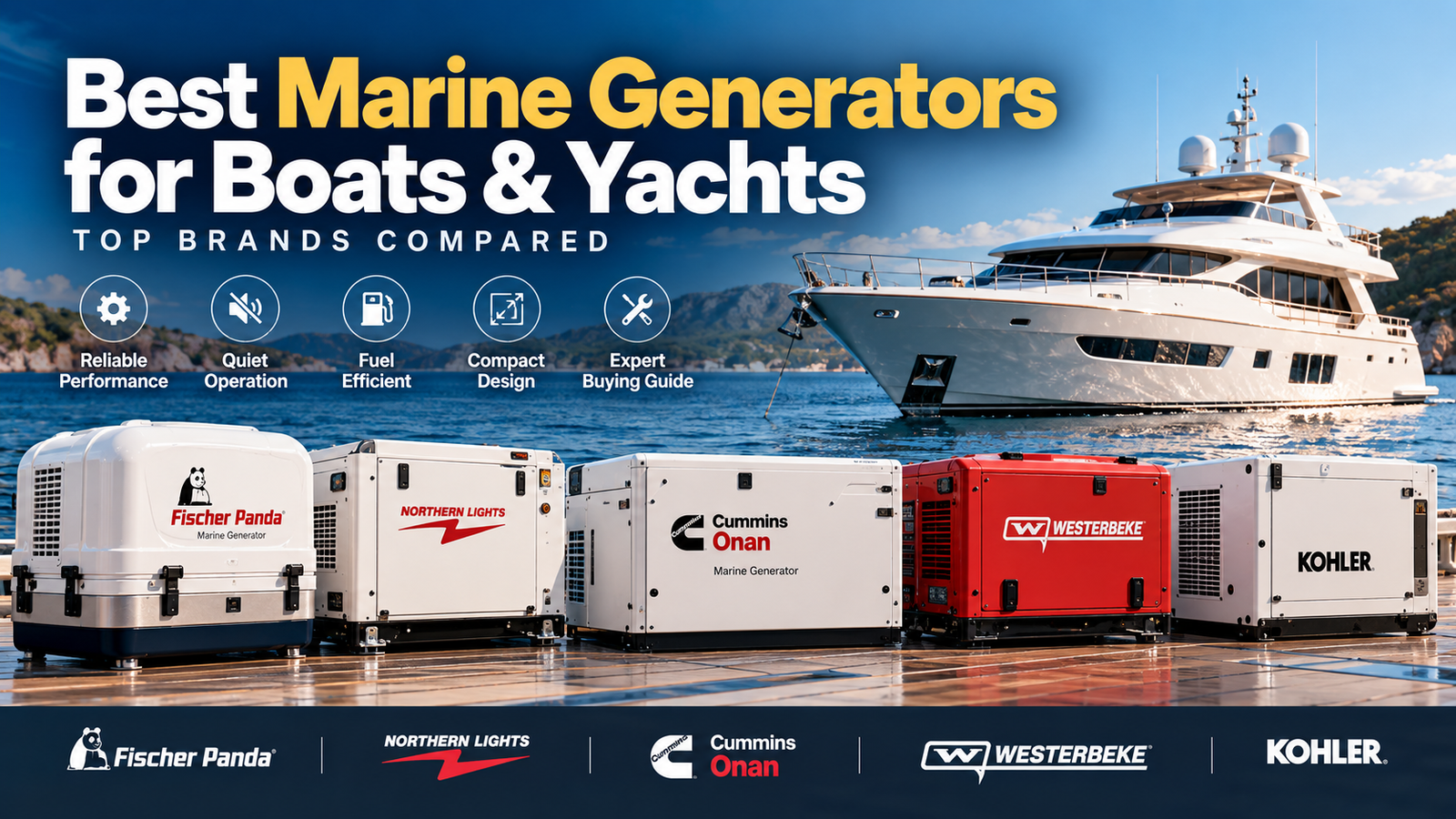
In this comprehensive guide, we’ll compare leading marine generator brands, including Fischer Panda, Northern Lights, Cummins Onan, Kohler, Westerbeke, WhisperPower and Mase.
We’ll also explain generator sizing, fuel consumption, installation considerations, maintenance, pricing and the important differences between conventional generators and modern hybrid marine power systems.
Our objective is straightforward:
Help you make an informed purchasing decision before investing in a new or replacement marine generator.
What Is a Marine Generator and How Does It Work?
A marine generator, also called a marine genset, is an onboard power-generation system designed to supply electrical energy to a vessel.
In a conventional diesel-powered marine generator, two main components work together:
- A diesel engine produces mechanical power.
- An electrical generator, commonly called an alternator, converts that mechanical power into electricity.
The generated electricity can supply compatible onboard AC equipment through the vessel’s electrical distribution system.
Marine generators are available in different output capacities, electrical configurations and mechanical designs.
Some are intended for smaller recreational vessels, while others are designed for larger yachts or demanding commercial marine applications.
The appropriate generator depends on the electrical system it must support.
What Does a Marine Generator Power?
A generator can provide electricity for numerous onboard systems, including:
- Air-conditioning equipment
- Refrigerators and freezers
- Battery chargers
- Electric cooking appliances
- Watermakers
- Laundry equipment
- Entertainment systems
- Auxiliary pumps
- Other onboard AC equipment
However, the fact that a generator can power these devices doesn’t mean it can necessarily operate all of them simultaneously.
Every generator has a rated electrical output, and some electrical equipment requires additional power during startup.
For example, an air-conditioning compressor may demand significantly more electrical power during startup than during normal operation.
If several compressors start together, their combined demand may exceed the generator’s available capacity.
This is why marine generator sizing should account for both normal operating loads and starting requirements.
A generator that appears large enough based on total running wattage may still struggle during certain operating conditions.
Marine Generator vs Portable Generator
A purpose-built marine generator is not simply a portable household generator installed inside a boat.
Marine generator installations must account for the vessel’s operating environment, which can include moisture, salt exposure, vibration, restricted machinery spaces and specific electrical safety requirements.
Important considerations include:
Cooling: Marine generators may use seawater-assisted cooling arrangements or other systems appropriate to their design.
Exhaust: Exhaust gases must be safely discharged through a properly engineered marine exhaust installation.
Electrical protection: The generator must integrate safely with the vessel’s electrical system, including appropriate protection and transfer arrangements.
Ventilation: The installation must provide the combustion air and heat management required by the manufacturer.
Fuel-system safety: Fuel connections and associated equipment must be suitable for the marine application.
Vibration isolation: Mounting arrangements must account for vibration, structure and equipment loads.
Portable gasoline generators create particular risks aboard boats, including carbon-monoxide poisoning, fire and electrical hazards.
They should not be treated as an inexpensive substitute for a properly engineered onboard marine generator system.
Practical recommendation: Select equipment specifically suitable for the intended marine application and have installation requirements reviewed by qualified marine professionals.
AC Marine Generators vs DC Battery-Charging Generators
Not all marine generator systems deliver power in the same way.
A conventional AC marine generator supplies alternating-current electricity suitable for the vessel’s electrical system.
Depending on the installation, that electricity can operate onboard appliances and battery chargers.
A DC marine generator is primarily intended to produce direct-current charging power, often for a battery-based electrical system.
The batteries may then supply AC equipment through an inverter.
This arrangement can be useful where battery storage and power management form a central part of the vessel’s electrical design.
For example, a yacht may use a battery bank to supply smaller overnight loads, while a generator operates when battery charging or higher electrical demand requires it.
However, DC generator and hybrid arrangements introduce additional system-design requirements.
Battery capacity, charging rates, inverter output, controls and electrical protection must all be compatible.
Neither AC nor DC generation is universally better.
The right configuration depends on the vessel’s complete electrical architecture.
Diesel vs Gasoline Marine Generators
For many cruising yachts and diesel-powered motor vessels, a marine diesel generator is a practical option.
Diesel generator systems are available across a broad range of capacities and can be integrated into vessels already designed around diesel fuel.
Potential advantages include fuel-system compatibility, suitability for various operating profiles and established marine diesel service practices.
Gasoline-powered marine generator options also exist, particularly for certain recreational applications.
However, gasoline systems require particular attention to ignition protection, ventilation and fuel-vapor safety.
The decision should consider the vessel’s existing fuel system, installation requirements, operating profile and applicable standards.
For diesel-powered yachts, a diesel genset is often the logical starting point—but the complete installation must still be evaluated.
What Makes a Marine Generator the Best Choice?
When searching for the best marine diesel generators, it’s easy to focus on horsepower, electrical output or manufacturer reputation.
But those numbers don’t tell the whole story.
A generator that performs well aboard one yacht may be unsuitable for another vessel of similar length.
The following factors deserve careful attention before purchasing.
Reliability and Durability
Reliability is one of the most important considerations when choosing a marine generator.
If your vessel depends on generator power for refrigeration, air conditioning, battery charging or essential auxiliary equipment, unexpected shutdowns can create serious inconvenience.
For some commercial operations, downtime can also mean lost revenue.
However, reliability is not determined by the manufacturer’s name alone.
It depends on several factors:
- Correct generator sizing
- Appropriate operating load
- Proper installation
- Effective cooling
- Routine maintenance
- Fuel quality
- Operating environment
- Availability of replacement parts
For example, a well-maintained generator operating within its intended duty range may provide more dependable service than a more expensive model subjected to poor maintenance or unsuitable loading.
What buyers should verify: The manufacturer’s intended application, duty rating, maintenance schedule and technical support arrangements.
Avoid treating general brand reputation as proof of a specific model’s expected service life.
Quiet Operation and Low Vibration
Noise is a major consideration aboard recreational yachts.
A generator may be located close to guest cabins, sleeping areas or entertainment spaces.
Even moderate machinery noise can become uncomfortable during extended operation.
This explains the demand for quiet marine generators and silent marine generators.
Manufacturers use different approaches to reduce noise and vibration, including acoustic enclosures, vibration-isolation mounts and specialized installation arrangements.
But advertised noise figures need careful interpretation.
A generator’s sound level depends on:
- Measurement distance
- Electrical load
- Engine operating speed
- Sound enclosure
- Installation environment
- Exhaust arrangement
- Measurement procedure
A generator measured at a greater distance may appear quieter on paper than another tested closer to the unit.
That doesn’t prove it will be quieter inside your yacht.
Important: A generator advertised as “silent” still produces mechanical, exhaust and vibration-related noise.
For meaningful comparisons, request model-specific sound measurements taken under comparable conditions.
Fuel Efficiency
Marine generator fuel consumption is especially important for owners who spend long periods at anchor or operate their generators daily.
Fuel consumption varies with generator load, engine design and operating conditions.
This means the most useful fuel-efficiency comparison isn’t necessarily the consumption figure at full rated output.
Instead, consider how much fuel a generator uses while supplying the loads your vessel will normally require.
For example, imagine two generators:
- Generator A is larger but usually operates at a relatively low percentage of rated capacity.
- Generator B is smaller and operates closer to the load range for which it was selected.
Generator B may be the more suitable option, provided it can safely handle the vessel’s peak and starting demands.
But the actual fuel-cost difference must be established using verified manufacturer data.
A smaller generator isn’t automatically more fuel-efficient in every application.
Compact Dimensions and Weight
A compact marine generator can be attractive when engine-room space is limited.
However, physical dimensions should never be evaluated in isolation.
The installation must also accommodate:
Cooling connections, exhaust components, electrical connections, sound enclosure, ventilation and maintenance access.
A generator that fits tightly into an available space may still be a poor installation if technicians cannot reach its filters, impeller or service panels.
Generator weight also matters.
The mounting structure must support the equipment, and its position can influence vessel weight distribution.
Practical recommendation: Check the complete installation envelope and required service clearances, not just the generator’s published dimensions.
Service Network and Spare Parts Availability
One of the most overlooked considerations when choosing a generator is the availability of service support.
A generator can have excellent technical specifications and still become inconvenient to own if essential replacement parts are difficult to obtain.
Before buying, investigate access to:
Marine generator spare parts, oil filters, fuel filters, seawater pump impellers, belts, sensors, service kits and model-specific electrical components.
For international yacht owners, the geographic availability of service support can be particularly important.
A brand may have strong coverage in one cruising region but more limited support elsewhere.
At JB Marine GmbH, we encourage buyers to consider future parts sourcing and maintenance requirements alongside the initial equipment purchase.
A generator is a long-term investment, not a one-time transaction.
Total Cost of Ownership
The initial marine generator price is only one part of the financial decision.
The true cost of ownership can include:
Purchase price + Installation + Fuel + Maintenance + Repairs + Downtime
A lower-cost generator may require additional installation work or prove more expensive to maintain.
Conversely, a more expensive generator isn’t automatically the better investment if a less costly unit meets the same technical requirements.
The right comparison is based on the complete installed system and expected operating conditions.
The cheapest generator isn’t always the least expensive generator to own.
Best Marine Generator Brands Compared
Several established manufacturers offer generators for recreational and commercial marine applications.
Among the brands worth evaluating are Fischer Panda, Northern Lights, Cummins Onan, Kohler, Westerbeke, WhisperPower and Mase.
Each has different product configurations, technical approaches and potential advantages.
The following profiles explain where each manufacturer may deserve consideration.
They are not rankings based on independently measured failure rates or controlled noise testing.
For a final purchasing decision, compare specific models using current manufacturer documentation.
1. Fischer Panda Marine Generators — Compact Marine Power Solutions

Fischer Panda marine generators are well established in marine power generation, particularly in applications where compact installation and acoustic considerations are important.
The manufacturer’s product portfolio includes different marine generator technologies and configurations.
Depending on the model, these may include AC generation, DC charging solutions and inverter-based systems.
Key strengths
Fischer Panda is worth considering for yacht owners who need to balance electrical output with limited installation space.
Certain models incorporate compact, sound-enclosed designs intended for marine applications.
The manufacturer’s range also makes it relevant to owners investigating more specialized onboard electrical systems.
What to verify before buying
Not every Fischer Panda generator has the same electrical architecture, rated output or installation requirements.
Buyers should confirm the exact model’s voltage, frequency, dimensions, cooling requirements, control system and maintenance access.
Parts availability and regional technical support should also be checked.
Potential best fit: Sailing yachts, motor yachts and installations where compact dimensions, noise considerations or specific power-system configurations are priorities.
For customers sourcing equipment through JB Marine GmbH, Fischer Panda is a particularly relevant brand to investigate.
2. Northern Lights Marine Generators — Conventional Diesel Power for Cruising

Northern Lights marine generators are associated with conventional marine diesel power-generation systems.
The brand is worth considering for cruising vessels where maintenance access, established diesel technology and dependable onboard power are important purchasing criteria.
Key strengths
Northern Lights offers marine generator configurations across different output classes.
For long-range cruising applications, buyers may value straightforward maintenance arrangements and access to technical documentation.
However, serviceability should be evaluated at model level.
What to verify before buying
Check the generator’s intended duty, output, cooling requirements, physical dimensions and service accessibility.
A generator used extensively at anchor may have different operating requirements from one used occasionally for battery charging.
Also confirm spare-parts and technical support availability in the vessel’s cruising region.
Potential best fit: Long-distance cruising yachts and vessels requiring conventional marine diesel generation.
3. Cummins Onan Marine Generators — Established Power Options for Motor Yachts

Cummins Onan marine generators are established products in recreational marine power generation.
The Onan range includes different output capacities and generator configurations suitable for various onboard electrical demands.
This makes Cummins Onan a manufacturer worth investigating for motor yachts and other vessels with significant AC requirements.
Key strengths
The range of marine generator options allows buyers to compare models based on required output, electrical configuration and installation characteristics.
Cummins also has an established background in engines and power-generation equipment.
However, the availability of particular models and service arrangements varies by market.
What to verify before buying
Check:
- Rated output in kW
- Voltage and frequency
- Single-phase or three-phase configuration
- Sound enclosure options
- Dimensions and weight
- Maintenance requirements
- Regional parts and service support
A generator with sufficient rated output may still be unsuitable if its voltage or frequency doesn’t match the vessel.
Potential best fit: Motor yachts and recreational vessels requiring established marine diesel generator configurations across different power capacities.
4. Kohler Marine Generators — Established Marine Installations and Replacement Projects

Kohler marine generators have an established history in yacht and marine power applications.
Many owners encounter Kohler-branded equipment when maintaining or replacing an existing generator.
For these buyers, identifying the existing generator correctly is particularly important.
Key strengths
Kohler-branded marine generator installations have an established equipment history, and technical information may be available for existing models.
For a replacement project, familiarity with the original generator can provide a useful starting point when assessing electrical and mechanical requirements.
What to verify before buying
Generator industry branding and corporate arrangements have changed over time.
Buyers should verify current product branding, model availability, spare-parts channels and warranty arrangements rather than assuming historical information remains current.
For existing equipment, record the full model and serial number before requesting replacement parts or a new generator.
Potential best fit: Owners maintaining Kohler-branded marine generators or comparing technically compatible replacement equipment.
5. Westerbeke Marine Generators — Options for Smaller Recreational Boats

Westerbeke marine generators are another established option in recreational marine power generation.
The brand has offered marine generator equipment in different fuel and output configurations.
For smaller boats, compact installation and compatibility with existing onboard systems are particularly important.
Key strengths
Westerbeke is worth considering when researching generator options for smaller recreational vessels or replacing an existing Westerbeke installation.
What to verify before buying
Confirm the generator’s fuel type, electrical output, voltage, frequency, cooling arrangement and current service support.
Do not assume a generator is suitable simply because it was originally installed on a boat of similar length.
Potential best fit: Smaller recreational vessels and owners seeking replacement solutions for existing Westerbeke equipment.
6. WhisperPower Marine Generators — Integrated and Hybrid Marine Power

WhisperPower marine generators are worth investigating for modern vessels that use integrated electrical power-management systems.
The manufacturer offers marine power equipment associated with generation, battery charging and inverter-based systems.
This can make WhisperPower relevant to owners planning a more comprehensive electrical upgrade.
Key strengths
The ability to evaluate generator operation as part of a wider onboard energy system can be useful for vessels with substantial battery storage or varying electrical demand.
A hybrid-oriented system may allow some onboard loads to operate from batteries without requiring the generator to run continuously.
However, actual performance depends on the complete system design.
What to verify before buying
Confirm compatibility between the generator, battery system, inverter, charging equipment and controls.
An integrated system requires careful electrical engineering and commissioning.
Potential best fit: Cruising yachts and modern vessels investigating generator-and-battery power systems.
7. Mase Marine Generators — Compact Generator Alternatives

Mase marine generators are another manufacturer worth considering when comparing compact marine diesel power solutions.
The Italian brand has developed generator products for different marine applications.
For yacht owners with restricted machinery space, a compact model may be worth evaluating alongside alternatives from Fischer Panda and other manufacturers.
Key strengths
Mase offers marine generator configurations that may suit space-conscious installations.
Its product range provides another option for buyers comparing generator dimensions, output and electrical specifications.
What to verify before buying
Confirm the exact model’s electrical rating, installation dimensions, cooling requirements, service access and regional parts availability.
Potential best fit: Recreational yachts and marine installations requiring compact generator options.
Marine Generator Brand Comparison Table
The following table summarizes the principal purchasing considerations for each manufacturer.
| Marine Generator Brand | Main Consideration | Potential Application |
|---|---|---|
| Fischer Panda | Compact, noise-conscious designs and specialized configurations | Sailing yachts and space-limited installations |
| Northern Lights | Conventional diesel generation and serviceability | Long-range cruising vessels |
| Cummins Onan | Established marine generator range and varied output options | Motor yachts and recreational vessels |
| Kohler | Established installed equipment and replacement considerations | Existing yacht generator installations |
| Westerbeke | Smaller recreational marine generator options | Smaller boats and replacement projects |
| WhisperPower | Integrated generator, battery and inverter systems | Hybrid-oriented yacht installations |
| Mase | Compact marine generator configurations | Space-constrained marine installations |
Important: This comparison identifies potential applications rather than declaring any manufacturer objectively superior.
Actual noise, reliability, fuel consumption, dimensions and maintenance costs must be evaluated using specific models and comparable data.
Fischer Panda vs Northern Lights vs Cummins Onan vs Kohler
When comparing the best yacht generators, these manufacturers frequently appear in the buying process.
But which is the better choice?
The answer depends on what matters most for your vessel.
Which Is Best for Quiet Operation?
For owners prioritizing low onboard noise, sound-enclosed models from Fischer Panda and other manufacturers deserve consideration.
However, a fair comparison requires model-specific sound measurements under equivalent conditions.
Exhaust routing, vibration isolation and installation quality can significantly influence the noise experienced aboard the vessel.
Best approach: Compare measured sound levels, enclosure configurations and installation requirements—not brand reputation alone.
Which Is Best for Compact Installation?
Fischer Panda and Mase offer compact marine generator options worth evaluating.
But the correct choice depends on more than the generator’s published length, width and height.
The complete installation must leave adequate space for cooling, exhaust, electrical connections and maintenance.
Best approach: Compare complete installed dimensions and service clearances before selecting a model.
Which Is Best for Long Operating Hours?
Northern Lights and Cummins Onan are among the established manufacturers worth considering for vessels that depend heavily on onboard diesel generation.
However, long operating hours do not automatically make one brand superior.
The generator’s intended duty rating, cooling system, maintenance schedule and operating load are essential.
Best approach: Select a model specifically suitable for the expected duty cycle.
Which Offers Better Service and Parts Support?
This depends on the country and cruising region.
A manufacturer may have strong service coverage in one market but fewer resources elsewhere.
Before purchasing, investigate the availability of maintenance kits, cooling components, filters, technical documentation and qualified technicians.
For vessels operating internationally, parts availability can be just as important as the generator’s original price.
Best approach: Verify regional service and parts support for the exact model before ordering.
Which Offers Better Value for Money?
A generator with a lower purchase price isn’t necessarily the better investment.
Consider the complete ownership cost:
Generator price + Installation + Fuel + Maintenance + Repairs + Potential downtime
The most expensive generator isn’t automatically the best either.
If a less expensive unit meets the vessel’s requirements and offers appropriate support, it may provide better value.
The key is to compare suitable models—not simply brands.
A generator should be selected for the power it can reliably deliver in your actual installation, not for the reputation attached to its name.
What Size Marine Generator Do You Need?
Choosing the correct generator capacity is one of the most important decisions you’ll make when buying a marine generator for your boat or yacht.
A generator that is too small may struggle to support your onboard equipment, especially when air-conditioning compressors, pumps or other electric motors start.
A generator that is unnecessarily large can cost more to purchase and install, occupy valuable space and operate inefficiently under certain conditions.
Here’s the principle that matters:
Your generator should be sized for the electrical loads you actually need to operate—not simply the length of your boat.
Two yachts of identical length can have completely different electricity requirements.
One might use gas cooking, efficient refrigeration and a modest battery charger.
The other might have several air-conditioning units, electric cooking equipment, a large watermaker and extensive onboard entertainment systems.
Their generator requirements will be very different.
Before comparing 5 kW, 8 kW, 10 kW or 15 kW marine generators, you need to understand how electrical demand is calculated.
Understand kW vs kVA
When reviewing marine generator technical specifications, you’ll often see electrical output expressed in two different units:
kW (kilowatts) and kVA (kilovolt-amperes).
They are related, but they are not interchangeable.
kW represents real electrical power.
kVA represents apparent electrical power, accounting for both voltage and current without treating their phase relationship as purely resistive.
For conventional AC systems, the relationship is:
\[ \text{kW}=\text{kVA}\times\text{Power Factor} \]
For example, a generator rated at 10 kVA with a rated power factor of 0.8 corresponds to:
\[ 10\times0.8=8\text{ kW} \]
However, this is an illustrative calculation, not a rule that every marine generator operates at a 0.8 power factor.
Actual ratings depend on the manufacturer’s specifications.
Some single-phase generators may be marketed with different rated power-factor assumptions.
Buying advice: When comparing marine generators, confirm the manufacturer’s continuous rated output in both kW and kVA where applicable, along with voltage, frequency, phase configuration and permitted operating conditions.
A 10 kVA label alone is not enough to establish whether the generator will support your electrical system.
Calculate Your Boat’s Simultaneous Electrical Load
The first practical step in marine generator sizing is identifying which appliances and systems are likely to operate at the same time.
This is called simultaneous electrical demand.
You don’t necessarily need to add the maximum rated wattage of every appliance aboard the vessel.
Instead, determine which equipment must realistically operate together, while separately accounting for startup loads and any necessary reserve capacity.
Consider this illustrative yacht electrical-load calculation:
Onboard Equipment Example Running Load Air-conditioning system 2,000 W Refrigerator and freezer 400 W Battery charger 1,000 W Watermaker 800 W Lighting and entertainment 300 W Auxiliary equipment 500 W Total simultaneous running load 5,000 W The example vessel has a simultaneous running load of approximately 5 kW.
That does not automatically mean a 5 kW generator is suitable.
The final selection must also account for motor starting demand, the electrical characteristics of the loads, environmental conditions and the generator’s actual continuous rating.
These wattages are hypothetical examples, not manufacturer specifications or recommended values for every yacht.
Account for Motor Starting Loads
One of the most common generator-sizing mistakes is considering only normal running power.
Electric motors can draw substantially more current during startup than during steady operation.
Equipment that may introduce significant starting loads includes:
- Air-conditioning compressors
- Refrigeration compressors
- Seawater pumps
- Freshwater pressure pumps
- Certain watermaker systems
- Other motor-driven equipment
For example, an air-conditioning system consuming 2 kW while running may require significantly greater electrical capacity during compressor startup.
The exact demand depends on the motor, starter, power electronics and installation.
A generator must be able to handle that starting event without unacceptable voltage or frequency deviation.
This is particularly important when several motors might start close together.
Practical solution: Where appropriate, a marine electrical specialist may consider soft-start equipment, variable-speed drives or load-sequencing controls.
These technologies can reduce certain starting demands, but they must be compatible with the equipment and electrical installation.
Add an Appropriate Capacity Margin
A sensible generator selection usually includes some allowance beyond calculated steady-state demand.
However, there is no universal percentage that guarantees correct sizing for every vessel.
The appropriate margin depends on:
Motor starting requirements, generator response, power factor, ambient conditions, anticipated future loads and operating profile.
For example, a vessel with predictable resistive loads may require a different approach from a yacht with several large compressor motors.
Avoid automatically adding 30% or 50% without understanding the reason.
An oversized generator can be just as undesirable as an undersized one.
Avoid Oversizing Your Marine Generator
Many buyers assume that purchasing a significantly larger generator provides greater reliability.
Not necessarily.
Diesel engines are designed to operate within specified load and temperature ranges.
Prolonged operation at very light loads can contribute to undesirable operating conditions in some diesel generator engines, potentially including incomplete combustion and deposits.
The manufacturer’s minimum recommended operating load and maintenance guidance should always be considered.
This does not mean a generator must run at maximum output.
It means the generator should be appropriately matched to the vessel’s normal operating demand.
A correctly sized generator should comfortably handle your peak requirements without spending most of its life unnecessarily underloaded.
Example Marine Generator Sizing Calculation
Let’s return to our hypothetical yacht with a 5 kW simultaneous running load.
Suppose the owner is considering an 8 kW marine diesel generator.
At 5 kW running demand, the generator would operate at:
\[ \frac{5}{8}\times100=62.5\% \]
of its rated real-power output, assuming the 8 kW rating applies continuously under the relevant conditions.
That may be a reasonable operating point for some generator models.
But we still haven’t confirmed whether the generator can start the vessel’s largest motors.
Nor have we verified the electrical phase, frequency, voltage, power factor or installation conditions.
Therefore, 8 kW is a candidate for further engineering evaluation—not a confirmed recommendation.
At JB Marine GmbH, customers requesting a generator quotation should ideally provide a list of their major onboard electrical loads.
That information helps narrow the appropriate generator class before specific models are compared.
The JB Marine P.O.W.E.R. Method for Choosing a Generator
Buying a marine generator becomes easier when you follow a consistent process.
That’s why we’ve developed the JB Marine P.O.W.E.R. Method, a practical five-step framework for evaluating marine generators for boats and yachts.
Rather than starting with a manufacturer or advertised price, the method begins with the vessel’s requirements.
The JB Marine P.O.W.E.R. Method
P
Profile Your Electrical Loads
Determine normal and peak electrical demand.
O
Observe Your Operating Pattern
Understand when, where and how long the generator will run.
W
Work Out the Correct Capacity
Match rated output and starting capability to the vessel.
E
Evaluate Installation and Efficiency
Check physical fit, electrical compatibility and fuel performance.
R
Review Reliability and Running Costs
Assess service support, maintenance and ownership costs.
P — Profile Your Electrical Loads
Start by listing the electrical equipment aboard your vessel.
Record running power, starting requirements and which appliances may operate simultaneously.
Where possible, use actual equipment nameplate data or measured loads rather than estimates.
This step helps establish the electrical demand that the generator must support.
O — Observe Your Operating Pattern
Consider how the generator will be used.
Will it operate primarily while anchored overnight?
Will it run during long passages?
Will it support air conditioning for many hours every day?
Or will it operate occasionally to recharge batteries?
A generator intended for frequent extended operation may require a different duty rating and maintenance strategy from one used intermittently.
W — Work Out the Correct Capacity
Once the load profile is understood, calculate the generator’s required continuous output and starting capability.
Check the manufacturer’s specifications for the proposed model.
Consider voltage, frequency, phase configuration and expected load characteristics.
This step helps avoid buying a generator that is either too small or unnecessarily large.
E — Evaluate Installation and Efficiency
Confirm that the generator can be installed safely and serviced conveniently.
Consider dimensions, weight, cooling, exhaust, ventilation, noise and electrical integration.
Review fuel consumption at realistic operating loads.
A technically suitable generator is not a good purchase if it cannot be installed correctly.
R — Review Reliability and Running Costs
Finally, compare maintenance requirements, spare-parts availability, warranty terms, regional service support and total ownership cost.
A generator should remain practical to operate long after the original purchase.
The complete process is:
ELECTRICAL LOAD → OPERATING PROFILE → GENERATOR CAPACITY → INSTALLATION → OWNERSHIP COST → PURCHASE
This is the central principle behind the JB Marine P.O.W.E.R. Method.
Best Marine Generators by Boat Type and Size
Boat length is useful for understanding the general type of vessel, but it is not a reliable substitute for calculating electrical demand.
The following recommendations describe common considerations for different vessel categories.
They should not be treated as fixed generator-sizing rules.
Best Marine Generators for Small Sailboats
Smaller sailing yachts often have limited installation space and relatively modest electrical requirements.
Before installing a diesel generator, owners should consider whether batteries, shore power, solar charging and an inverter can meet their actual needs.
A dedicated generator may still be appropriate for vessels with substantial AC loads, but it introduces additional weight, fuel consumption, maintenance and installation complexity.
For owners who genuinely require onboard generation, compact models from manufacturers such as Fischer Panda, Mase or other suitable brands may deserve consideration.
The final decision should follow a proper electrical-load assessment.
Best Marine Generators for 30–40 Foot Boats
A 30–40 foot vessel may require anything from no dedicated generator to a substantial onboard power system, depending on its equipment.
A cruising sailboat with modest loads has different requirements from a motor yacht with air conditioning and electric galley appliances.
Small marine diesel generators may be appropriate for some vessels in this category.
However, generator selection should be based on calculated loads and available installation space.
Best Marine Generators for 40–50 Foot Yachts
Yachts in this category may have more demanding hotel loads.
Common equipment includes:
Air conditioning, refrigeration, battery chargers, galley appliances and auxiliary pumps.
Depending on the vessel’s electrical arrangement, generators in the middle of the recreational marine output range may be considered.
But there is no single correct capacity for every 40–50 foot yacht.
For example, two vessels of the same length may have very different air-conditioning loads.
The appropriate generator should be selected after calculating normal demand and starting requirements.
Best Marine Generators for 50–70 Foot Motor Yachts
Larger motor yachts often have more extensive onboard electrical systems.
Potential requirements include multiple air-conditioning zones, larger battery chargers, watermakers and additional domestic equipment.
For these vessels, generator selection may involve higher output capacities and more advanced electrical load management.
Some installations may also benefit from redundancy or multiple generator arrangements.
However, adding a second generator is a system-design decision involving electrical controls, transfer arrangements, space and operating requirements.
It should not be treated as a universal necessity.
Best Marine Generators for Superyachts
Superyachts can have complex electrical systems supporting extensive hotel loads, auxiliary machinery and operational equipment.
Generator installations may include multiple gensets, automated load management and redundancy.
Some vessels use parallel generator operation, allowing multiple units to supply a common electrical system.
Such arrangements require appropriately designed synchronization, protection and control systems.
For superyachts, generator selection should be undertaken as part of a complete marine electrical-engineering assessment.
Best Marine Generators for Commercial Boats
Commercial vessels may operate generators for longer periods and under more demanding duty cycles.
Reliability, maintenance accessibility, service intervals and downtime become particularly important.
The generator must also meet any applicable vessel, classification, flag-state and regulatory requirements.
For these applications, selecting the correct duty rating is essential.
A generator designed for intermittent recreational use should not automatically be assumed suitable for continuous commercial operation.
Best Marine Generator Sizes: 5 kW, 8 kW, 10 kW, 15 kW or 20 kW?
When comparing marine generators for sale, buyers often begin by searching for a specific output capacity.
Common searches include 5 kW marine diesel generator, 8 kW marine generator, 10 kW marine diesel generator and 15 kW marine generator.
These categories can help narrow the search, but they are not universal recommendations based on boat length.
Generator Capacity General Applications to Investigate 3–5 kW Modest onboard AC loads and battery charging 6–8 kW Moderate recreational yacht electrical demand 9–12 kW Multiple onboard AC appliances and higher combined loads 13–20 kW Larger recreational vessel electrical systems Above 20 kW Higher-demand yachts and certain commercial applications These categories are illustrative. Actual suitability depends on continuous ratings, starting loads and the vessel’s electrical configuration.
3–5 kW Marine Generators
Smaller generators may be suitable for vessels with modest electrical requirements.
Potential applications include battery charging, selected domestic appliances and limited AC equipment.
However, the ability to operate air conditioning or other motor-driven equipment depends on actual starting and running loads.
A 5 kW generator should not automatically be considered adequate for every small yacht.
6–8 kW Marine Generators
An 8 kW marine generator may be worth investigating for a recreational vessel with moderate electrical demand.
For example, it may be a candidate for an installation requiring several kilowatts of continuous power, provided motor starting and electrical compatibility are verified.
Generator models in this class may be available from several established marine manufacturers.
The correct choice depends on the specific vessel.
9–12 kW Marine Generators
A 10 kW marine diesel generator may be considered for yachts with more substantial electrical requirements.
Potential loads can include air conditioning, battery charging, refrigeration and galley equipment.
However, these loads must be assessed for simultaneous operation.
A 10 kW generator isn’t automatically suitable for a vessel simply because its equipment totals less than 10 kW on paper.
13–20 kW Marine Generators
Generators in this output class may be relevant to larger yachts with significant onboard electrical demand.
Such installations can involve multiple air-conditioning systems, large charging equipment and other substantial AC loads.
At this level, installation dimensions, cooling capacity, electrical integration and maintenance access become especially important.
20 kW and Larger Marine Generators
Higher-capacity marine generators are used in applications with more demanding electrical systems.
These may include large yachts and commercial vessels.
For such installations, generator selection may require detailed load studies, consideration of multiple operating modes and appropriate redundancy.
The important rule remains unchanged: generator capacity should follow the electrical design, not the other way around.
50Hz vs 60Hz Marine Generators — Which Do You Need?
One of the most important technical checks before purchasing a generator is confirming the vessel’s required electrical frequency.
Marine generators are commonly available in 50Hz and 60Hz configurations.
These systems are not automatically interchangeable.
Understanding Frequency and Voltage
Electrical frequency describes the number of AC cycles per second.
A 50Hz system operates at 50 cycles per second.
A 60Hz system operates at 60 cycles per second.
Voltage describes electrical potential difference.
A generator must provide electrical output compatible with the vessel’s distribution system and connected equipment.
Incorrect frequency or voltage can cause operational problems or equipment damage.
European 230V/50Hz and Other Common Configurations
Many European recreational vessels use 230V/50Hz AC electrical systems.
However, larger vessels may use three-phase arrangements or other configurations.
Do not assume that every European yacht has the same electrical system.
Check the vessel’s electrical documentation and equipment ratings.
North American 120V/60Hz and Split-Phase Systems
Many North American recreational vessels use 60Hz electrical systems.
Depending on the installation, these may include 120V or 120/240V split-phase arrangements.
Larger vessels may use other voltage and phase configurations.
A generator intended for one arrangement should not be assumed compatible with another.
Single-Phase vs Three-Phase Marine Generators
A single-phase marine generator supplies power through a single-phase AC configuration.
A three-phase marine generator provides three-phase electrical output.
Three-phase systems may be used where equipment and distribution requirements justify them.
The appropriate choice depends on the vessel’s electrical design.
Selecting the wrong phase configuration can make an otherwise suitable generator incompatible with the installation.
Can You Use a 60Hz Generator on a 50Hz Boat?
Not without confirming that the complete electrical system can safely accommodate the difference.
Some equipment may be frequency-sensitive, particularly certain motors, pumps, compressors and timing-dependent devices.
Frequency conversion may be possible with appropriate engineered equipment, but it should not be assumed.
Changing engine speed on a conventional fixed-speed generator can also affect voltage regulation, output and engine operating requirements.
Buying advice: Before ordering a marine generator, confirm the required voltage, frequency, phase arrangement and rated output.
These specifications should appear clearly in any quotation.
How Quiet Are Modern Marine Generators?
For yacht owners, noise can be almost as important as electrical output.
A generator may operate for several hours while guests are sleeping, relaxing or entertaining.
This makes acoustic performance an important consideration when choosing the best quiet marine generator.
What Does a Marine Generator dB Rating Mean?
Generator noise is commonly expressed in decibels, often using A-weighted sound-pressure measurements, written as dB(A).
However, a decibel figure without measurement conditions is incomplete.
For example, a sound-pressure measurement taken at one meter cannot be directly compared with another taken at seven meters as though the conditions were identical.
Generator load, enclosure and test environment also matter.
When comparing manufacturers, request noise data with the measurement method clearly identified.
Why Sound Enclosures Matter
A sound enclosure is designed to reduce noise radiated from the generator.
Depending on its construction, it may incorporate acoustic insulation, panels and ventilation arrangements.
However, a sound enclosure must still allow the generator to operate within its required cooling and ventilation conditions.
Never add insulation or restrict airflow without following the manufacturer’s installation requirements.
How Vibration Travels Through a Yacht
Noise doesn’t travel only through the air.
Generator vibration can be transmitted through mounting points, machinery structures and connected equipment.
This is called structure-borne vibration.
Appropriate vibration-isolation mounts and installation techniques can help reduce transmission.
However, mounts must be selected for the generator’s weight, operating characteristics and installation.
Exhaust and Cooling-Water Noise
A generator’s exhaust system can contribute significantly to onboard noise.
Marine exhaust installations may incorporate waterlocks, silencers and other components appropriate to the system design.
The arrangement must also protect against water entering the engine and comply with manufacturer requirements.
Exhaust modifications should be undertaken by qualified professionals.
How to Compare Noise Ratings Fairly
When comparing silent marine generators, check:
Noise level + Measurement distance + Electrical load + Sound enclosure + Test conditions
If two manufacturers use different measurement methods, the published figures may not provide a fair comparison.
A properly installed generator with a suitable acoustic arrangement may provide better onboard comfort than a nominally quieter unit installed poorly.
Marine Generator Fuel Consumption and Efficiency
Fuel consumption matters because marine generators can accumulate substantial operating hours, particularly on cruising yachts.
But determining the most economical generator requires more than comparing maximum-output fuel figures.
What Affects Diesel Generator Fuel Consumption?
Marine generator fuel consumption depends on several factors:
- Electrical load
- Engine efficiency
- Generator efficiency
- Operating speed
- Ambient and installation conditions
- Maintenance condition
- Fuel characteristics
A generator operating at 25% load may have a different fuel-consumption rate per kilowatt-hour than the same generator operating at 75% load.
This is why manufacturer fuel-consumption tables are valuable when available.
Why Generator Load Matters
The generator’s load profile influences both operating efficiency and engine condition.
A diesel generator that spends most of its time operating at very low load may not be working in its intended operating range.
On the other hand, a generator that is frequently overloaded may experience poor electrical performance or protective shutdowns.
The goal is to choose a generator whose normal operating demand aligns with its intended use.
Variable-Speed vs Fixed-Speed Generators
Conventional fixed-speed AC generators generally operate at a speed related to their required electrical frequency and alternator pole configuration.
For example, a four-pole synchronous generator commonly operates at approximately:
- 1,500 rpm for 50Hz
- 1,800 rpm for 60Hz
These are examples of conventional synchronous arrangements, not universal operating speeds for every marine generator.
Variable-speed generator systems can adjust engine speed according to operating requirements.
Where an inverter-based architecture is used, the system can convert generated electrical power into the required AC output.
This may offer advantages under certain variable-load conditions.
However, actual efficiency, noise and maintenance benefits must be assessed using the specific manufacturer’s technical data.
Variable-speed technology is not automatically the best solution for every vessel.
Can a Larger Generator Use More Fuel Than Necessary?
Yes, an unnecessarily large generator can result in avoidable operating costs under some conditions.
Suppose a yacht normally requires only a few kilowatts of electricity but uses a much larger generator.
The generator may spend substantial time operating at low load.
Depending on the equipment, this can affect efficiency and maintenance considerations.
However, the exact fuel difference cannot be established from generator size alone.
Compare model-specific fuel consumption at the same delivered electrical load.
How to Estimate Annual Generator Fuel Costs
A useful calculation is:
\[ \text{Annual Fuel Cost}=\text{Fuel Use per Hour}\times\text{Operating Hours}\times\text{Fuel Price} \]
For example, suppose a generator consumes an illustrative 2 liters of diesel per hour at the vessel’s typical operating load.
Assume:
- Fuel consumption: 2 L/hour
- Operating time: 500 hours/year
- Diesel price: €1.50/L
Annual fuel consumption:
\[ 2\times500=1,000\text{ liters} \]
Estimated annual fuel cost:
\[ 1,000\times1.50=€1,500 \]
This is a hypothetical calculation to demonstrate the method, not a fuel-consumption claim for a specific generator.
Actual consumption must be obtained from manufacturer data or reliable operating measurements.
The calculation also excludes maintenance, servicing and other operating expenses.
For a yacht that runs its generator extensively, even modest differences in fuel consumption can become financially meaningful over several years.
That is why the best marine generator should be evaluated according to its real operating efficiency—not simply its rated maximum output.
Marine Generator Installation — What Should You Check Before Buying?
You’ve compared the leading marine generator brands, calculated your electrical requirements and identified a suitable generator capacity.
Now comes another important question:
Will the generator actually work in your boat?
A generator can have excellent technical specifications and still be unsuitable because of limited installation space, incompatible electrical connections, inadequate cooling arrangements or poor maintenance access.
This is especially important when replacing an existing marine diesel generator.
The new generator may have different dimensions, mounting requirements, electrical connections and cooling specifications.
Before purchasing, evaluate the complete installation—not just the generator itself.
Engine-Room Space and Dimensions
The first step is checking the available installation space.
Measure the compartment’s length, width and height, but don’t stop there.
You must also account for the generator’s sound enclosure, mounting arrangement, ventilation requirements and access to service components.
For example, a generator may physically fit into a machinery compartment but leave insufficient room to remove the seawater pump impeller or replace a fuel filter.
That can turn routine maintenance into an expensive job.
Practical recommendation: Compare the manufacturer’s installation drawings with the actual available space, including the route required to move the generator into position.
Generator Weight and Vessel Balance
Marine generators vary considerably in weight.
A larger generator can introduce additional loads on the vessel’s structure and mounting system.
Its position may also affect vessel trim and weight distribution.
The installation must be assessed for structural support, mounting strength and vibration isolation.
Never assume that an existing generator foundation is automatically suitable for a replacement model.
Seawater Cooling and Exhaust Installation
Many marine diesel generators use seawater-assisted cooling systems.
Depending on the design, seawater may pass through a heat exchanger before being discharged through the exhaust system.
Correct installation is essential.
The arrangement must account for seawater intake, strainers, hoses, exhaust routing, waterlock capacity and protection against seawater entering the engine.
Incorrect marine exhaust design can lead to serious engine damage.
For that reason, cooling and exhaust arrangements should follow the generator manufacturer’s installation instructions and be reviewed by qualified marine professionals.
Ventilation and Heat Management
A generator produces heat during operation.
The machinery compartment must provide suitable ventilation and combustion air according to the generator’s requirements.
Inadequate ventilation can contribute to excessive operating temperatures and poor performance.
Never assume that a generator with a sound enclosure requires no additional ventilation.
Electrical Connections and Shore-Power Integration
A marine generator installation must integrate correctly with the vessel’s electrical distribution system.
This includes appropriate circuit protection, switching arrangements, grounding and bonding, and compatibility with the vessel’s voltage, frequency and phase configuration.
The installation must prevent unsafe interaction between shore power and generator power.
Applicable marine electrical standards and manufacturer instructions should guide the design.
Electrical installation and commissioning should be performed by qualified marine electricians.
Noise Insulation and Vibration Isolation
Even a generator marketed as a quiet marine generator can produce unwanted onboard noise if installed incorrectly.
Noise can travel through machinery foundations, bulkheads and connected equipment.
Appropriate vibration mounts, exhaust arrangements and acoustic enclosures can help improve onboard comfort.
However, these components must be compatible with the generator and its installation requirements.
Service Accessibility
Here’s a simple buying question that can save considerable frustration:
Can a technician comfortably service the generator after installation?
Check access to oil filters, fuel filters, impellers, belts, coolant connections, electrical panels and other maintenance points.
A compact installation should never come at the expense of essential maintenance access.
How Much Does a Marine Generator Cost?
One of the most common questions from buyers is:
How much does a marine generator cost?
The answer depends on much more than generator capacity.
The final price can vary significantly according to manufacturer, model, electrical output, enclosure, control equipment, installation requirements and market availability.
For a meaningful marine generator price comparison, request quotations for equivalent technical configurations.
What Determines Marine Generator Price?
The main price factors include:
- Manufacturer and model
- Rated electrical output
- Voltage and frequency
- Single-phase or three-phase configuration
- Engine and alternator technology
- Sound enclosure
- Control and monitoring equipment
- Included accessories
- Warranty terms
- Delivery destination
A basic generator quotation may not include everything needed for installation.
Always confirm the complete scope of supply.
New vs Used Marine Generator Prices
A new marine generator generally offers the advantages of unused equipment, current documentation and applicable manufacturer warranty coverage.
A used marine generator may have a lower purchase price, but condition and maintenance history become important.
When comparing prices, consider whether the used unit requires servicing, replacement components or installation modifications.
A low initial price can quickly lose its appeal if substantial repairs are required.
Installation Costs
Generator installation can involve more than positioning the equipment.
Depending on the project, additional work may include:
Mounting modifications, cooling connections, exhaust components, electrical wiring, control integration, sound insulation and commissioning.
A replacement generator that closely matches the original installation may require less modification than a completely different model.
However, compatibility must be verified rather than assumed.
Shipping and Import Costs
For international buyers, shipping is another important part of the budget.
Freight costs depend on the generator’s weight, dimensions, packaging, shipping route and delivery destination.
Import duties, taxes and customs charges may also apply.
At JB Marine GmbH, international customers should provide their delivery country and destination port when requesting a generator quotation.
This helps establish the commercial requirements for the proposed supply.
Total Ownership Cost Over Five Years
A generator’s purchase price is only the beginning.
A useful five-year cost assessment considers:
Cost Category What to Include Purchase Generator and included equipment Installation Labor, materials and commissioning Fuel Expected operating hours and consumption Maintenance Scheduled service parts and labor Repairs Reasonable repair allowance Downtime Operational consequences of failure The objective isn’t to predict every future expense perfectly.
It’s to avoid making a purchasing decision based only on the lowest initial quotation.
The best-value marine generator is the one that delivers suitable performance at a reasonable total ownership cost.
New vs Used Marine Generators — Which Is Better?
Should you purchase a new marine generator or consider a used unit?
Both options can be worth evaluating, depending on the application, equipment condition and budget.
But the risks are different.
Advantages of Buying a New Marine Generator
A new generator offers several potential benefits.
You receive unused equipment with documentation and warranty coverage according to the manufacturer’s applicable terms.
You may also have greater flexibility in selecting the required voltage, frequency, output and accessory configuration.
For owners planning a long-term yacht upgrade, a new generator can be attractive because its operating history begins with the installation.
However, new equipment still needs proper sizing and installation.
A brand-new generator that doesn’t match the vessel’s electrical system is still the wrong purchase.
When a Used Generator May Be Worth Considering
A used marine diesel generator may be suitable when the buyer has a limited budget or needs to replace an older installation.
It may also be worth considering when an exact replacement model is no longer readily available new.
But condition must be evaluated carefully.
Low operating hours do not automatically prove good condition.
A generator can deteriorate through poor storage, corrosion, inadequate maintenance or unsuitable operation.
What to Inspect Before Buying Used
Before purchasing a used generator, investigate its:
Model and serial number, operating hours, maintenance history, cooling condition, corrosion, electrical output, starting performance and load-test results.
Where practical, a qualified technician should inspect and test the unit.
A load test can help establish whether the generator performs under electrical demand.
However, one successful test does not guarantee future reliability.
Warranty and Documentation Considerations
Ask whether the generator is supplied with any warranty, service records, manuals or test documentation.
Used equipment may have limited warranty coverage or be sold under different commercial terms from new equipment.
These conditions should be clear before payment.
When Replacing an Old Generator Makes More Sense Than Repairing It
A repair may be sensible when the fault is isolated and the generator is otherwise in good condition.
Replacement becomes worth investigating when major repairs are approaching, parts are difficult to source or the existing generator no longer meets the vessel’s requirements.
Consider:
Repair cost + Expected future repairs + Parts availability + Downtime
against the cost and expected benefits of replacement.
This is similar to the decision process discussed in our boat repowering guide.
The objective is to restore dependable operation at a reasonable long-term cost.
Marine Generator Maintenance and Lifespan
A marine generator is a mechanical and electrical system that requires regular maintenance.
Even the best marine diesel generators can develop problems when neglected or operated outside their intended conditions.
How Long Do Marine Generators Last?
There is no universal operating-hour figure that accurately predicts the lifespan of every marine generator.
Service life depends on the model, duty cycle, operating load, maintenance, installation quality and environment.
A well-maintained generator operating within its intended range may provide many years of useful service.
However, operating hours alone cannot establish its remaining life.
Maintenance records, physical condition and operating performance are equally important.
Routine Marine Generator Maintenance
Routine maintenance may include:
- Engine oil and oil-filter replacement
- Fuel-filter inspection and replacement
- Cooling-system checks
- Seawater pump impeller inspection
- Belt inspection
- Coolant maintenance
- Electrical connection inspection
- Exhaust-system inspection
- General checks for leaks and corrosion
The correct service intervals depend on the manufacturer’s manual.
Never substitute a generic maintenance schedule for the instructions applicable to your specific generator.
Common Marine Generator Problems
Common symptoms include difficult starting, overheating, unstable electrical output, excessive vibration and unexpected shutdowns.
These symptoms can have several causes.
For example, overheating may involve seawater flow, coolant condition, heat-exchanger performance or other faults.
Unstable electrical output may involve load changes, engine-speed regulation or electrical components.
Diagnose the fault before replacing parts.
Working on energized electrical equipment, hot cooling systems or running machinery can be hazardous. Complex diagnostics should be performed by qualified technicians.
Signs Your Generator May Need Replacement
Replacement may be worth evaluating when the generator experiences repeated major failures, severe corrosion, significant mechanical deterioration or persistent parts-support problems.
Another reason is a substantial change in the vessel’s electrical requirements.
If the original generator can no longer support the boat’s equipment, replacement or electrical-system redesign may be more appropriate than repeated repairs.
Why Maintenance Records Matter When Buying Used
A used generator with documented maintenance provides more useful information than one advertised only with a low hour reading.
Service records can help establish whether oil changes, cooling maintenance and other routine work were performed.
However, records should complement—not replace—physical inspection and testing.
Marine Generator vs Inverter and Lithium Battery System
Modern yacht owners increasingly compare traditional marine diesel generators with inverter and battery-based electrical systems.
This is an important comparison because some vessels may be able to reduce generator operating hours through better energy management.
But batteries do not create electricity.
They store energy that must be replenished from shore power, solar panels, alternators, generators or other charging sources.
When an Inverter/Battery System May Be Enough
For a vessel with modest electrical demand, a properly sized battery and inverter system may supply many onboard loads.
This can be attractive for overnight use when owners want to avoid running an engine.
However, the battery system must have sufficient usable capacity and the inverter must support the required continuous and peak loads.
The system also needs an appropriate charging strategy.
When a Diesel Generator Still Makes Sense
A marine diesel generator remains valuable where sustained electrical demand exceeds what the battery system can economically or practically support.
Examples may include extended air-conditioning operation, substantial galley loads and frequent high-power battery charging.
A generator can provide electricity independently of shore-power availability, subject to fuel supply and operating conditions.
Hybrid Generator and Battery Systems
A hybrid marine power system combines generation, battery storage, inverters and power-management controls.
In some installations, the batteries can supply lower overnight loads while the generator operates during periods of higher demand or scheduled charging.
This can reduce generator runtime in suitable applications.
However, savings depend on system efficiency, battery capacity, charging behavior and actual operating loads.
Can Solar Panels Replace a Marine Generator?
Solar panels can contribute useful energy to a vessel’s electrical system.
Whether they can replace a generator depends on the boat’s electricity demand, available solar area, weather, battery capacity and operating profile.
For some small cruising vessels, solar and batteries may cover a substantial portion of onboard energy needs.
For yachts with high air-conditioning or other continuous electrical loads, solar alone may be insufficient.
A proper energy-budget calculation is necessary.
How to Combine a Generator, Batteries and Shore Power
An integrated system must safely manage multiple power sources.
This may require transfer equipment, inverters, battery chargers, monitoring systems and appropriate electrical protection.
The design must prevent unsafe source interaction and account for the vessel’s electrical configuration.
Such installations should be engineered and commissioned by qualified marine electrical specialists.
Sometimes the best generator solution is a smaller generator supported by a properly designed battery system. Other times, a dedicated conventional genset remains the most practical choice.
Common Mistakes When Buying a Marine Generator
Choosing the wrong generator can result in unnecessary expense, poor performance and avoidable downtime.
These are ten mistakes worth avoiding.
Mistake 1 — Buying Based Only on Boat Length
A 50-foot yacht does not automatically require a specific generator capacity.
Electrical demand depends on the equipment installed and how it is used.
Better approach: Calculate simultaneous running loads and starting requirements.
Mistake 2 — Choosing the Largest Generator Available
More capacity isn’t always better.
An unnecessarily large diesel generator may spend excessive time operating at low load.
Better approach: Select a generator that matches normal demand while accommodating appropriate peak requirements.
Mistake 3 — Ignoring Motor Starting Loads
Air-conditioning compressors and pumps can require additional electrical capacity during startup.
Better approach: Include starting demand in the sizing assessment.
Mistake 4 — Buying the Wrong Voltage or Frequency
A generator with the correct kW rating can still be incompatible with the vessel.
Better approach: Verify voltage, frequency and phase configuration before ordering.
Mistake 5 — Comparing Noise Ratings Without Context
Advertised decibel figures may use different measurement conditions.
Better approach: Compare model-specific noise data under equivalent conditions.
Mistake 6 — Ignoring Service Access
A generator that fits into the engine room may still be difficult to maintain.
Better approach: Check access to all routine service points.
Mistake 7 — Focusing Only on Purchase Price
A low initial price may be offset by higher installation or maintenance costs.
Better approach: Compare total ownership cost.
Mistake 8 — Overlooking Parts Availability
A generator is less convenient to own when replacement parts or technical support are difficult to obtain.
Better approach: Investigate regional service support before purchasing.
Mistake 9 — Purchasing Used Equipment Without Testing
A used generator may have hidden mechanical or electrical problems.
Better approach: Request documentation and arrange an appropriate inspection and load test.
Mistake 10 — Failing to Plan the Complete Installation
Cooling, exhaust, ventilation, mounting and electrical integration are essential.
Better approach: Evaluate the complete generator installation before placing an order.
Which Marine Generator Brand Should You Choose?
After comparing the leading manufacturers, the natural question is:
Which brand is actually best for my boat?
There is no universal winner.
The most suitable brand depends on the available models, electrical requirements, installation conditions and service support.
Best Choice When Space Is Limited
Investigate compact models from Fischer Panda, Mase and other manufacturers offering suitable dimensions.
Compare complete installed size, not just the generator housing.
Best Choice When Quiet Operation Is a Priority
Consider sound-enclosed models from Fischer Panda, Cummins Onan, Northern Lights and other manufacturers with appropriate acoustic options.
Use comparable model-specific noise measurements rather than assuming one brand is always quieter.
Best Choice for Long-Distance Cruising
Northern Lights, Cummins Onan and other established marine generator manufacturers are worth evaluating.
Focus on duty suitability, maintenance accessibility and support in your intended cruising regions.
Best Choice for Larger Electrical Loads
Investigate appropriately rated models from manufacturers offering the required output class.
For large yachts, consider whether load management, redundancy or multiple generators are justified.
Best Choice for Hybrid Marine Power Systems
WhisperPower and Fischer Panda are among the manufacturers worth investigating for generator configurations that may integrate with battery-centered power systems.
Compatibility with the complete electrical architecture is essential.
Best Choice for Budget-Conscious Buyers
Compare the fully installed cost of technically suitable models.
A carefully inspected used generator may be an option, but the potential savings must justify the condition and warranty risks.
The correct brand is the one offering a suitable model for your application—not necessarily the brand with the strongest marketing.
What Information Should You Send JB Marine GmbH for a Generator Quote?
If you’re planning to purchase a marine generator for sale through JB Marine GmbH, providing accurate technical information will help make the quotation process more useful.
Ideally, include:
- Vessel type and approximate length
- Existing generator brand and model, if applicable
- Existing generator identification plate or serial number
- Required electrical output or load information
- Voltage and frequency
- Single-phase or three-phase requirements
- Available installation dimensions
- Expected operating hours and application
- Preference for new or used equipment
- Required accessories or sound enclosure
- Delivery country and destination port
If you don’t know the required generator capacity, explain which onboard systems you intend to operate.
A detailed electrical-load assessment may still be necessary before a final model is selected.
Example Marine Generator Enquiry
Subject: Marine Diesel Generator Quotation Request
Dear JB Marine GmbH,
We are looking for a new marine diesel generator for our motor yacht.
Vessel: 50-foot motor yacht Electrical system: 230V / 50Hz Generator capacity: To be confirmed based on our onboard loads Main equipment: Air conditioning, refrigeration, battery charger and galley appliances Preferred condition: Brand new Delivery destination: Split, Croatia
Please advise on suitable generator options, including available specifications, price, warranty, estimated delivery time and shipping arrangements.
We can provide additional electrical-load information and installation dimensions if required.
Kind regards,
Why Accurate Specifications Make Quotations More Useful
A quotation is only useful when the proposed generator meets the vessel’s requirements.
Providing the correct technical details reduces the risk of receiving an offer for equipment that is unsuitable.
It also helps clarify which accessories, controls and installation components may be required.
At JB Marine GmbH, our objective is to support informed marine-equipment purchasing decisions, with equipment availability and supply conditions confirmed for each enquiry.
Frequently Asked Questions About the Best Marine Generators
1. What Is the Best Marine Generator for a Boat?
The best marine generator is one that matches the vessel’s electrical demand, starting loads, installation requirements and operating profile.
No single generator is best for every boat.
2. Which Marine Generator Brand Is the Most Reliable?
Fischer Panda, Northern Lights, Cummins Onan and other established manufacturers offer marine generator products worth evaluating.
However, reliable comparisons require model-specific operating data, maintenance information and comparable testing. Brand reputation alone cannot establish which is most reliable.
3. Is Fischer Panda a Good Marine Generator Brand?
Fischer Panda marine generators are worth considering for compact marine installations and applications where noise and space are important.
The suitability of a particular model depends on its specifications and the vessel’s requirements.
4. Are Northern Lights Marine Generators Reliable?
Northern Lights is an established marine diesel generator manufacturer.
Reliability depends on the specific model, installation, operating conditions and maintenance. Review the manufacturer’s documentation and available service support before purchasing.
5. Are Cummins Onan Marine Generators Good?
Cummins Onan marine generators offer established marine power-generation options across different capacities.
They can be suitable for many recreational vessels when correctly sized, installed and maintained.
6. Which Marine Generator Is the Quietest?
There is no defensible universal answer without comparing specific models under equivalent conditions.
Sound enclosures, vibration isolation, exhaust design and installation quality all influence onboard noise.
7. What Size Generator Do I Need for a 40-Foot Boat?
The required capacity depends on the vessel’s electrical equipment and simultaneous demand.
A 40-foot boat with modest loads may need a much smaller power system than one with extensive air conditioning and electric cooking.
8. What Size Generator Do I Need for a 50-Foot Yacht?
A 50-foot yacht’s generator should be sized using its actual electrical-load profile.
Boat length alone cannot determine the correct kW rating.
9. Is a 5 kW Marine Generator Enough?
A 5 kW marine generator may be sufficient for a vessel with modest electrical demand.
However, motor starting loads and simultaneous appliance use must be checked before confirming suitability.
10. Is an 8 kW Generator Enough for Air Conditioning?
An 8 kW marine generator may support some marine air-conditioning installations, but suitability depends on compressor starting demand, running load and other equipment operating simultaneously.
The air-conditioning manufacturer’s electrical specifications should be reviewed.
11. What Is the Difference Between kW and kVA?
kW represents real electrical power, while kVA represents apparent electrical power.
They are related through power factor:
\[ \text{kW}=\text{kVA}\times\text{Power Factor} \]
The generator’s rated power factor and electrical specifications should be confirmed.
12. Should I Choose a 50Hz or 60Hz Generator?
Choose the frequency required by your vessel’s electrical system.
Many European recreational vessels use 50Hz, while many North American vessels use 60Hz, but the actual installation must be verified.
13. Is a Diesel Marine Generator Better Than Gasoline?
Diesel generators are often practical for diesel-powered cruising vessels, but neither fuel type is universally better.
The choice depends on the vessel’s fuel system, application and marine safety requirements.
14. How Much Fuel Does a Marine Generator Use?
Fuel consumption varies according to generator model, output and operating load.
Use manufacturer fuel-consumption data at the expected electrical demand to estimate operating costs.
15. How Long Do Marine Diesel Generators Last?
There is no universal lifespan for all marine diesel generators.
Service life depends on operating conditions, maintenance, loading, installation quality and equipment condition.
16. Can a Marine Generator Run All Night?
Some properly installed marine generators may be suitable for extended operation when operated within the manufacturer’s limits.
However, exhaust safety, ventilation, cooling, maintenance and applicable operating requirements must be considered. Never operate a generator where exhaust gases could accumulate in occupied spaces.
17. Is It Better to Buy a New or Used Marine Generator?
A new generator generally offers unused equipment and applicable manufacturer warranty coverage.
A used generator may reduce initial cost but requires careful condition assessment, documentation and testing.
18. Can Solar Panels and Lithium Batteries Replace a Generator?
For some vessels with modest electrical demand, a properly designed solar and battery system may substantially reduce or eliminate the need for a dedicated generator.
For yachts with sustained high electrical loads, a generator may remain necessary.
19. What Should I Check Before Replacing My Existing Generator?
Check the existing generator’s model, electrical output, voltage, frequency, dimensions, mounting, cooling, exhaust and control arrangements.
A replacement should be assessed for complete installation compatibility.
20. Can JB Marine GmbH Help Source a Marine Generator for International Delivery?
JB Marine GmbH handles marine equipment enquiries for European and international customers.
Customers can request generator sourcing information and a quotation by providing the required technical specifications and delivery destination. Availability, shipping and commercial terms are confirmed for each enquiry.
Conclusion — The Best Marine Generator Is the One That Fits Your Boat
Choosing among the best marine generators requires more than comparing manufacturers or selecting a generator with an impressive kW rating.
The right decision begins with understanding your vessel.
How much electricity do you actually need?
Which appliances operate simultaneously?
What are the motor starting requirements?
How often will the generator run?
And can the equipment be installed and maintained properly?
Those questions matter more than marketing claims.
Manufacturers such as Fischer Panda, Northern Lights, Cummins Onan, Kohler, Westerbeke, WhisperPower and Mase offer different solutions for marine power generation.
But the best option depends on the specific model and application.
That’s why the JB Marine P.O.W.E.R. Method provides a useful buying framework:
P — Profile Your Electrical Loads Identify the equipment and electrical demand.
O — Observe Your Operating Pattern Understand how the generator will be used.
W — Work Out the Correct Capacity Match continuous and starting requirements.
E — Evaluate Installation and Efficiency Check compatibility, dimensions, cooling, noise and fuel performance.
R — Review Reliability and Running Costs Consider maintenance, parts support and total ownership cost.
The complete buying process is:
ELECTRICAL REQUIREMENTS → OPERATING PROFILE → CORRECT GENERATOR SIZE → INSTALLATION COMPATIBILITY → LONG-TERM COST → PURCHASE
Remember:
The best marine generator isn’t necessarily the largest or most expensive. It’s the one that delivers the right power for your vessel safely, efficiently and reliably.
Need a Marine Generator? Contact JB Marine GmbH
Are you looking for a marine diesel generator, a compact yacht generator or a replacement genset for your vessel?
JB Marine GmbH welcomes enquiries for marine generators and associated marine equipment, including Fischer Panda marine generators and other generator options subject to availability.
Whether you’re planning a new installation, replacing an older generator or evaluating equipment for a repower project, the first step is identifying the correct technical requirements.
To request a quotation, provide your vessel details, required electrical output, voltage, frequency, existing generator information where applicable, and delivery destination.
For international customers, include the delivery country and port so shipping arrangements can be evaluated.
Write a comment
Your email address will not be published. All fields are required