JB Marine Engines | Marine Inboard Engines | Diesel & Sterndrives

Search

VAT Number: DE 288442659 | Registration Number: HRB 12546
Cummins vs Volvo Penta

Cummins vs Volvo Penta Marine Engines: Key Differences Explained

You are planning a repower.

One supplier recommends a Cummins marine engine. Another suggests a Volvo Penta marine engine.

Both manufacturers are established names in marine propulsion. Both offer diesel engines across multiple power ranges and applications. And depending on your vessel, you may find suitable options from either manufacturer.

So how do you choose?

Searching for Cummins vs Volvo Penta can quickly lead to strong opinions about which brand is supposedly better.

That's not the most useful way to approach the decision.

The better question is:

Which engine configuration is better suited to your particular vessel, duty cycle, drivetrain, installation and service requirements?

A recreational motor yacht that operates a few hundred hours per year has different requirements from a commercial workboat operating for long periods under load.

Likewise, an owner replacing an existing Volvo Penta installation faces different compatibility questions from someone building a new propulsion system around a Cummins engine.

At JB Marine GmbH, we believe marine engines should be compared by application and specification—not simply by the badge on the valve cover.

This guide will help you understand the important differences between Cummins and Volvo Penta marine engines, what to compare between individual models and what information you should collect before choosing an engine for a new installation or repower.

Quick Answer: Cummins vs Volvo Penta Marine Engines

Cummins and Volvo Penta both offer established marine diesel propulsion solutions, but the right choice depends on the specific engine model, vessel, duty cycle, drivetrain, installation requirements and local service considerations.

Cummins offers marine diesel engines across recreational and commercial applications, including propulsion and auxiliary configurations.

Volvo Penta provides marine propulsion solutions that include inboard diesel engines as well as integrated propulsion and control systems for various recreational and commercial applications.

When comparing them, look beyond horsepower.

Consider:

  • Engine displacement
  • Rated power and RPM
  • Duty rating
  • Engine dimensions
  • Dry weight
  • Fuel and air systems
  • Gearbox or drive compatibility
  • Controls and instrumentation
  • Electrical requirements
  • Parts and service availability
  • Installation requirements
  • Total repower cost

There is no universally superior marine engine brand for every vessel. The better engine is the one correctly matched to the application.

Cummins Marine Engines: An Overview

Cummins has a long-established presence in diesel engine manufacturing, with marine engines used in recreational, commercial and auxiliary applications.

Depending on the engine family, Cummins marine products cover a broad range of vessel types and operating requirements.

For buyers, one of the most important things to understand is that the name Cummins marine engine covers many different engine families.

These can differ substantially in:

  • Displacement
  • Power output
  • Rated RPM
  • Duty rating
  • Physical dimensions
  • Weight
  • Electronic systems
  • Application

So comparing "Cummins" against another manufacturer without identifying the actual engine model doesn't tell you enough.

A proper comparison should be:

Specific Cummins model vs specific Volvo Penta model for a defined application.

Popular Cummins Marine Engine Families

Depending on market and application, buyers may encounter Cummins marine engine families such as:

  • QSB
  • QSC
  • QSL
  • QSM
  • QSK

Within these families, individual engines can be offered in different ratings and configurations.

For example, the Cummins QSB6.7 marine engine is a 6.7-liter inline six-cylinder diesel used across multiple marine applications and power ratings.

The same basic engine family can therefore appear in vessels with quite different operating requirements.

This leads to an important lesson:

Don't compare engines using model family or displacement alone. Check the exact rating and application.

Cummins QSB6.7 as an Example

The QSB6.7 is useful for understanding how marine engine comparisons should be approached.

Key characteristics of the marine QSB6.7 family include:

  • 6.7-liter displacement
  • Inline six-cylinder configuration
  • Four-stroke diesel design
  • Turbocharging and aftercooling
  • High-pressure common-rail fuel system
  • Electronic engine management

Depending on the marine rating and configuration, the QSB6.7 is available at different power outputs.

This matters because a buyer searching for a Cummins QSB6.7 for sale shouldn't stop at the model name.

You also need to know:

Which horsepower rating?

At what RPM?

For what duty/application?

With or without a gearbox?

What electrical configuration?

Which accessories are included?

Those same questions apply when comparing the engine with a Volvo Penta alternative.

Volvo Penta Marine Engines: An Overview

Volvo Penta is another major name in marine propulsion, offering solutions for recreational and commercial applications.

Its marine range includes diesel engines as well as propulsion, controls and related systems.

Buyers may encounter Volvo Penta engines in applications ranging from smaller yachts and motorboats to larger vessels requiring considerably more power.

As with Cummins, however, the brand name alone isn't enough to make a buying decision.

A Volvo Penta marine engine should be evaluated by:

  • Exact model
  • Power rating
  • Rated RPM
  • Displacement
  • Duty/application
  • Propulsion configuration
  • Dimensions
  • Weight
  • Control system
  • Installation requirements

Popular Volvo Penta Marine Engine Families

Depending on vessel type, market and application, common Volvo Penta diesel families include:

  • D1
  • D2
  • D4
  • D6
  • D8
  • D13

These families span very different vessel and power requirements.

A Volvo Penta D1-30, for example, belongs in a completely different comparison from a D8 or D13.

Likewise, the D4 and D6 families are often encountered in recreational marine applications where installation dimensions, drivetrain choice and electronic controls can be important parts of the propulsion package.

This is why searching only for Volvo Penta engines for sale is just the beginning.

The model and configuration matter far more than the manufacturer name alone.

The First Big Difference: Engine Range and Application

One of the first areas to examine in a Cummins vs Volvo Penta comparison is how the available engines align with your vessel.

Don't start by asking:

Which manufacturer has the better engines?

Start by asking:

Which manufacturer has an engine that matches my required power, duty cycle and propulsion configuration?

Imagine you need approximately 350 HP.

Finding a Cummins engine around that output and a Volvo Penta engine around the same output doesn't automatically make them equivalent.

The engines could differ in:

  • Displacement
  • Number of cylinders
  • Rated RPM
  • Weight
  • Dimensions
  • Torque characteristics
  • Duty classification
  • Gearbox requirements
  • Control systems

That can have a major effect on installation.

Horsepower Alone Is Not a Fair Comparison

This deserves emphasis.

Suppose two marine engines are both advertised at approximately 350 HP.

Engine A develops its rated power at one RPM.

Engine B develops similar power at another RPM.

One engine may have a larger displacement.

One may be physically heavier.

One may use a different gearbox ratio.

One may require different controls.

Both engines can still be excellent products.

But they aren't automatically interchangeable.

This is especially important when repowering a boat.

Compare Rated Power and RPM Together

Horsepower should always be considered with engine speed.

Why?

Because engine RPM interacts with the drivetrain.

Your gearbox then determines shaft speed according to its reduction ratio.

And shaft speed influences the propeller arrangement.

So the system is better understood as:

Engine power + Engine RPM → Gearbox ratio → Shaft speed → Propeller → Vessel performance

This is why choosing between Cummins and Volvo Penta marine engines cannot be reduced to a horsepower number.

Compare Duty Ratings, Not Just Maximum Power

Marine diesel engines are used very differently.

A recreational boat might operate relatively few hours annually and spend limited time at maximum output.

A commercial vessel may operate for many hours per day and spend much more time under significant load.

Those are not the same duty cycles.

Manufacturers therefore publish ratings or application classifications for their engines.

When comparing engines, verify that the power rating you're considering is suitable for the intended vessel operation.

A high advertised horsepower figure isn't automatically the correct choice if the engine's rating doesn't match the application's duty requirements.

This becomes especially important for:

  • Workboats
  • Passenger vessels
  • Charter operations
  • Fishing vessels
  • Government/service vessels
  • High-hour commercial applications

Compare horsepower within the correct duty context.

Engine Displacement: Bigger Doesn't Automatically Mean Better

Another common comparison is displacement.

Buyers may assume a larger-displacement engine must automatically be stronger, more durable or more suitable.

That's too simplistic.

Displacement is an important engine characteristic, but it should be considered alongside:

  • Power output
  • RPM
  • Duty cycle
  • Engine design
  • Weight
  • Vessel requirements

The goal isn't to buy the largest engine.

The goal is to select an engine that operates appropriately within the vessel's propulsion system.

Engine Dimensions Can Decide the Comparison

For repowers, physical dimensions can sometimes eliminate an otherwise attractive engine from consideration.

You need to check:

  • Overall length
  • Width
  • Height
  • Mount positions
  • Clearance
  • Service access
  • Removal/installation access

Suppose a Cummins engine and Volvo Penta engine both meet your desired power requirement.

One may fit your existing engine room with relatively modest modifications.

The other may require substantial structural or installation changes.

Suddenly, the engine with the lower purchase price isn't necessarily the cheaper repower.

This is why total installed cost matters more than engine price alone.

Engine Weight Matters Too

Weight can affect:

  • Vessel trim
  • Weight distribution
  • Engine mounts
  • Installation
  • Handling

A replacement engine that is substantially lighter or heavier than the original deserves additional evaluation.

Again, there is no universal advantage to being lighter or heavier.

It depends on the vessel.

Fuel-System Technology

Modern marine diesel engines commonly use electronically managed fuel systems, including common-rail technology in many engine families.

This can provide precise control over fuel delivery and support modern performance and emissions strategies.

But for buyers, electronic engine technology also introduces practical considerations.

You may need to consider:

  • Electronic control modules
  • Sensors
  • Wiring harnesses
  • Diagnostic equipment
  • Displays
  • Compatible controls
  • Electrical voltage

This is particularly important when replacing an older mechanically controlled engine.

A modern Cummins marine diesel engine or Volvo Penta marine diesel engine may require considerably different supporting systems from the engine being removed.

Mechanical vs Electronic Installation

If your current vessel has an older mechanical engine, moving to a modern electronic engine can be a significant upgrade.

But don't assume it is simply:

Old engine out → New engine in.

The project may involve changes to:

  • Wiring
  • Instrumentation
  • Throttle controls
  • Shift controls
  • Alarm systems
  • Engine displays
  • Electrical supply

This doesn't make electronic engines a poor choice.

It simply means those installation requirements need to be included in the repower plan and budget.

Integrated Propulsion Systems Matter

This is an area where the comparison becomes more interesting.

Marine propulsion isn't only about the engine block.

Depending on the model and application, the complete propulsion package may involve:

  • Engine
  • Marine gearbox
  • Sterndrive
  • Pod-drive system
  • Electronic controls
  • Displays
  • Monitoring
  • Joystick or maneuvering systems

Volvo Penta is particularly associated with integrated marine propulsion solutions across parts of its product range, while Cummins engines are also used with compatible marine transmissions and propulsion equipment from various suppliers.

For buyers, neither approach should automatically be treated as better.

Instead, ask:

What propulsion configuration does my vessel need?

Repowering an Existing Vessel Changes the Question

If you're building a new boat, you may have considerable freedom to design the propulsion system around the selected engine.

A repower is different.

The boat already exists.

So do:

  • Engine beds
  • Engine-room dimensions
  • Shaft
  • Propeller
  • Exhaust
  • Cooling system
  • Fuel system
  • Electrical system
  • Controls

Now compatibility becomes a major part of the Cummins vs Volvo Penta decision.

A technically excellent engine can become an expensive repower if it requires extensive modifications.

Conversely, an engine that integrates more closely with the existing installation may reduce project complexity.

If You Already Have a Volvo Penta Engine

Suppose your vessel currently uses a Volvo Penta engine.

Should you automatically replace it with another Volvo Penta?

Not necessarily.

But staying within the same manufacturer may sometimes simplify parts of the compatibility discussion if a suitable replacement model and configuration exist.

You still need to check:

  • Mounts
  • Dimensions
  • Gearbox or drive
  • Controls
  • Exhaust
  • Cooling
  • Electrical system

Never assume that a newer Volvo Penta engine is a direct replacement for an older Volvo Penta model simply because the badge is the same.

If You Already Have a Cummins Engine

The same principle applies.

Replacing an older Cummins with a newer Cummins marine engine may provide a logical starting point, but compatibility still needs verification.

Engine families evolve.

Power ratings change.

Electronics change.

Dimensions and accessories can change.

The model name alone doesn't guarantee a drop-in replacement.

What Information Should You Collect Before Comparing Engines?

Before asking a supplier to compare Cummins and Volvo Penta options, gather information about the existing vessel.

Ideally, provide:

  • Vessel manufacturer and model
  • Vessel length
  • Vessel displacement
  • Hull type
  • Recreational or commercial application
  • Current engine manufacturer
  • Exact engine model
  • Engine serial number
  • Current horsepower
  • Rated RPM
  • Current gearbox/drive
  • Gear ratio
  • Electrical voltage
  • Approximate engine-room dimensions
  • Photographs of the installation
  • Delivery destination

If you're contacting JB Marine GmbH, providing these details gives us a much better starting point than simply saying:

"I need a 400 HP engine."

A horsepower requirement tells us part of the story.

The vessel tells us the rest.

What We've Established So Far

The first lesson from comparing Cummins vs Volvo Penta marine engines is straightforward:

Don't compare brands in isolation. Compare specific engines for a specific vessel and application.

Horsepower matters.

But so do:

RPM.

Duty rating.

Displacement.

Dimensions.

Weight.

Gearbox or drive configuration.

Electronics.

Installation requirements.

Once those factors are considered, the comparison becomes much more useful.

Performance, Efficiency, Maintenance and Ownership

Once you've narrowed the comparison to specific Cummins and Volvo Penta marine engines, the next question is usually about performance.

Which engine uses less fuel?

Which one is easier to maintain?

Which has better parts availability?

Which one costs less to own?

These are sensible questions, but there isn't one accurate brand-wide answer. A Cummins QSB6.7 shouldn't represent every Cummins engine, just as a Volvo Penta D4 shouldn't represent the entire Volvo Penta range.

The useful comparison is between specific models operating in comparable applications.

Cummins vs Volvo Penta: Performance

Performance is more than maximum horsepower.

When comparing engines, consider:

  • Rated power and RPM
  • Displacement
  • Duty rating
  • Operating range
  • Gear ratio
  • Propeller requirements
  • Vessel displacement
  • Intended cruising conditions

A properly matched engine, gearbox and propeller combination can matter more than a small difference in advertised horsepower.

Two boats using the same engine can also deliver very different results because of hull condition, vessel weight, propeller selection and drivetrain configuration.

That's why performance should always be evaluated in the context of the vessel.

Fuel Efficiency: Which Uses Less Fuel?

A common question is:

Is Cummins or Volvo Penta more fuel-efficient?

There is no responsible brand-wide answer.

Fuel consumption depends on the exact engine, power rating, load, RPM and vessel installation.

It can also be affected by:

  • Hull design and condition
  • Vessel displacement
  • Gear ratio
  • Propeller
  • Sea conditions
  • Maintenance condition

Manufacturer fuel-consumption data can help when comparing engines, but make sure the figures represent comparable operating points.

For many recreational vessels, consumption at realistic cruising loads may be more useful than maximum-output consumption.

Commercial operators may have a completely different operating profile.

A better question is therefore:

How efficiently does each engine operate at the loads and speeds relevant to my vessel?

Controls and Electronics

Modern Cummins marine engines and Volvo Penta marine engines can use sophisticated electronic engine-management systems.

Depending on the model and configuration, an installation may involve:

  • Engine control modules
  • Wiring harnesses
  • Sensors
  • Digital displays
  • Electronic throttle and shift controls
  • Alarm systems
  • Diagnostic connections

For a repower, determine exactly what is included with the engine and what must be purchased separately.

This is particularly important when replacing an older mechanically controlled diesel.

Volvo Penta Electronic Vessel Control

Volvo Penta's Electronic Vessel Control (EVC) is used across relevant modern propulsion configurations to integrate engine information, controls and related vessel functions.

For buyers, the important question is what the particular installation requires.

Before purchasing, establish whether the package includes:

  • Controls
  • Displays
  • Wiring harnesses
  • Required interfaces

The engine price should not automatically be treated as the complete control-system price.

Cummins Electronic Engine Management

Relevant modern Cummins marine diesel engines also use electronic engine-management and diagnostic systems.

As with Volvo Penta, the practical issue is compatibility with the vessel.

If an older mechanical engine is being replaced with an electronic Cummins engine, controls, instrumentation and wiring should be included in the project plan from the beginning.

12V vs 24V Electrical Systems

Electrical configuration can become an important repower consideration.

If the vessel is 12V while the proposed engine is configured for 24V—or the reverse—components such as the starter, alternator, relays, controls and instrumentation may be affected.

Don't assume conversion is simply a matter of changing batteries.

Verify the requirements for the exact engine configuration.

When requesting a quotation from JB Marine GmbH, specify whether the vessel operates on 12V or 24V.

Maintenance, Parts and Service Support

Rather than asking which brand is universally easier to maintain, compare the requirements of the exact engines you're considering.

Routine marine diesel maintenance commonly involves areas such as:

  • Engine oil and filters
  • Fuel filters
  • Cooling system
  • Seawater system
  • Belts
  • Air-intake components
  • Manufacturer-specified inspections

But maintenance intervals are only part of the ownership experience.

Service access matters too.

Before selecting an engine, consider whether routine service components will remain accessible once it is installed. An engine that physically fits the compartment may still be frustrating and expensive to maintain if filters, belts or pumps are difficult to reach.

Parts and technical support should also be evaluated in the regions where the vessel actually operates.

Check:

  • Routine parts availability
  • Major component availability
  • Qualified service support
  • Diagnostic capability
  • Typical parts lead times

This is especially important for commercial vessels, charter boats and long-distance cruising yachts, where extended downtime can cost far more than a small difference in initial engine price.

Neither manufacturer should automatically be assumed to have better support everywhere.

The relevant question is which engine can be effectively supported where your vessel operates.

Reliability: Look Beyond the Brand Name

You'll find owners who strongly prefer Cummins and others who strongly prefer Volvo Penta.

Those experiences can be useful, but reliability depends on more than the manufacturer.

Consider:

  • Correct engine selection
  • Installation quality
  • Duty cycle
  • Maintenance history
  • Cooling-system condition
  • Fuel quality
  • Operating load
  • Propeller matching

A high-quality engine can still experience problems when installed incorrectly or operated outside its intended application.

Examples include inadequate cooling-water supply, poor shaft alignment, unsuitable propeller loading, incorrect exhaust arrangements or electrical installation problems.

So when comparing Cummins vs Volvo Penta reliability, evaluate both the engine and the quality of the complete propulsion installation.

New vs Used Cummins and Volvo Penta Engines

If you're considering a used marine engine, condition and history can become more important than brand.

For either manufacturer, investigate:

  • Exact model and serial number
  • Horsepower and rated RPM
  • Operating hours
  • Previous application
  • Maintenance history
  • Reason for removal
  • Cooling and fuel-system condition
  • Leaks or corrosion
  • Electronic fault history where available
  • Included accessories
  • Gearbox details
  • Testing documentation
  • Warranty, if applicable

A clean exterior isn't evidence of good internal condition.

A used Cummins with documented history may be a stronger candidate than an unknown Volvo Penta—and the opposite can be equally true.

New or Used for a Repower?

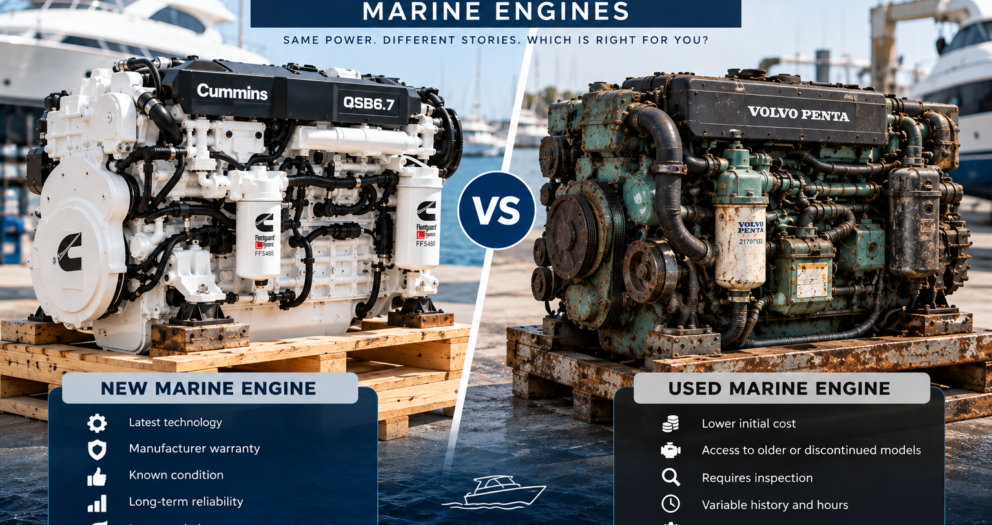
A new marine engine provides a known starting condition and may include applicable warranty coverage, but installing a modern engine into an older vessel can require changes to controls, wiring, mounts or supporting systems.

A properly evaluated used engine may reduce initial cost or provide closer compatibility with an older installation.

The decision should therefore consider:

Condition + Compatibility + Installation + Support + Total Cost

rather than simply:

New vs Used.

Purchase Price vs Total Cost of Ownership

One of the biggest mistakes in a Cummins vs Volvo Penta comparison is focusing only on the engine purchase price.

Suppose Engine A costs less but requires:

  • New gearbox
  • New controls
  • Modified mounts
  • Exhaust changes
  • Electrical modifications

Engine B costs more but integrates more easily with the vessel.

The lower-priced engine may not produce the lower-priced project.

A more useful calculation is:

Engine

Gearbox or drive

Controls and instrumentation

Accessories

Shipping

Installation and modifications

Commissioning

=

Total Installed Cost

For long-term ownership, also consider expected operating hours, fuel consumption at relevant loads, maintenance requirements, parts availability and potential downtime.

The JB Marine MATCH Framework

To make the Cummins vs Volvo Penta comparison practical, use the JB Marine MATCH Framework.

M — Mission

What does the vessel actually do?

Recreational cruising, charter, fishing and commercial work can place very different demands on an engine.

A — Application & Rating

Does the exact engine rating match the intended duty cycle?

Compare engines within the correct application—not simply by maximum horsepower.

T — Total Installed Cost

What will the complete project cost after the gearbox, controls, accessories, shipping, installation and modifications are included?

C — Compatibility

Will the engine work correctly with the vessel's engine room, drivetrain, cooling, exhaust, electrical system and controls?

H — Help & Support

Can appropriate parts, diagnostics and technical support be obtained where the vessel operates?

Together:

M — Mission
A — Application & Rating
T — Total Installed Cost
C — Compatibility
H — Help & Support

This produces a much more useful comparison than simply asking:

"Is Cummins better than Volvo Penta?"

The Key Principle

When comparing Cummins vs Volvo Penta marine engines, focus on the specific engine and propulsion package rather than brand reputation alone.

A Cummins configuration may fit one vessel particularly well.

A Volvo Penta configuration may suit another.

In some projects, both may satisfy the technical requirements, leaving installation complexity, availability, service support and total ownership cost as the meaningful differences.

How to Choose Between Cummins and Volvo Penta

By this point, one thing should be clear:

Choosing between Cummins and Volvo Penta marine engines isn't about finding a universal winner.

It's about matching the engine to the boat.

You need the right power rating, drivetrain configuration, physical dimensions, controls, duty classification and support for the way the vessel will actually operate.

For a new installation, you may have considerable freedom.

For a repower, however, the existing vessel places limits on what can be installed economically.

That's where a structured comparison becomes valuable.

Cummins vs Volvo Penta Comparison Checklist

Before choosing either manufacturer, compare the exact engine models across these areas.

Comparison FactorWhat to Check
Rated PowerHP/kW at the specified RPM
Rated RPMMaximum/rated engine speed
DisplacementEngine displacement and configuration
Duty RatingRecreational or applicable commercial rating
DimensionsLength, width, height and service clearance
WeightDry weight and effect on installation
Gearbox/DriveCompatible transmission or propulsion system
Gear RatioSuitability for shaft and propeller
Electrical System12V/24V and required electrical equipment
ControlsMechanical/electronic system requirements
CoolingInstallation and cooling requirements
ExhaustExhaust size and installation requirements
Parts & ServiceSupport where the vessel operates
Included EquipmentControls, displays, harnesses and accessories
Total Installed CostEngine plus complete installation

Don't complete this comparison using assumptions.

Use the specifications for the exact engine configuration you're considering.

Cummins vs Volvo Penta for Boat Repowering

A boat repower changes the comparison considerably.

When building a new vessel, the engine room and propulsion system may be designed around the chosen engine.

With an existing boat, you're working with what is already there.

You may already have:

  • Engine beds
  • Shaft
  • Propeller
  • Gearbox or drive
  • Exhaust
  • Cooling
  • Fuel system
  • Electrical system
  • Controls
  • Instrumentation

The more of that equipment you can appropriately retain, the less extensive the repower may become.

However, keeping existing equipment simply to save money isn't always the right choice.

Every retained component still needs to be compatible with the replacement engine.

Replacing Cummins With Cummins

If the boat already has a Cummins engine, looking at another Cummins marine engine is a logical starting point.

But don't assume the new engine will be a direct replacement.

Even within the same manufacturer, generations can differ in:

  • Dimensions
  • Mount positions
  • Rated RPM
  • Electronics
  • Controls
  • Exhaust requirements
  • Cooling connections
  • Gearbox compatibility

An older mechanically controlled Cummins installation, for example, can be significantly different from a newer electronically controlled engine.

Verify the entire installation before ordering.

Replacing Volvo Penta With Volvo Penta

The same rule applies when replacing an existing Volvo Penta marine engine.

Remaining with Volvo Penta may simplify certain projects when an appropriate replacement model and propulsion configuration are available.

But the Volvo Penta name on both engines doesn't guarantee identical:

  • Engine mounts
  • Dimensions
  • Gearbox or drive interfaces
  • Controls
  • Wiring
  • Displays
  • Cooling
  • Exhaust

Compare the old and new specifications directly.

Can You Replace Volvo Penta With Cummins?

Potentially, yes.

But changing manufacturer usually requires a more detailed compatibility assessment.

Suppose your boat currently uses a Volvo Penta diesel and you want to install a Cummins.

Check:

  • Physical dimensions
  • Engine mounts
  • Gearbox compatibility
  • Gear ratio
  • Shaft alignment
  • Propeller
  • Exhaust
  • Cooling
  • Fuel connections
  • Electrical system
  • Controls
  • Instrumentation

The fact that both engines produce similar horsepower doesn't make the conversion automatic.

The reverse is equally true when replacing Cummins with Volvo Penta.

Changing brands is possible when the complete propulsion installation supports it.

Marine Gearbox Compatibility

The marine gearbox deserves particular attention during a repower.

If you want to retain the existing transmission, identify:

  • Manufacturer
  • Exact model
  • Gear ratio
  • Input power capacity
  • Input RPM capability
  • Rotation
  • Engine interface
  • Current condition

A gearbox that handled the old engine doesn't automatically suit the replacement.

Likewise, replacing the gearbox may affect shaft speed and potentially the propeller requirements.

Think of the drivetrain as one system:

Engine → Gearbox → Shaft → Propeller

Changing one major component can affect everything downstream.

Volvo Penta Sterndrive and Integrated Propulsion Considerations

Not every Volvo Penta installation uses a conventional engine-and-shaft arrangement.

Some vessels use Volvo Penta sterndrives or other integrated propulsion configurations.

In those cases, replacing the engine with another manufacturer's engine may be more complicated than replacing a conventional inboard engine and marine gearbox.

The existing propulsion system, controls and interfaces need to be evaluated as a complete package.

This is one reason buyers should identify the propulsion configuration, not merely the engine model, when requesting a replacement.

Don't Forget Engine-Room Access

An engine may fit according to its published dimensions and still be difficult to install.

Ask:

Can the old engine actually be removed?

Can the new engine physically pass through the available access?

Engine-room access may involve:

  • Hatches
  • Doors
  • Interior structures
  • Deck openings
  • Lifting points
  • Crane access

A repower budget should account for installation access before the engine arrives.

New Installation vs Repower: The Decision Is Different

For a new vessel or major refit, buyers may have greater freedom to choose between Cummins and Volvo Penta based on the desired propulsion package.

For a repower, compatibility can carry more weight.

This creates an important distinction:

Best engine on paper ≠ best engine for the existing installation.

A slightly more expensive engine that requires fewer modifications may produce a more economical overall project.

Conversely, a lower-priced engine requiring major fabrication, new controls and drivetrain changes can become the more expensive option after installation.

Questions to Ask Before Buying a Cummins or Volvo Penta Engine

Before purchasing, get clear answers to these questions.

1. What Is the Exact Engine Model?

Never purchase based only on horsepower.

2. What Is the Exact Power Rating?

Confirm both horsepower/kW and rated RPM.

3. What Duty Rating Applies?

Make sure the engine rating suits the intended recreational or commercial application.

4. Is the Engine New, Used or Remanufactured?

These are different product conditions and should be clearly identified.

5. If Used, How Many Operating Hours Does It Have?

Hours should be considered alongside maintenance and operating history.

6. Is the Serial Number Available?

This can be important for identifying the engine configuration and obtaining appropriate parts or documentation.

7. What Equipment Is Included?

Ask specifically about:

  • Gearbox
  • Controls
  • Displays
  • Wiring harness
  • Engine mounts
  • Alternator
  • Starter
  • Other accessories

8. What Electrical Configuration Does It Use?

Confirm 12V or 24V.

9. Is a Gearbox Included?

If yes, confirm the manufacturer, model and ratio.

10. What Warranty Applies?

Understand what is covered, for how long and under what conditions.

11. Is Documentation Included?

Ask about manuals and available engine documentation.

12. What Are the Shipping Terms?

Clarify packaging, collection, freight and delivery arrangements.

13. What Information Is Needed to Check Compatibility?

This is particularly important for repowers.

Common Mistakes When Comparing Cummins and Volvo Penta

Mistake 1: Asking Which Brand Is Better

It's too broad.

Instead ask:

Which specific engine is appropriate for this vessel and application?

That turns an opinion question into a technical comparison.

Mistake 2: Comparing Horsepower Alone

Similar horsepower doesn't mean identical performance or compatibility.

Compare rated RPM, displacement, duty rating, gearbox and installation requirements as well.

Mistake 3: Comparing Prices Without Comparing Packages

One quotation may include a gearbox, controls and instrumentation.

Another may quote the engine only.

Those prices aren't directly comparable.

Always establish exactly what is included.

Mistake 4: Ignoring Duty Rating

A power rating appropriate for one operating profile may not suit another.

This is particularly important when comparing recreational and commercial applications.

Mistake 5: Assuming the Existing Gearbox Will Work

Verify the gearbox model, ratio, input capacity, RPM and interface before deciding to retain it.

Mistake 6: Forgetting Installation Costs

The purchase price is only part of a repower.

Mounts, controls, electrical work, cooling, exhaust, drivetrain modifications and labor can materially change the project cost.

Mistake 7: Choosing Based Only on Online Opinions

Owner forums can provide useful experiences, but two owners may be discussing completely different engines, boats, duty cycles and maintenance histories.

Use owner experience as context—not as a substitute for specifications.

Mistake 8: Buying Before Checking Dimensions

This mistake is avoidable.

Confirm:

Length. Width. Height. Mounts. Access. Service clearance.

Then buy.

Which Is Better for Recreational Boats?

Both Cummins and Volvo Penta offer engines used in recreational marine applications.

Rather than choosing based on the brand alone, recreational owners should compare:

  • Appropriate power rating
  • Vessel performance requirements
  • Installation space
  • Propulsion configuration
  • Controls
  • Noise and comfort considerations relevant to the exact installation
  • Local service support
  • Total installed cost

For some boats, a Volvo Penta propulsion package may integrate naturally with the existing setup.

For others, a Cummins engine paired with an appropriate marine transmission may be an excellent technical fit.

The vessel determines the comparison.

Which Is Better for Commercial Vessels?

Commercial operators should place particular emphasis on the exact engine's duty classification and expected operating profile.

Important considerations include:

  • Annual operating hours
  • Typical engine load
  • Required power
  • Downtime sensitivity
  • Parts availability
  • Service support
  • Maintenance requirements
  • Propulsion configuration

The correct commercial engine should be selected for the actual duty—not simply because a similar engine performs well in a recreational boat.

Which Is Better for a Repower?

For a repower, compatibility becomes one of the biggest decision factors.

The strongest candidate may be the engine that provides the right combination of:

Correct rating + physical fit + drivetrain compatibility + support + reasonable total installed cost.

Sometimes that will be Cummins.

Sometimes Volvo Penta.

Sometimes both manufacturers will have technically suitable options.

The purpose of the comparison is to identify those options—not force every vessel toward the same brand.

The JB Marine MATCH Framework: Final Decision

Before making your decision, return to the JB Marine MATCH Framework from Part 2.

M — Mission

What is the vessel expected to do?

A — Application & Rating

Does the exact engine rating match that operating requirement?

T — Total Installed Cost

What will the complete project cost—not merely the engine?

C — Compatibility

How well does the engine integrate with the vessel and drivetrain?

H — Help & Support

Can the engine be effectively serviced and supported where you operate?

If you can answer those five questions with reliable information, you're in a much stronger position to compare the engines objectively.

Cummins vs Volvo Penta: Frequently Asked Questions

Is Cummins or Volvo Penta Better?

There is no universal answer. Both manufacturers produce marine diesel engines for a range of applications. Compare the exact models based on power rating, duty cycle, propulsion configuration, installation compatibility, support and total cost.

Is Cummins or Volvo Penta More Reliable?

Reliability depends on the specific engine, installation quality, operating conditions, maintenance and duty cycle. Brand name alone isn't enough to predict the reliability of a particular installation.

Which Is More Fuel-Efficient: Cummins or Volvo Penta?

Fuel consumption varies by engine model, rating, load and vessel installation. Compare manufacturer data for equivalent operating conditions rather than making a brand-wide assumption.

Are Cummins Marine Engines Good for Repowering?

Cummins offers marine engines used in repower applications, but suitability depends on the specific engine and vessel. Dimensions, mounts, gearbox, cooling, exhaust, electrical systems and duty rating should all be checked.

Are Volvo Penta Engines Good for Repowering?

Volvo Penta engines can also be considered for repower projects where the model and propulsion configuration suit the vessel. Compatibility with the existing drivetrain and supporting systems should be verified before purchase.

Can I Replace a Volvo Penta Engine With a Cummins?

Potentially. The project needs to account for dimensions, mounts, gearbox or drive, shaft, propeller, exhaust, cooling, electrical systems and controls.

Can I Replace a Cummins Engine With a Volvo Penta?

Potentially. As with any change of engine manufacturer, the complete propulsion and installation requirements should be checked rather than relying on horsepower alone.

Which Has Cheaper Parts: Cummins or Volvo Penta?

Parts pricing varies by engine model, component, country and supplier. Instead of assuming one manufacturer is universally cheaper, investigate parts availability and typical costs for the exact models you're considering in your operating region.

Which Has Better Service Support?

This varies by location. Check the authorized service and parts network in the countries and ports where your vessel normally operates.

Should I Buy a New or Used Cummins or Volvo Penta Engine?

Both new and properly evaluated used engines can be viable. New engines offer a known starting condition, while used engines can reduce initial cost. For used engines, condition, history, hours, testing and included equipment deserve particular attention.

Should I Keep My Existing Marine Gearbox During a Repower?

Only if it is in suitable condition and technically compatible with the replacement engine. Check power capacity, input RPM, gear ratio, rotation and interface requirements.

What Information Do I Need for a Marine Engine Quote?

Provide the engine model or desired horsepower, vessel details, application, gearbox requirements, electrical voltage, quantity and delivery destination. For a repower, information about the existing engine and installation is especially useful.

Final Thoughts: Compare the Engine, Not Just the Brand

The Cummins vs Volvo Penta question doesn't need to become a brand contest.

Both manufacturers offer established marine propulsion products.

What matters is whether the particular engine you're considering matches your boat.

Before purchasing, compare:

Power and RPM.

Duty rating.

Dimensions and weight.

Gearbox or drive.

Electrical configuration.

Controls.

Installation requirements.

Parts and service support.

Total installed cost.

Then apply the JB Marine MATCH Framework:

Mission → Application & Rating → Total Installed Cost → Compatibility → Help & Support

That approach gives you something much more useful than a generic brand recommendation:

a technically informed engine choice based on your vessel and operating requirements.

Looking for a Cummins or Volvo Penta Marine Engine?

JB Marine GmbH supplies marine engines for customers looking for replacement engines, repowering options and new propulsion projects.

If you already know the engine you require, send us:

  • Manufacturer and model
  • Required horsepower
  • Quantity
  • Gearbox requirements
  • Electrical voltage
  • Delivery destination

For a repower, also provide:

  • Existing engine make and model
  • Serial number
  • Existing horsepower and RPM
  • Gearbox model and ratio
  • Vessel make/model
  • Recreational or commercial application
  • Photographs of the engine identification plate
  • Photographs of the existing installation

This information helps establish the requirements before comparing available engine options.

Whether you're considering a Cummins marine engine, Volvo Penta marine engine, or comparing both for a repower, the goal should remain the same:

Choose the propulsion solution that fits the vessel—not simply the most familiar name.
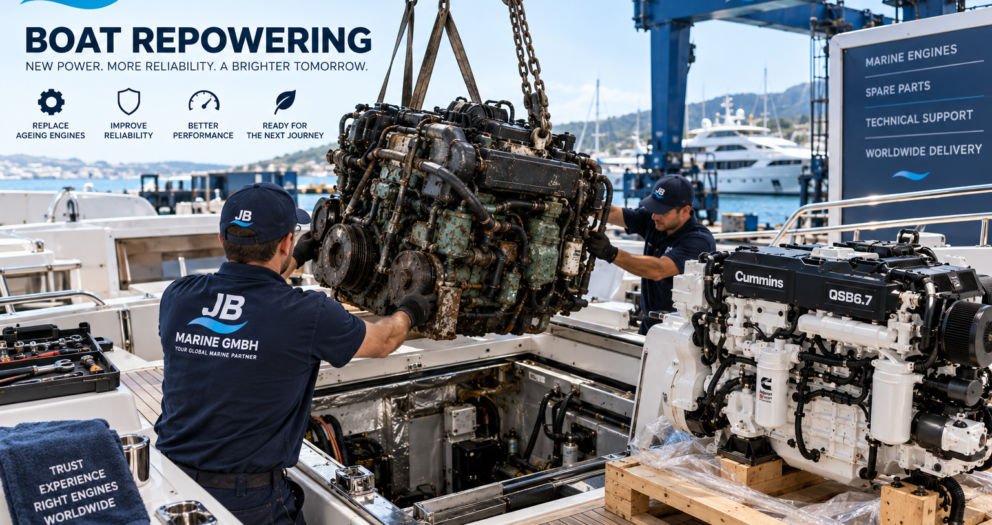
boat repowering

Boat Repowering Guide: When Should You Replace Your Marine Engine?

Your marine diesel engine has started asking for more attention than it used to.

First, it was a cooling-system repair.

A few months later, another component needed replacing.

Now there's more smoke than you remember, the engine doesn't feel quite as strong under load, and you're beginning to wonder whether you can trust it for another season.

Then another repair estimate arrives.

And suddenly you're asking a much bigger question:

Should I repair this engine again, rebuild it—or replace it completely?

It's a decision almost every owner of an aging vessel eventually has to consider.

Unfortunately, there's no magic number of years or operating hours that tells you exactly when to replace a marine engine.

A well-maintained older engine may still have useful service ahead of it. Meanwhile, a younger engine with fewer hours can develop expensive problems because of poor maintenance, corrosion, overheating, unsuitable operating conditions or long periods of inactivity.

That's why boat repowering should be treated as an engineering and financial decision rather than simply an age decision.

At JB Marine GmbH, replacement-engine inquiries often begin with horsepower or an existing engine model. But identifying an appropriate repower option requires more information than that. The existing gearbox, engine-room dimensions, duty cycle, electrical system, cooling and exhaust arrangements, vessel characteristics and intended use can all influence the decision.

Before you start shopping for a replacement marine engine, therefore, there is one question worth answering:

Does the existing engine genuinely need replacing?

Let's start there.

Quick Answer: When Should You Repower a Boat?

Boat repowering should be considered when the existing engine's reliability, repair costs, parts availability, condition or performance no longer make sense for the vessel's intended use.

Age and engine hours are useful indicators, but neither should determine the decision alone.

Before replacing an engine, evaluate:

  • Current mechanical condition
  • Maintenance and repair history
  • Frequency of breakdowns
  • Cost of upcoming repairs
  • Parts availability
  • Engine reliability
  • Vessel usage
  • Expected future ownership
  • Gearbox and drivetrain condition
  • Cost and complexity of installing a replacement

A major repair doesn't automatically mean you need a new engine.

Likewise, an engine that still starts and runs isn't automatically economical to keep.

The right time to repower is when the technical and financial case for replacement becomes stronger than continuing to maintain the existing propulsion system.

What Is Boat Repowering?

Boat repowering is the process of replacing or substantially changing a vessel's existing propulsion engine or propulsion package.

In its simplest form, that could mean removing an old diesel engine and installing another compatible engine.

In a more extensive project, repowering can involve replacing or modifying:

  • Marine engine
  • Gearbox
  • Engine mounts
  • Shaft
  • Propeller
  • Exhaust system
  • Cooling system
  • Fuel system
  • Electrical system
  • Controls
  • Instrumentation

That's why the phrase repower boat engine can describe projects ranging from relatively straightforward replacements to major engineering work.

A successful repower isn't simply about getting another engine into the engine room.

It's about making the complete propulsion system work correctly together.

Repowering vs Repairing vs Rebuilding a Marine Engine

These terms are sometimes used loosely, but they describe different approaches.

Understanding the difference is important because the right solution may not actually be a complete repower.

Marine Engine Repair

A repair normally addresses a particular fault or component.

For example:

  • Replacing a leaking pump
  • Repairing a starter
  • Replacing a damaged hose
  • Correcting an electrical fault
  • Replacing a faulty sensor
  • Repairing part of the cooling system

If the engine is fundamentally healthy and the problem is isolated, repairing it may be more sensible than replacing the entire engine.

A failed component doesn't automatically mean a failed engine.

Marine Engine Rebuild or Overhaul

A rebuild or overhaul goes considerably further.

Depending on the engine, its condition and the scope of work, this may involve disassembly, inspection, measurement and replacement or reconditioning of significant internal components.

The exact meaning of "rebuilt" can vary.

That's important.

If you're considering a rebuilt engine—or paying to rebuild your current one—ask exactly what the work includes.

For example:

  • Was the engine fully disassembled?
  • Which components were inspected?
  • Which components were measured?
  • Which parts were replaced?
  • Were cylinder components addressed?
  • Was the cylinder head serviced?
  • Was the fuel system inspected?
  • Was the cooling system serviced?
  • Was the engine tested afterward?
  • What documentation is provided?
  • What warranty applies to the work?

Don't evaluate a rebuild by the word "rebuilt." Evaluate it by the work that was actually performed.

Marine Engine Repower

A repower replaces the existing propulsion engine with another engine or propulsion package.

The replacement might be:

  • A new marine engine
  • A used marine engine
  • A manufacturer-remanufactured engine
  • A different model from the same manufacturer
  • An engine from another manufacturer

Repowering becomes especially relevant when continuing to repair or rebuild the existing engine no longer makes technical or financial sense. Cummins Marine Engines

But it introduces a different challenge:

Compatibility.

The replacement engine has to work with the boat.

Engine-Only Replacement vs Complete Repower

Not every marine engine repower requires replacing the entire drivetrain.

Sometimes the existing gearbox, shaft and other components can remain.

In other situations, changing the engine triggers additional modifications throughout the propulsion system.

Engine-Only Replacement

An engine-only replacement may be possible when the replacement engine is appropriately compatible with the existing:

  • Gearbox
  • Mounting arrangement
  • Shaft
  • Propeller
  • Cooling system
  • Exhaust system
  • Electrical system
  • Controls

This can potentially reduce the complexity and cost of the project.

However, compatibility should be verified rather than assumed.

Even two engines with similar horsepower can have different:

  • Rated RPM
  • Torque characteristics
  • Physical dimensions
  • Mounting points
  • Electrical requirements
  • Exhaust arrangements
  • Gearbox interfaces

So when someone describes an engine as a "direct replacement," the specifications still need checking.

Complete Propulsion Repower

A more extensive repower may involve replacing the engine and several associated systems.

For example, an older mechanically controlled engine may be replaced by a modern electronically controlled diesel.

That could potentially require:

  • New gearbox
  • New control system
  • Electronic display
  • New wiring
  • Modified engine mounts
  • Exhaust modifications
  • Cooling modifications
  • Propeller evaluation

The engine may physically fit inside the boat while still requiring substantial installation work.

This is one reason marine engine replacement cost cannot be estimated accurately from the engine price alone.

Buying the engine and completing the repower are two different costs.

How Long Does a Marine Diesel Engine Last?

This is one of the first questions owners ask when considering boat engine replacement:

"How many hours should my marine diesel engine last?"

It would be convenient if there were one number.

There isn't.

Marine diesel engine service life depends on many variables, including:

  • Engine design
  • Duty rating
  • Operating load
  • Maintenance
  • Fuel quality
  • Cooling-system condition
  • Lubrication
  • Installation
  • Operating environment
  • Storage conditions
  • Frequency of use

Two identical engines can therefore reach the same number of operating hours in very different mechanical condition.

This is why generalized claims such as "a marine diesel lasts exactly X hours" should be treated carefully.

Engine Hours vs Engine Condition

Marine engine hours are useful.

They just aren't enough by themselves.

Imagine two identical engines.

Engine A

It has accumulated substantial hours but has been regularly serviced, operated within its intended duty cycle and maintained with documented attention to the cooling, fuel and lubrication systems.

Engine B

It has far fewer hours but has spent long periods inactive, has incomplete maintenance history and has experienced repeated overheating problems.

Which one would you rather own?

You can't answer responsibly from the hour meters alone.

That's the point.

Engine hours tell you how long an engine has operated. They don't tell you everything that happened during those hours.

High Hours Don't Automatically Mean It's Time to Repower

An engine with substantial operating hours may still be performing well.

If it:

  • Starts correctly
  • Maintains appropriate operating temperature
  • Produces expected power
  • Has acceptable oil consumption
  • Has good maintenance history
  • Has readily available parts
  • Remains reliable

then age or hours alone may not justify replacement.

For a commercial operator, regular inspection and maintenance records can be particularly valuable when making this assessment.

Repowering an otherwise serviceable engine simply because the hour meter has reached an arbitrary number may mean replacing equipment before there is a strong technical or economic reason to do so.

Low Hours Don't Automatically Mean the Engine Is Healthy

The opposite assumption can also cause problems.

A 20-year-old engine with low hours may sound attractive.

But why are the hours low?

Perhaps the boat was used only occasionally.

That's possible.

But the engine may also have spent years sitting in a humid marine environment.

Long periods of inactivity can contribute to problems involving:

  • Corrosion
  • Seals
  • Fuel contamination
  • Cooling components
  • Electrical connections

This doesn't mean low-hour engines are bad.

It means low hours need context just as much as high hours do.

8 Signs It May Be Time to Repower Your Boat

There is no single symptom that automatically means you need a new engine.

However, several warning signs together can make the case for repowering a boat much stronger.

1. Repairs Are Becoming More Frequent

Every marine engine needs maintenance.

That's normal.

What's more concerning is when repairs become increasingly frequent and unpredictable.

You fix one problem.

Then another appears.

Then another.

Eventually, the issue isn't simply how much each repair costs.

It's how much confidence you still have in the engine.

For a recreational owner, unreliable propulsion can ruin planned time on the water.

For a commercial operator, repeated downtime can directly affect revenue.

When reliability becomes a recurring problem, it may be time to compare continued repairs against a repower.

2. Major Repair Costs Are Approaching Replacement Economics

Suppose an older engine now needs significant internal work.

The repair is possible.

But should you do it?

That depends on what you're getting for the money.

Consider:

Cost of the repair

versus

Condition of the rest of the engine

versus

Expected remaining service

versus

Cost of a suitable replacement

A €5,000 repair on an otherwise healthy, well-supported engine may make sense.

The same repair on an obsolete engine with additional major problems could be difficult to justify.

The question isn't:

"Can this engine be repaired?"

Many engines can.

The better question is:

"Does repairing this engine still make economic sense?"

3. Replacement Parts Are Becoming Difficult to Find

Parts availability can eventually become a bigger problem than engine condition.

An older engine might still run beautifully.

But if a critical component fails and replacement parts are extremely difficult or impossible to source, the vessel can remain out of service for an extended period.

Investigate availability of:

  • Filters
  • Pumps
  • Cooling components
  • Fuel-system parts
  • Gaskets
  • Sensors
  • Electrical components
  • Major internal components

For older or discontinued engines, parts support deserves serious consideration when deciding whether to rebuild or repower.

4. Reliability Is Affecting How You Use the Boat

This is easy to underestimate.

Ask yourself:

Do I still trust the engine?

If you avoid longer journeys because you're worried about a breakdown, reliability has already changed how you use the vessel.

For commercial vessels, the calculation can be even more direct.

If the engine regularly causes cancelled work, lost charters or operational delays, downtime needs to become part of the boat repower cost calculation.

An unreliable engine can be expensive even when the repair invoices look manageable.

5. Excessive Smoke or Oil Consumption Has Developed

Changes in smoke or oil consumption can indicate that an engine needs investigation.

But they don't automatically mean it needs replacing.

Smoke can have many possible causes depending on its color, operating conditions and engine design.

Likewise, increased oil consumption can have several causes.

The correct response is diagnosis.

Not assumption.

A qualified technician may need to evaluate the engine before deciding whether the problem calls for repair, overhaul or replacement.

Symptoms should trigger investigation—not an automatic engine purchase.

6. Persistent Overheating or Cooling-System Problems

A marine diesel engine depends heavily on an effective cooling system.

Recurring overheating deserves serious attention.

Potential causes can exist in different parts of the cooling arrangement, so the problem should be properly diagnosed rather than immediately blamed on the entire engine.

But repeated overheating can also contribute to more serious engine damage.

If an older engine has a history of significant overheating combined with other mechanical problems, a repower may deserve consideration.

7. Performance Has Declined Significantly

Perhaps the boat no longer reaches its previous cruising performance.

Maybe the engine struggles under load.

Fuel consumption appears to have increased.

Acceleration feels different.

Before deciding the engine is worn out, investigate the complete system.

Performance problems can also involve:

  • Propeller condition
  • Hull fouling
  • Fuel supply
  • Air intake
  • Turbocharger
  • Gearbox
  • Excess vessel weight
  • Other installation factors

A proper diagnosis prevents an expensive mistake:

Replacing an engine that wasn't actually the primary problem.

8. The Existing Engine No Longer Meets the Vessel's Needs

Sometimes the engine hasn't failed at all.

The vessel's requirements have changed.

Perhaps a recreational vessel is moving into a different operating role.

Maybe the boat has gained significant weight through modifications.

Perhaps the owner wants to change the propulsion configuration.

In these situations, repowering may be driven by operational requirements rather than mechanical failure.

But increasing horsepower isn't automatically the solution.

The vessel, drivetrain, gearbox, shaft and propeller must all be considered before changing power.

The First Repowering Decision: Diagnose Before You Buy

When an aging engine becomes frustrating, buying a replacement can feel like the fastest way forward.

But the first step in a good repower isn't shopping.

It's diagnosis.

Understand:

What is wrong with the current engine?

What would it cost to repair?

What would a rebuild realistically provide?

Are parts still available?

How reliable is the engine likely to be afterward?

How long do you plan to keep the vessel?

What will a complete repower actually cost?

Only then should you compare replacement options.

This is particularly important when contacting a supplier such as JB Marine GmbH. Providing the existing engine model, serial number, horsepower, rated RPM, gearbox information, vessel application and photographs of the current installation can make the discussion much more productive than simply asking:

"What 400 HP engine do you have?"

Horsepower matters.

But a successful repower requires much more than matching one number.

Repair, Rebuild or Repower Your Marine Engine?

Once you've established that your existing marine engine has a problem, the next decision isn't automatically to replace it.

You generally have three paths to consider:

Repair it.

Rebuild it.

Repower the boat.

Each option can make sense under the right circumstances.

The mistake is choosing one before understanding the condition of the engine, the cost of the work and what you expect from the vessel afterward.

A €3,000 repair can be a sensible investment if it restores a fundamentally healthy engine to reliable service.

The same €3,000 can become the beginning of an expensive cycle if the engine has several other major problems waiting behind it.

That's why this decision needs to look beyond the next invoice.

Repair vs Rebuild vs Repower: What's the Difference?

Here's a practical way to think about the three options.

FactorRepairRebuildRepower
Main purposeCorrect a specific faultRestore major engine systems/componentsReplace existing propulsion engine
Initial costOften lowerCan be substantialUsually larger project investment
Engine retainedYesYesNo
Existing installation changesUsually limitedUsually limitedCan range from minor to extensive
Parts availabilityImportantCriticalImportant for replacement engine
Engine history remains relevantYesYesReplacement starts with its own history
DowntimeDepends on repairCan be significantDepends on installation complexity
Gearbox changesUsually unnecessaryUsually unnecessaryMay be required
WarrantyDepends on work/partsDepends on rebuilderDepends on replacement engine/supplier
Best evaluated byFault + overall conditionCore engine condition + rebuild economicsTotal project cost + compatibility

The table doesn't tell you which option is "best."

It tells you what needs to be investigated.

When Does Repairing the Existing Marine Engine Make Sense?

Repair is often worth considering when the fault is identifiable and the rest of the engine remains in good condition.

For example, an engine doesn't necessarily need replacing because of:

  • A failed starter
  • A leaking pump
  • A faulty sensor
  • A damaged hose
  • A localized electrical problem
  • A serviceable cooling-system fault

If the engine has otherwise been reliable, parts remain readily available and the repair restores normal operation, replacing the entire engine could be unnecessary.

Look Beyond the Failed Component

Before approving a significant repair, ask:

What condition is the rest of the engine in?

If you're spending money on one major component today, are several other expensive components likely to require attention soon?

This is where maintenance history and professional inspection become valuable.

A repair makes a stronger financial case when the engine surrounding the failed component is still fundamentally sound.

When Does Rebuilding a Marine Engine Make Sense?

A marine engine rebuild can occupy the middle ground between continued repairs and complete replacement.

Instead of replacing the engine, major components are inspected and restored or replaced as necessary.

For some older engines, this can make excellent sense.

Particularly when:

  • The basic engine is suitable for the vessel.
  • The engine block and major structure remain serviceable.
  • Parts are available.
  • The existing installation works well.
  • Replacement would require substantial vessel modifications.
  • A competent rebuild can provide a reasonable service outlook.

But a rebuild shouldn't be chosen just because it appears cheaper than a new engine.

You need to understand what you're actually buying.

What Should a Marine Engine Rebuild Include?

There isn't one universal rebuild specification covering every engine and workshop.

That's why the word rebuilt needs explanation.

Depending on engine condition and scope, work may involve inspection or attention to areas such as:

  • Cylinder head
  • Pistons
  • Cylinder liners or bores
  • Piston rings
  • Bearings
  • Crankshaft
  • Connecting rods
  • Valvetrain
  • Oil system
  • Fuel system
  • Cooling components
  • Gaskets and seals

But don't assume every item was replaced simply because an engine is advertised as rebuilt.

Ask for documentation.

You want to know:

What was inspected?

What was measured?

What was reused?

What was replaced?

Which specifications were followed?

Who performed the work?

Was the engine tested afterward?

What warranty applies?

A detailed rebuild record is more meaningful than a fresh coat of paint.

When Does a Complete Boat Repower Make Sense?

A full boat repowering project deserves consideration when the disadvantages of keeping the existing engine begin to outweigh the cost and complexity of replacement.

Several factors can push the decision in that direction.

Reliability Has Become Unacceptable

If you're repeatedly repairing the engine and still don't trust it, reliability itself has value.

For a recreational owner, reliability affects confidence and time on the water.

For a commercial operator, reliability can directly affect revenue.

The financial impact of downtime should therefore be considered alongside repair costs.

Major Repairs Are Required on an Aging Engine

Suppose an older engine requires significant internal work.

You could rebuild it.

But if other expensive systems are also approaching the end of their practical service life, the rebuild may not solve the complete ownership problem.

This is where you need to look at the engine as a whole.

Not just the failed component.

Parts Support Is Becoming Difficult

An engine can be mechanically repairable while becoming commercially impractical to maintain.

If critical components are difficult to source, every future breakdown can create extended downtime.

For vessels that need dependable availability, this can become a strong reason to investigate a replacement marine engine.

Your Operating Requirements Have Changed

Perhaps the boat is now being used more intensively.

Maybe it has moved from recreational use into charter or commercial service.

Perhaps modifications have changed the vessel's displacement.

Or you want a propulsion system better suited to your future operating profile.

Repowering can therefore be proactive rather than reactive.

The old engine doesn't necessarily need to be dead.

It may simply no longer be the right engine for the job.

The JB Marine REPOWER Framework

At JB Marine GmbH, a useful repower discussion needs to go beyond one question:

"How old is the engine?"

Age matters.

But it isn't enough.

For this guide, we can organize the decision around seven factors.

Together, they form the JB Marine REPOWER Framework.

R — Reliability

Ask the most practical question first:

Can you trust the engine?

Think about:

  • Breakdown frequency
  • Starting reliability
  • Overheating history
  • Oil or coolant problems
  • Unplanned repairs
  • Lost operating time

A technically repairable engine can still become economically unattractive if reliability has deteriorated badly.

Reliability is especially important when the vessel operates commercially or travels where technical support isn't immediately available.

E — Economics

Next, examine the numbers.

Don't compare:

Repair invoice vs engine purchase price.

Compare:

Cost of keeping the current engine reliably operational

against

Total cost of installing and operating the replacement.

Suppose your current engine needs a €6,000 repair.

A replacement engine costs €20,000.

At first glance, repairing seems obvious.

But what if the old engine is also likely to need expensive fuel-system and cooling-system work?

What if parts are becoming scarce?

What if repeated downtime is costing the business money?

Now the calculation changes.

Likewise, don't automatically assume replacement is better.

If €6,000 restores an otherwise healthy and well-supported engine to dependable service, spending substantially more on a repower may not make financial sense.

Economics requires looking forward, not simply comparing today's invoices.

P — Parts & Support

Ask:

Can this engine still be supported properly?

Investigate the availability of:

  • Routine service parts
  • Cooling-system components
  • Fuel-system components
  • Sensors
  • Electrical components
  • Major internal parts
  • Technical information
  • Qualified service

An older engine with excellent parts availability may remain practical for years.

Another engine of similar age can become difficult to operate because one critical component is no longer readily obtainable.

This is why engine age alone is a weak repower trigger.

Supportability matters more than the calendar.

O — Operating Requirements

What does the vessel need to do now?

And what will it need to do over the next several years?

Consider:

  • Recreational or commercial use
  • Expected annual hours
  • Typical cruising load
  • Vessel displacement
  • Operating environment
  • Required reliability
  • Planned changes to vessel use

The engine that suited the boat 15 years ago may not be the engine that best suits its current operation.

But don't use changing requirements as an excuse to simply install more horsepower.

Power changes need to be evaluated across the complete propulsion system.

W — Wear & Condition

This is where professional diagnosis becomes essential.

Instead of guessing based on age, evaluate the engine's actual condition.

Depending on circumstances, useful information may come from:

  • Maintenance history
  • Visual inspection
  • Oil analysis
  • Compression or cylinder assessment where appropriate
  • Electronic diagnostics
  • Cooling-system inspection
  • Fuel-system evaluation
  • Operational testing

The more expensive the decision, the stronger the case for obtaining reliable technical evidence.

E — Engine-Room Compatibility

Now look at the proposed replacement.

Will it actually fit?

This question involves much more than length and width.

Consider:

  • Engine dimensions
  • Height
  • Service access
  • Weight
  • Engine mounts
  • Gearbox
  • Shaft alignment
  • Exhaust
  • Cooling connections
  • Fuel connections
  • Electrical system
  • Controls

A replacement engine can be excellent on paper and still be wrong for a particular engine room.

This is one reason buyers should provide photographs and dimensions when discussing a repower with JB Marine GmbH.

The more we know about the existing installation, the easier it becomes to identify compatibility questions before an engine is purchased.

R — Remaining Ownership Horizon

Finally, ask:

How long do you intend to keep the vessel?

This can significantly change the economics.

If you plan to operate the boat for many more years, investing in a well-planned repower may make more sense.

If the vessel will be sold soon, the economics may look different.

Commercial owners should also consider the expected working life of the vessel and whether a new propulsion investment supports the business case.

The Core REPOWER Principle

Put the seven factors together:

R — Reliability

E — Economics

P — Parts & Support

O — Operating Requirements

W — Wear & Condition

E — Engine-Room Compatibility

R — Remaining Ownership Horizon

And one principle emerges:

Don't repower simply because an engine is old. Repower when reliability, economics, supportability, condition and future vessel requirements make replacement the stronger technical case.

That distinction matters.

A 20-year-old engine with strong parts support, excellent maintenance and dependable operation may still be worth keeping.

A much younger engine with severe damage and poor support may not be.

Age is information. It isn't the verdict.

New vs Used Marine Engine for a Repower

Once you've decided to repower, another question appears:

Should the replacement engine be new or used?

A new marine engine may provide:

  • Known starting condition
  • Current documentation
  • Applicable warranty coverage
  • A clean maintenance history from installation onward

A properly evaluated used marine engine may provide:

  • Lower initial purchase cost
  • Access to older or discontinued models
  • Potentially closer compatibility with an existing installation
  • Strong value when history and condition can be verified

Neither option automatically wins.

The decision should consider:

  • Condition
  • Engine hours
  • Maintenance history
  • Warranty
  • Parts support
  • Included equipment
  • Installation requirements
  • Expected vessel usage
  • Total project cost

This is exactly why the new-versus-used decision should be made after understanding the repower requirements—not before.

Choosing the Replacement Engine: Don't Start With Horsepower Alone

One of the most common mistakes in a marine engine repower is assuming horsepower is the main compatibility requirement.

Imagine your current engine produces 350 HP.

You find another 350 HP engine.

Does that make it suitable?

Not necessarily.

Two engines with identical advertised horsepower can have different:

  • Rated RPM
  • Torque characteristics
  • Dimensions
  • Weight
  • Duty ratings
  • Gearbox requirements
  • Electronic systems
  • Cooling requirements
  • Exhaust requirements

The replacement engine needs to match the vessel and propulsion system, not simply the number printed on the specification sheet.

Vessel Type Matters

A replacement engine needs to suit the vessel.

Important characteristics can include:

  • Hull type
  • Vessel length
  • Displacement
  • Existing propulsion arrangement
  • Desired cruising performance
  • Operating environment
  • Recreational or commercial use

A planing recreational boat and a heavy displacement workboat can require very different propulsion considerations even if their horsepower requirements appear similar.

Duty Cycle Matters

A marine engine's power rating needs to be considered alongside how the vessel will operate.

An engine intended for relatively light recreational operation may not be appropriate for a vessel expected to operate for long periods under demanding commercial loads.

When requesting a marine diesel engine replacement, therefore, tell the supplier how the vessel will actually be used.

Don't provide only the desired horsepower.

Rated RPM Matters

Horsepower doesn't operate independently of engine speed.

Suppose the existing engine develops its rated output at one RPM while the proposed replacement reaches similar horsepower at a substantially different RPM.

That difference can affect:

  • Gearbox selection
  • Gear ratio
  • Shaft speed
  • Propeller requirements

This is another reason an apparently similar engine may not be a direct replacement.

The Marine Gearbox Is Part of the Repower Decision

The gearbox is sometimes treated as an accessory.

It shouldn't be.

Your marine gearbox connects the engine's output to the propeller system.

When evaluating a replacement engine, consider:

  • Gearbox make
  • Model
  • Gear ratio
  • Input power capacity
  • Input RPM
  • Rotation
  • Interface with the engine
  • Current gearbox condition

In some repowers, retaining the existing gearbox may be possible.

In others, replacing it may be technically necessary or financially sensible.

Never assume.

Verify.

The Propeller Cannot Be Ignored

Changing engine power, rated RPM or gearbox ratio can change what the propeller needs to do.

That means a repower may require the existing propeller to be evaluated.

A poorly matched propeller can prevent the new engine from operating as intended.

So the propulsion chain should be viewed as:

Engine → Gearbox → Shaft → Propeller → Vessel

Change one major part and you may affect the others.

This is one of the most important concepts in successful repowering a boat.

Before You Buy the Replacement Engine

At this stage, you should know two things.

First:

Whether replacing the existing engine makes sense.

Second:

What characteristics the replacement engine needs.

Only now should the buying process become serious.

Before placing an order, gather as much information as possible about:

  • Existing engine
  • Gearbox
  • Engine-room dimensions
  • Vessel
  • Electrical system
  • Exhaust
  • Cooling
  • Controls
  • Shaft and propeller
  • Intended operation

This preparation can prevent an expensive situation where an attractive engine is purchased first and compatibility problems are discovered afterward.

Planning a Marine Engine Repower Correctly

Deciding to repower is only half the job.

The next challenge is making sure the replacement engine actually works with the vessel.

This is where a repower can either become a well-planned upgrade or an expensive chain of unexpected modifications.

A marine diesel engine doesn't operate independently.

It works as part of a complete system:

Engine → Gearbox → Shaft → Propeller → Vessel

Around that system are the cooling, exhaust, fuel, electrical and control systems.

Change the engine and you may affect several of them.

That's why the most important rule before purchasing a replacement marine engine is simple:

Measure first. Verify compatibility. Then buy.

Marine Engine Repower Compatibility Checklist

Before ordering an engine, work through the following areas.

1. Engine Dimensions

Start with the obvious question:

Will the replacement engine physically fit?

Check:

  • Overall length
  • Width
  • Height
  • Clearance around the engine
  • Space above the engine
  • Access for installation
  • Future service access

The last point is particularly important.

An engine might technically fit into the compartment while leaving insufficient space to replace filters, service belts or access important components.

Don't design only for installation.

Design for maintenance too.

2. Engine Weight

The replacement engine's weight also matters.

A substantial change in weight can affect:

  • Vessel trim
  • Weight distribution
  • Mounting requirements
  • Handling characteristics

If you're replacing a heavy older diesel with a lighter modern engine, the weight reduction may sound automatically beneficial.

But vessel balance still needs to be considered.

The same applies when the replacement is heavier.

Don't evaluate horsepower and dimensions while ignoring mass.

3. Engine Mounts

Engine mounts aren't simply there to hold the engine in place.

They form part of the alignment between the engine, gearbox and shaft.

Check:

  • Mount locations
  • Mount spacing
  • Engine-bed arrangement
  • Height
  • Alignment requirements

If the replacement engine has different mounting positions, fabrication work may be necessary.

This is one of those costs that can easily be overlooked when calculating a boat repower cost from the engine price alone.

Can You Keep Your Existing Marine Gearbox?

Sometimes.

But it must be verified.

Keeping the existing marine gearbox can potentially reduce the cost and complexity of a repower, particularly when it remains in good condition and is technically compatible with the replacement engine.

Before retaining it, investigate:

  • Gearbox manufacturer
  • Exact model
  • Gear ratio
  • Power rating
  • Input RPM capability
  • Rotation
  • Engine interface
  • Current condition

The existing gearbox must be suitable for the replacement engine's output and operating characteristics.

"It bolts on" does not necessarily mean "it is correctly matched."

Why Gear Ratio Matters

A marine gearbox doesn't simply connect the engine to the propeller.

Its reduction ratio determines the relationship between engine speed and shaft speed.

For example, if a new engine operates at a different rated RPM from the old engine, retaining the same gearbox ratio can change propeller shaft speed.

That can affect the suitability of the existing propeller.

This is why changing the engine may lead to questions about the gearbox and propeller even when neither component is physically damaged.

Shaft and Propeller Compatibility

The shaft and propeller are critical parts of the propulsion system.

When repowering a boat, consider whether the existing drivetrain remains appropriate for the replacement engine.

Important factors can include:

  • Engine power
  • Engine RPM
  • Gear ratio
  • Shaft dimensions
  • Propeller diameter
  • Propeller pitch
  • Vessel characteristics

A propeller that worked correctly with the previous engine and gearbox combination may not automatically be ideal for the new setup.

After a repower, the engine should be able to operate within the appropriate manufacturer specifications under load.

Propeller selection and drivetrain calculations should therefore be handled by appropriately qualified marine professionals where required.

Exhaust System Requirements

The replacement engine may have different exhaust requirements.

Check:

  • Exhaust outlet size
  • Routing
  • Backpressure requirements
  • Exhaust hose
  • Water injection arrangement where applicable
  • Silencer/waterlock arrangement where applicable
  • Existing component condition

An exhaust system should not simply be reused because it physically connects.

The system needs to meet the requirements of the replacement engine and installation.

Cooling System Compatibility

Marine engines depend heavily on correct cooling.

Depending on the propulsion system, a repower may require evaluation of:

  • Seawater intake
  • Seacock
  • Strainer
  • Seawater hose
  • Heat exchanger
  • Coolant circuit
  • Seawater pump
  • Associated plumbing

If the replacement engine has different cooling-flow requirements, the existing system may require modification.

This is an area where cutting corners can become expensive very quickly.

Fuel System Considerations

Older marine diesels and modern electronically controlled engines can have different fuel-system requirements.

Before installing a marine diesel engine replacement, inspect the existing:

  • Fuel tanks
  • Supply lines
  • Return lines
  • Filters
  • Water separators
  • Shutoff arrangements

Fuel cleanliness is particularly important for modern high-pressure injection systems.

An expensive new engine should not inherit a neglected fuel system without proper evaluation.

12V vs 24V Marine Engine Electrical Systems

This is one of the easiest repower details to overlook.

Your vessel may operate a 12V electrical system, while an available replacement engine is configured for 24V.

Or the opposite may be true.

That doesn't automatically mean the engine can never be used.

But it does mean the electrical configuration must be addressed correctly.

Components potentially affected can include:

  • Starter motor
  • Alternator
  • Relays
  • Engine wiring
  • Instrumentation
  • Control modules
  • Batteries
  • Charging system

Do not assume that converting a marine engine from 24V to 12V—or from 12V to 24V—is simply a matter of changing the battery.

The exact requirements depend on the engine and its electrical/control architecture.

For electronically controlled engines in particular, verify manufacturer specifications and component compatibility before making changes.

When requesting a repower quotation from JB Marine GmbH, include the vessel's electrical voltage from the beginning.

That small piece of information can prevent a large compatibility problem later.

Controls and Instrumentation

Older marine engines may use mechanical throttle and shift controls.

Modern engines may use electronic controls and digital displays.

Changing between systems can add:

  • New control heads
  • Wiring harnesses
  • Displays
  • Sensors
  • Interface components
  • Installation labor

If you're replacing an older mechanical engine with a newer electronically controlled engine, don't assume the existing dashboard and controls can simply remain unchanged.

Ask what comes with the engine package and what must be purchased separately.

Boat Repower Cost: What Should You Budget For?

One of the most common searches around boat repowering is:

How much does it cost to repower a boat?

There is no responsible universal price.

A small recreational boat with a relatively straightforward engine replacement is very different from a commercial vessel requiring extensive drivetrain and engine-room modifications.

Instead of looking for one number, calculate the project in categories.

A useful starting formula is:

Engine + Gearbox + Accessories + Shipping + Installation + Modifications + Commissioning = Approximate Total Repower Cost

The key word is total.

The Engine Price Is Not the Repower Price

Suppose you find a replacement engine for €20,000.

That does not necessarily mean you have a €20,000 repower project.

You may still need:

  • Gearbox
  • Engine mounts
  • Controls
  • Instrumentation
  • Wiring
  • Exhaust components
  • Cooling components
  • Fuel-system work
  • Shaft work
  • Propeller modifications
  • Lifting/crane services
  • Installation labor
  • Freight
  • Taxes or customs charges where applicable
  • Commissioning

Some projects need only a few of these.

Others need many.

This is why comparing engine purchase prices without comparing installation requirements can be misleading.

Hidden Boat Repowering Costs

Several costs frequently appear only after the project begins.

Engine Mount Fabrication

A replacement engine with different mount locations may require changes to the engine beds or brackets.

Exhaust Modifications

Different exhaust dimensions or requirements may mean replacing hoses, fittings or other components.

Cooling-System Changes

Seawater plumbing may need to be resized or rerouted.

Electrical Conversion

Moving between 12V and 24V configurations—or mechanical and electronic engine systems—can increase parts and labor requirements.

New Controls and Displays

Modern engines may require manufacturer-compatible electronic controls or displays.

Propeller Work

Changes in rated RPM, power or gearbox ratio may require propeller evaluation or modification.

Freight and Handling

A marine engine for sale may look competitively priced until international freight, packaging and inland delivery are added.

For international buyers, total landed cost matters more than warehouse price.

How Long Does a Boat Repower Take?

There isn't one universal timeline.

Repower duration depends on factors such as:

  • Engine availability
  • Shipping time
  • Removal of the existing engine
  • Engine-room access
  • Fabrication
  • Gearbox availability
  • Electrical work
  • Exhaust modifications
  • Cooling modifications
  • Shaft alignment
  • Propeller work
  • Testing
  • Commissioning

A relatively straightforward replacement can be very different from a custom repower requiring significant fabrication.

Before beginning the project, identify which components are available and which modifications need to be completed.

Good planning can reduce the amount of time a vessel remains out of service.

For commercial operators, that downtime should be treated as part of the economic calculation.

Common Boat Repowering Mistakes

Many expensive repower problems begin before the engine is purchased.

Here are some of the most important mistakes to avoid.

Mistake 1: Choosing by Horsepower Alone

A 400 HP engine isn't automatically a suitable replacement for another 400 HP engine.

Check:

  • RPM
  • Duty rating
  • Dimensions
  • Weight
  • Gearbox
  • Installation requirements

Horsepower is a requirement—not the entire specification.

Mistake 2: Assuming Similar Power Means a Drop-In Replacement

Two engines can have similar power while using completely different mounting, electrical, exhaust and control arrangements.

Treat the phrase drop-in replacement cautiously unless compatibility has actually been verified.


Mistake 3: Ignoring Gearbox Ratio

A gearbox mismatch can affect shaft speed and propeller performance.

Always include gearbox information when evaluating a replacement engine.

Mistake 4: Forgetting the Propeller

The existing propeller was selected around a particular propulsion arrangement.

Change the engine or gearbox and that relationship may change.

Evaluate the complete drivetrain.

Mistake 5: Underestimating Electrical Changes

This is particularly common when moving between:

  • 12V and 24V
  • Mechanical and electronic engines
  • Analog and digital instrumentation

Identify electrical requirements before ordering the engine.


Mistake 6: Ignoring Exhaust and Cooling Requirements

If the replacement engine needs different exhaust capacity or cooling flow, existing systems may need modification.

These systems should be evaluated as part of the repower plan—not after installation begins.

Mistake 7: Comparing Engine Prices Instead of Complete Repower Costs

A cheaper engine may require more modification.

A more expensive engine may integrate more easily.

Until you calculate installation, accessories, shipping and commissioning, you don't know which option is genuinely less expensive.

Mistake 8: Buying Before Measuring

This might be the simplest lesson in the entire guide.

Measure first. Buy second.

Record:

  • Engine-room length
  • Width
  • Height
  • Access opening
  • Mount positions
  • Service clearances

Then compare those measurements against the proposed engine configuration.

A fantastic engine that doesn't fit isn't a fantastic deal.

Information to Collect Before Requesting a Marine Engine Repower Quote

The more accurate information you provide, the more useful the engine discussion can be.

Before contacting JB Marine GmbH or another marine engine supplier, collect as much of the following information as possible:

1. Existing engine manufacturer

2. Exact engine model

3. Engine serial number

4. Current horsepower

5. Rated RPM

6. Approximate operating hours

7. Engine dimensions where available

8. Vessel manufacturer and model

9. Vessel length

10. Vessel displacement/weight where available

11. Hull type

12. Recreational or commercial application

13. Current gearbox manufacturer and model

14. Gear ratio

15. Shaft information where relevant

16. Propeller information where available

17. Vessel electrical voltage — 12V or 24V

18. Mechanical or electronic controls

19. Photographs of the current engine and installation

20. Delivery destination

If you already have a particular replacement model in mind, include that too.

Why Photos Can Be Extremely Helpful

When discussing a repower remotely, photographs can provide useful context that specifications alone may not show.

Useful photographs include:

  • Complete engine installation
  • Engine identification plate
  • Gearbox identification plate
  • Front of engine
  • Rear of engine
  • Both sides
  • Engine mounts
  • Exhaust arrangement
  • Cooling connections
  • Dashboard/controls
  • Engine-room access

Photos don't replace proper measurements or professional installation assessment.

But they can help identify questions early.

Frequently Asked Questions About Boat Repowering

What Does Repowering a Boat Mean?

Boat repowering means replacing or substantially changing a vessel's existing propulsion engine or propulsion package. Depending on the project, it may involve only the engine or also the gearbox, controls, electrical system, cooling, exhaust, shaft or propeller.

When Should I Replace My Boat Engine?

Consider replacement when declining reliability, repeated repair costs, poor parts availability, major engine wear or changing vessel requirements make continued operation of the existing engine increasingly impractical. Age or engine hours alone should not determine the decision.

How Many Hours Does a Marine Diesel Engine Last?

There is no universal hour limit for every marine diesel engine. Service life depends on engine design, duty cycle, maintenance, operating conditions, cooling, fuel quality and other factors. Evaluate engine condition and history alongside operating hours.

Is It Cheaper to Rebuild or Replace a Marine Engine?

It depends on the engine and project. Rebuilding may cost less when the existing engine is fundamentally sound, parts remain available and the current installation is suitable. Repowering may make more sense when major repairs, poor support, recurring failures or future operating requirements reduce the value of rebuilding.

How Much Does It Cost to Repower a Boat?

There is no single boat repower cost. The total depends on engine price, gearbox, accessories, shipping, labor, vessel modifications and commissioning. Calculate the complete installed project rather than comparing engine prices alone.

Can I Install a More Powerful Engine When Repowering?

Potentially, but increasing horsepower should not be done without evaluating the vessel, gearbox, shaft, propeller, engine mounts and other drivetrain components. More horsepower isn't automatically appropriate or beneficial.

Can I Keep My Existing Gearbox?

Possibly. Compatibility should be checked using the gearbox model, ratio, input capacity, RPM, rotation, engine interface and current condition.

Can a 24V Marine Engine Be Converted for a 12V Boat?

Sometimes a different electrical configuration may be technically possible, but it depends on the specific engine and its electrical architecture. Components such as the starter, alternator, relays, wiring, controls and electronic modules may be affected. Verify the correct configuration for the exact engine rather than assuming a simple battery change is sufficient.

Should I Buy a New or Used Engine for a Repower?

Either can be appropriate. A new engine generally provides a known starting condition and may include applicable warranty coverage. A properly evaluated used engine may reduce initial cost or provide closer compatibility with an older installation. Compare condition, configuration, warranty, installation requirements and total project cost.

Does Changing the Engine Mean I Need a New Propeller?

Not always. However, changes in engine output, rated RPM or gearbox ratio can affect propeller requirements. The existing propeller should therefore be evaluated as part of the repower.

How Long Does a Boat Repower Take?

The timeline depends on engine availability, shipping, engine-room access, required modifications, gearbox and drivetrain work, electrical changes, testing and commissioning. A direct replacement may be considerably faster than a custom installation.

What Information Do I Need for a Marine Engine Repower Quote?

At minimum, provide the current engine model, horsepower, rated RPM, vessel/application, gearbox details, electrical voltage and delivery destination. Serial numbers, photographs, engine-room measurements and propeller information can make the evaluation more useful.

Conclusion: Repower Based on the Vessel, Not Just the Engine

So, when should you replace your marine engine?

Not simply when it becomes old.

Not when it reaches an arbitrary number of operating hours.

And not automatically when the first expensive repair arrives.

A good marine engine repower decision considers the complete picture.

Return to the JB Marine REPOWER Framework:

R — Reliability

Can you still depend on the existing engine?

E — Economics

Does continuing to repair it make financial sense compared with replacement?

P — Parts & Support

Can you still obtain the parts and technical support needed to operate it?

O — Operating Requirements

Does the engine still suit what the vessel needs to do?

W — Wear & Condition

What does actual inspection tell you?

E — Engine-Room Compatibility

Will the proposed replacement integrate properly with the vessel?

R — Remaining Ownership Horizon

How long do you expect to keep and operate the boat?

Those questions are more useful than asking:

"Is my engine too old?"

Because the objective isn't to install the newest engine you can find.

It's to build a propulsion system that makes sense for the vessel.

Planning a Boat Repower? Talk to JB Marine GmbH

If you're considering boat repowering or searching for a replacement marine engine, JB Marine GmbH can help you review available engine options based on your project requirements.

When requesting a quotation, send as much information as possible, including:

  • Existing engine make and model
  • Engine serial number
  • Current horsepower and RPM
  • Vessel make/model and application
  • Gearbox model and ratio
  • 12V or 24V electrical system
  • Preferred replacement engine, if known
  • Required accessories
  • Photographs of the existing installation
  • Delivery destination

If you don't yet know which replacement engine you need, start with the information from the existing installation.

A successful repower begins with understanding the boat—not simply choosing an engine from a catalogue.

JB Marine GmbH can then help identify relevant available options and prepare a quotation based on the information provided.

new vs used marine engine

New vs Used Marine Engines: Complete Buyer’s Guide

Buying a new vs used marine engine often begins with a surprisingly simple question:

Should I buy new or used?

Imagine you're repowering a boat and have narrowed your search down to two engines.

The first is a new marine engine with a higher purchase price, known condition and applicable manufacturer warranty.

The second is a used marine engine of the same general power range. It costs considerably less, looks clean in the photographs and appears to offer exactly what you need.

At first glance, the decision seems obvious.

Why spend substantially more if the used engine can do the same job?

But then the questions begin.

How many hours has the used engine operated?

Was it installed in a recreational boat or a commercial vessel?

Has it been properly maintained?

What caused it to be removed?

Is the gearbox included?

Does it have service records?

What happens if you install it and discover that it needs major repairs?

These questions are why comparing a new and used marine engine based on purchase price alone can be misleading.

At JB Marine GmbH, inquiries for marine engines often involve more than simply identifying a model and horsepower. Buyers may also need to consider the condition, configuration, gearbox, accessories, intended application and delivery requirements before two offers can genuinely be compared. Cummins Marine Engines

The real question, therefore, isn't simply:

"Should I buy new or used?"

It's:

"Which engine gives me the right combination of condition, compatibility, reliability and total cost for my vessel?"

That's the question this guide will help you answer.

Quick Answer: Is It Better to Buy a New or Used Marine Engine?

A new marine engine generally offers greater certainty about its starting condition, operating history, documentation and applicable warranty coverage. A properly evaluated used marine engine, however, can offer significant value by reducing the initial purchase cost.

Neither option is automatically better for every boat.

The decision should consider:

  • Engine condition
  • Operating history
  • Engine hours
  • Previous application
  • Maintenance history
  • Warranty
  • Included equipment
  • Compatibility with the vessel
  • Installation requirements
  • Parts and service availability
  • Shipping costs
  • Expected future use

A carefully selected used engine can make excellent financial sense.

A poorly evaluated used engine can turn a low purchase price into an expensive project.

Likewise, buying new doesn't automatically eliminate installation costs or compatibility problems.

The goal isn't to buy the cheapest engine. The goal is to buy the engine that makes financial and technical sense once it is installed and operating in your boat. Cummins Marine Engines

What Is Considered a New Marine Engine?

A new marine engine is generally an engine that has not previously been placed into normal service.

For many buyers, the appeal is straightforward.

You're beginning with a known starting point rather than inheriting years of unknown operation.

Depending on the manufacturer, seller, market and application, a new engine may also come with applicable manufacturer or supplier warranty coverage and current documentation.

But there is an important detail buyers sometimes overlook:

"New engine" does not necessarily mean "complete propulsion package."

You need to understand exactly what you're buying.

A New Engine Doesn't Always Include Everything You Need

Suppose you request the price of a new 400 HP marine diesel.

One supplier quotes €25,000.

Another quotes €30,000.

Is the first supplier €5,000 cheaper?

Maybe.

But not necessarily.

The first quotation might be for the engine alone.

The second could include:

  • Marine gearbox
  • Engine mounts
  • Wiring harness
  • Instrument panel or display
  • Controls
  • Additional accessories

Until you know exactly what each quotation includes, comparing the two prices tells you very little.

This is particularly important when searching online for new marine engines for sale.

An advertised price may represent one specific configuration rather than everything required to install the engine in your vessel.

Bobtail Engine vs Complete Propulsion Package

You'll frequently encounter the term bobtail engine in the marine market.

Generally, a bobtail marine engine refers to an engine supplied without the marine transmission or gearbox.

A more complete propulsion package may include the engine and gearbox together, potentially with other installation components.

However, package contents can vary considerably.

Never assume that controls, displays, mounts, harnesses or other accessories are included simply because an engine is advertised as "complete."

Ask the supplier for a written list.

When requesting a quotation from JB Marine GmbH, for example, providing your gearbox requirements and telling us whether you need a bobtail engine or a more complete engine-and-gearbox package can help make the quotation much more relevant to your project.

What Is a Used Marine Engine?

A used marine engine is an engine that has previously been operated in service.

That definition sounds simple.

The reality isn't.

"Used" describes the engine's ownership and operating history. It doesn't automatically tell you its current condition.

One used engine might have relatively limited hours, detailed service records and a well-documented history.

Another might have operated intensively for years with little documentation.

Both can still appear online under the same description:

Used marine engine for sale.

That's why the word used by itself tells you very little about value.

The condition and history behind the word matter much more.

Not All Used Marine Engines Are Equal

Imagine three engines of the same model.

Engine A

1,000 operating hours, documented maintenance history and clear information about the previous vessel.

Engine B

700 operating hours but no service records and little information about its previous use.

Engine C

2,000 operating hours with comprehensive maintenance documentation and a clear inspection history.

Which one is the best purchase?

You cannot reliably answer from the hour meters alone.

Engine B has the fewest reported hours.

But does that make it the best engine?

Not necessarily.

This leads to one of the most important principles when buying a used marine diesel engine:

Engine hours are evidence. They are not the entire story.

Marine Engine Hours: How Important Are They?

Buyers naturally want to know the operating hours of a used engine.

That's sensible.

Hours provide useful information about how long an engine has operated.

But they need context.

One of the most common questions is:

"How many hours are too many for a marine diesel engine?"

There isn't one responsible universal number that answers that question for every marine engine.

Why?

Because two engines with identical hours can have very different histories.

Consider the difference between an engine that has received appropriate maintenance and one that has not.

Or between an engine operating under a suitable load profile and one that has spent much of its life in unfavorable operating conditions.

Or between an engine with documented service history and one whose past is almost completely unknown.

The hour meter matters.

How those hours were accumulated matters too.

Low Hours Don't Automatically Mean Better Condition

This can sound counterintuitive.

Surely an engine with 500 hours must be better than one with 2,000?

Not automatically.

A low-hour engine may have spent long periods unused.

Depending on storage conditions and maintenance, inactivity can bring its own problems.

A higher-hour engine may have been operated regularly and professionally maintained throughout its service life.

This doesn't mean higher hours are better.

It means hours should never be interpreted without context.

When evaluating a used engine, consider the hours together with:

  • Engine age
  • Service history
  • Previous application
  • Operating environment
  • Physical condition
  • Storage history
  • Known repairs
  • Inspection findings
  • Available diagnostic information

This gives you a much more complete picture.

Recreational vs Commercial Engine History

One of the most useful questions you can ask about a used engine is:

"What was this engine used for?"

An engine removed from a recreational yacht may have experienced a very different operating profile from an engine removed from a commercial workboat.

But even here, avoid making assumptions.

A recreational engine isn't automatically in excellent condition.

A commercial engine isn't automatically worn out.

Maintenance history and operating conditions still matter.

The point is that previous application gives context to the operating hours.

If you're considering used marine engines for sale, try to find out:

  • What type of vessel used the engine?
  • Was the application recreational or commercial?
  • Why was the engine removed?
  • How long has it been out of service?
  • Was it running when removed?
  • Is maintenance documentation available?

These questions can tell you much more than a polished photograph.

Maintenance History Can Be More Valuable Than Appearance

Marine engines can be cleaned.

They can be painted.

Covers can be polished.

A clean engine photograph is useful, but it is not a mechanical inspection.

This matters particularly when buying remotely.

A freshly painted engine may look impressive in an advertisement while telling you almost nothing about the internal mechanical condition.

Likewise, an engine with cosmetic wear isn't automatically a poor engine.

That's why serious buyers should look beyond appearance.

Ask for whatever reliable information is available regarding:

  • Oil changes
  • Filter replacements
  • Cooling-system maintenance
  • Fuel-system service
  • Major repairs
  • Overhauls
  • Replacement components
  • Previous faults
  • Service records

The more verifiable information you have, the less you're relying on assumptions.

Why Was the Used Engine Removed?

This question is simple and surprisingly useful.

Why is the engine for sale?

There can be many perfectly reasonable answers.

A vessel may have undergone a complete repower.

The owner may have upgraded to a different power configuration.

The vessel may have been dismantled.

A commercial operator may have replaced engines as part of a fleet-maintenance program.

But the answer gives you valuable context.

If possible, ask:

Was the engine operational when removed?

Was it removed because of a mechanical problem?

Was it tested after removal?

How has it been stored since removal?

None of these questions alone guarantees engine condition.

Together, however, they help build a clearer picture of what you're buying.

Used vs Reconditioned vs Remanufactured Marine Engines

This is one area where terminology can become confusing very quickly.

A buyer searching for a marine diesel engine for sale might encounter:

Used

Reconditioned

Rebuilt

Remanufactured

ReCon

These terms should not automatically be treated as interchangeable.

Understanding what the seller actually means is more important than the label itself.

What Is a Used Marine Engine?

A used engine has previously been in service.

It may be sold:

  • As removed
  • Inspected
  • Tested
  • Serviced
  • Cleaned and prepared for resale

The exact preparation varies.

That's why the seller should clearly describe the engine's known condition and what work, if any, has been performed.

What Is a Reconditioned Marine Engine?

The word reconditioned can mean different things depending on who is selling the engine.

One seller might use it for an engine that received extensive mechanical work.

Another might use it for an engine that was inspected, serviced and had selected components replaced.

This creates a simple rule:

Never buy the word "reconditioned." Buy the documented work behind it.

Ask:

  • What was inspected?
  • What was replaced?
  • What was repaired?
  • Was the engine disassembled?
  • Were internal components measured?
  • Was it tested afterward?
  • Who performed the work?
  • Is documentation available?
  • What warranty, if any, is provided?

A clear description of the work performed is much more valuable than the label alone.

What Is a Remanufactured Marine Engine?

A genuinely remanufactured engine typically goes through a more extensive defined process than an ordinary used engine, but buyers still need to understand whose remanufacturing standard is being referenced.

Manufacturer-backed remanufacturing programs may have specific processes, specifications and warranty conditions.

That is different from an independent seller simply describing an engine as "remanufactured."

If you encounter a remanufactured marine engine, ask:

Who remanufactured it?

To what specification?

Which components were replaced or restored?

What documentation supports the claim?

What warranty applies?

Again, documentation matters.

Manufacturer ReCon Programs Are Their Own Category

Some engine manufacturers operate formal remanufacturing or ReCon programs.

These products should not automatically be grouped together with ordinary used engines.

For example, Cummins offers manufacturer ReCon products under its own program.

That is different from a private seller advertising a used Cummins engine as "reconditioned."

The distinction matters because the processes, documentation and warranty arrangements may be different.

If you're comparing:

New vs Used vs Manufacturer ReCon

treat them as three separate purchasing options until you've confirmed exactly what each offer includes.

New vs Used Marine Engine: The First Big Lesson

We're now in a position to answer something important.

When you see two marine engines advertised at different prices, you're often not comparing only:

New vs Used.

You may actually be comparing:

Known vs uncertain history

Different package contents

Different operating hours

Different previous applications

Different gearbox arrangements

Different warranty conditions

Different levels of documentation

Different installation requirements

That is why the cheapest number on the screen cannot tell you which engine represents better value.

A €12,000 used engine that needs €8,000 of unexpected work is no longer a €12,000 engine.

And a €25,000 new engine that requires extensive modifications to the vessel may cost considerably more than €25,000 by the time the boat returns to service.

The number that matters isn't simply the purchase price.

It's the cost of getting the right engine reliably installed and operating in your vessel.

— New vs Used Marine Engines: Comparing Cost, Risk and Long-Term Value

In Part 1, we established an important principle:

"Used" doesn't automatically mean poor condition, and "new" doesn't automatically mean the best choice for every vessel.

Now we can make the comparison more practical.

Imagine you have two engines in front of you.

One is new.

The other is used and considerably cheaper.

Instead of asking:

"Which engine costs less?"

Ask:

"What will it cost to put each engine into reliable service in my vessel?"

That single change in thinking can completely change a purchasing decision.

Let's compare the two options.

New vs Used Marine Engine: Side-by-Side Comparison

The table below gives you a starting point.

FactorNew Marine EngineUsed Marine Engine
Initial purchase priceGenerally higherOften lower
Previous operating hoursNo normal prior serviceVaries by engine
Operating historyKnown starting pointDepends on available records
Condition assessmentGreater initial certaintyRequires more investigation
WarrantyMay include applicable manufacturer/supplier warrantyVaries; may be limited or unavailable
Maintenance historyNo previous normal-service historyImportant to investigate
DocumentationGenerally easier to establishDepends on engine and seller
AvailabilityDepends on model and stockDepends on used inventory
Older-model compatibilityMay require vessel modificationsSimilar replacement engine may simplify some aspects
Inspection before purchaseStill importantParticularly important
Unexpected repair riskGenerally more predictable initiallyDepends heavily on condition and history
Installation costCan still be significantCan still be significant
Purchase evaluationSpecification and package focusedSpecification, package, condition and history focused

This table isn't meant to declare a winner.

It shows why the decision depends on the project.

Now let's look at each option more closely.

Advantages of Buying a New Marine Engine

There are several reasons buyers prefer new marine engines for sale, especially when reliability and long-term ownership are major priorities.

1. You Begin With a Known Starting Point

Perhaps the most obvious advantage is that the engine hasn't accumulated a previous owner's normal operating history.

You aren't trying to determine:

  • How the previous owner operated it
  • Whether maintenance was delayed
  • Whether it overheated years ago
  • Whether contaminated fuel caused problems
  • Whether major repairs were completed correctly

That reduces some of the uncertainty that naturally comes with used machinery.

For a buyer planning to keep a vessel for many years, that known starting point can be valuable.

2. Warranty Coverage May Be Available

A new engine may be supplied with applicable manufacturer or supplier warranty coverage.

But don't stop at the word warranty.

Ask what it actually covers.

Warranty conditions can depend on:

  • Manufacturer
  • Engine model
  • Application
  • Recreational or commercial use
  • Country or market
  • Installation requirements
  • Commissioning requirements
  • Time and operating-hour limitations

A warranty has value only when you understand its conditions.

Always request the applicable terms for the exact engine you're buying.

3. Documentation Is Usually Easier to Establish

Correct documentation becomes important throughout engine ownership.

You may need:

  • Engine identification
  • Installation information
  • Owner/operator information
  • Maintenance schedules
  • Parts information
  • Warranty documentation
  • Technical specifications

With a new engine, establishing the correct documentation for the supplied configuration is generally more straightforward.

That can make future maintenance and parts identification easier.

4. You May Gain Access to Current Engine Technology

Depending on the engine model, a newer marine diesel may offer more modern:

  • Electronic controls
  • Fuel-injection systems
  • Instrumentation
  • Diagnostics
  • Emissions technology

But there is an important qualification.

Newer technology isn't automatically better for every repower project.

If your existing vessel has older mechanical controls and relatively simple electrical systems, installing a modern electronically controlled engine may require additional modifications.

The technology may offer benefits, but the installation needs to support it.

5. New Can Make Long-Term Planning Easier

If you expect to keep a vessel for many years or operate it extensively, beginning with a new engine can make maintenance planning more predictable.

You know when the engine entered service.

You can build your own maintenance history from day one.

And you aren't inheriting unknown decisions made by previous owners.

For some commercial operators, that predictability can be particularly valuable because downtime has a direct business cost.

Disadvantages of Buying a New Marine Engine

New engines also come with trade-offs.

Understanding them helps prevent the assumption that new automatically means simple.

1. Higher Initial Purchase Cost

This is usually the most obvious disadvantage.

A new marine diesel engine will often require a larger initial investment than a comparable used unit.

And the engine itself may be only part of the project cost.

You may also require:

  • Gearbox
  • Controls
  • Displays
  • Wiring
  • Engine mounts
  • Exhaust modifications
  • Cooling-system modifications
  • Propeller changes
  • Installation labor

That's why your budget should consider the complete project rather than only the engine invoice.

2. A New Engine May Require More Repower Modifications

Suppose your vessel currently uses an older engine that is no longer produced.

You choose a modern replacement with similar horsepower.

The power output looks right.

But the new engine may have different:

  • Dimensions
  • Mounting points
  • Rated RPM
  • Electronic controls
  • Exhaust requirements
  • Cooling requirements
  • Gearbox interface

Suddenly, what looked like an engine replacement becomes a larger boat repowering project.

This doesn't make the new engine a bad choice.

It simply means installation costs should be evaluated before making the purchase.

Advantages of Buying a Used Marine Engine

Used engines deserve a fair evaluation too.

A carefully selected used marine engine can be a practical solution for the right vessel and budget.

1. Lower Initial Purchase Price

This is the main attraction.

A used engine may allow a buyer to obtain the required power at a substantially lower initial cost than purchasing new.

That can be especially relevant when:

  • Repowering an older vessel
  • Working within a fixed project budget
  • Replacing an existing engine with a similar model
  • Expected annual operating hours are relatively limited

But lower price only becomes genuine value when the engine's condition justifies the purchase.

2. A Similar Replacement May Reduce Some Conversion Work

Suppose your vessel already uses a particular engine model.

Finding a compatible used replacement from the same family may potentially reduce some of the changes required compared with installing a completely different modern engine.

Existing:

  • Mounting arrangement
  • Gearbox
  • Exhaust
  • Cooling
  • Controls
  • Wiring

may be closer to the replacement configuration.

But don't assume this makes the engine a direct swap.

Exact specifications still need to be checked.

3. Used Engines Can Provide Access to Older or Discontinued Models

Sometimes the engine you need is no longer available new.

A well-maintained used unit may allow an owner to retain a familiar propulsion configuration without completely redesigning the installation.

This can be useful when maintaining an older vessel where extensive modifications wouldn't make economic sense.

4. A Documented Used Engine Can Offer Strong Value

This is where the word used becomes too broad.

Consider a marine diesel with:

  • Verifiable serial number
  • Known hours
  • Service records
  • Clear previous application
  • Good physical condition
  • Inspection information
  • Appropriate testing

Now compare it with another used engine that has:

  • Unknown hours
  • No service history
  • Unknown previous vessel
  • No documentation
  • No testing information

Both are technically used engines.

They are not equally attractive purchases.

Condition plus documentation creates a much stronger buying case than price alone.

At JB Marine GmbH, this is why details such as the exact engine model, serial information where available, configuration, gearbox and condition matter when discussing a used engine with a buyer.

Risks and Disadvantages of Buying a Used Marine Engine

The potential savings are real.

So are the risks.

1. Unknown Maintenance History

If maintenance records aren't available, you may not know whether the engine received appropriate servicing throughout its previous life.

This doesn't automatically mean the engine is bad.

It means your uncertainty is higher.

And uncertainty has financial value.

The less you know, the more careful the inspection should be.

2. Hidden Wear or Damage

Not every problem is visible from the outside.

A clean engine photograph cannot tell you everything about:

  • Internal wear
  • Previous overheating
  • Fuel-system condition
  • Cooling-system condition
  • Oil pressure
  • Compression
  • Electronic faults
  • Previous repairs

For a high-value purchase, a qualified inspection or appropriate testing can therefore be worthwhile.

3. Warranty May Be Limited or Unavailable

Some used engines may be sold with limited seller warranties.

Others may be sold without warranty.

Never assume.

Ask:

What warranty applies to this exact engine?

And get the answer in writing.

4. Accessories May Be Missing

A used engine might be advertised at an attractive price but lack components you need.

For example:

  • Gearbox
  • Controls
  • Instrumentation
  • Wiring harness
  • Mounts
  • Starter
  • Alternator
  • Sensors
  • Other installation components

Replacing missing equipment can reduce the apparent savings quickly.

This is why used marine engine price should always be evaluated alongside package contents.

5. Future Parts Availability Should Be Considered

An older engine may fit your vessel beautifully.

But can you still obtain the parts required to maintain it?

Before purchasing an older or discontinued engine, investigate the availability of:

  • Routine service filters
  • Gaskets
  • Cooling components
  • Fuel-system components
  • Sensors
  • Electrical parts
  • Major replacement components

An inexpensive engine becomes much less attractive if one unavailable component can keep the vessel out of service.

The JB Marine TRUE COST Framework

This brings us to the most important part of the comparison.

When buyers compare new vs used marine engines, purchase price gets most of the attention.

But purchase price is only one number.

At JB Marine GmbH, a more useful way to think about an engine purchase is to examine what it takes to put that engine into dependable service.

For this guide, we'll call that the:

TRUE COST Framework

Each letter represents one area you should investigate before deciding.

T — Technical Condition

What condition is the engine actually in?

For a new engine, this question is relatively straightforward.

For a used engine, investigate:

  • Physical condition
  • Leaks
  • Corrosion
  • Known faults
  • Previous repairs
  • Available test results
  • Inspection findings

Don't allow a fresh coat of paint to answer a mechanical question.

R — Remaining Service Potential

How much useful service might the engine reasonably provide in your application?

There is no universal formula based on hours alone.

Consider:

  • Engine hours
  • Age
  • Maintenance
  • Previous duty
  • Operating environment
  • Condition
  • Inspection findings

A properly maintained higher-hour engine may sometimes present a clearer buying proposition than a lower-hour engine with an uncertain history.

U — Usage Requirement

What will you do with the engine?

This is often more important than asking what the previous owner did.

Will your vessel be:

  • Recreational?
  • Commercial?
  • Charter?
  • Fishing?
  • Workboat?
  • Seasonal?
  • High-hour operation?

An engine that makes sense for occasional recreational use may not make sense for a commercial vessel where downtime immediately affects revenue.

Your application changes the value of risk.

E — Equipment Included

What's actually included in the price?

Check for:

  • Gearbox
  • Gear ratio
  • Controls
  • Displays
  • Harnesses
  • Mounts
  • Alternator
  • Starter
  • Filters
  • Other accessories

This is where two quotations that initially appear thousands of euros apart can become much closer.

Compare package against package.

C — Compatibility

Will the engine actually work with the vessel?

Check:

  • Dimensions
  • Weight
  • Engine mounts
  • Gearbox
  • Gear ratio
  • Shaft
  • Propeller
  • Cooling
  • Exhaust
  • Fuel system
  • Electrical system
  • Controls

This is particularly important during a repower.

The cheapest engine in the wrong configuration can become the most expensive option.

O — Ownership Costs

Purchase price is only the beginning.

Consider expected:

  • Maintenance
  • Filters
  • Fluids
  • Replacement parts
  • Repairs
  • Fuel consumption
  • Service support

A cheaper used engine requiring immediate major maintenance may have a higher short-term ownership cost than expected.

Likewise, don't assume new automatically means zero maintenance cost.

Every engine needs proper servicing.

S — Shipping and Installation

If you're purchasing a marine engine from Germany or another international market, include the cost of getting it to your vessel.

Depending on the transaction, that may include:

  • Packaging
  • Crating
  • Inland transport
  • Freight
  • Insurance
  • Customs charges
  • Applicable taxes
  • Port charges
  • Final delivery

Then add installation.

Only after these costs are considered can you begin comparing realistic project totals.

T — Time and Downtime Risk

This final factor is easy to overlook.

What does downtime cost you?

For a recreational boat owner, an unexpected repair might mean losing part of the boating season.

For a commercial operator, downtime could mean lost revenue every day the vessel isn't working.

That changes how you should think about risk.

A commercial buyer may reasonably place greater value on predictability, support and reduced downtime exposure.

Don't Compare Engine Prices—Compare the Cost of Reliable Operation

This is the central lesson of the TRUE COST Framework.

Suppose you have:

Used Engine: €14,000

New Engine: €25,000

The difference is €11,000.

It seems enormous.

But now imagine the used engine requires:

€2,500 in missing accessories.

€2,000 in immediate maintenance and repairs.

€1,500 in additional installation work.

The difference is already much smaller.

Now imagine the new engine requires a different gearbox and extensive control-system modifications.

Suddenly the calculation changes again.

This is why the question:

"Which engine is cheaper?"

isn't enough.

The better question is:

"What is the expected total cost of getting each engine correctly installed and operating reliably in my vessel?"

That's the number worth comparing.

When Does Buying a New Marine Engine Make Sense?

There are situations where a new engine may deserve stronger consideration.

For example, when:

  • The vessel will remain in service for many years.
  • The engine will accumulate substantial annual operating hours.
  • Downtime carries significant financial consequences.
  • Known history is especially important.
  • Applicable warranty coverage is a priority.
  • An appropriate used engine cannot be verified.
  • Current technology or certification is required for the application.

None of these automatically means you must buy new.

They simply increase the value of the advantages a new engine can provide.

When Can Buying a Used Marine Engine Make Sense?

A used engine may deserve serious consideration when:

  • The purchase budget is limited.
  • The engine's identity and condition can be verified.
  • Maintenance history is available.
  • The engine is compatible with the existing installation.
  • The vessel has relatively modest annual operating requirements.
  • A similar replacement can reduce extensive conversion work.
  • The total project economics make sense.

The key phrase is:

properly evaluated.

Buying used shouldn't mean buying blind.

Used Should Mean Evaluated, Not Guessed

There's nothing inherently wrong with purchasing a used boat engine.

There is something risky about purchasing one based entirely on:

"The seller says it runs well."

Good purchasing decisions replace assumptions with information.

Verify what can be verified.

Inspect what can be inspected.

Document what is included.

Understand what isn't included.

Calculate shipping and installation.

Then compare the total project against the new-engine alternative.

That approach doesn't eliminate every risk.

But it turns an emotional buying decision into a much more informed one.

How to Inspect, Compare and Choose the Right Marine Engine

By now, the difference between a new marine engine and a used marine engine should look much less like a simple price comparison.

A new engine can offer a known starting point, current documentation and applicable warranty coverage.

A used engine can offer substantial savings and, when carefully selected, excellent value.

But when buying used, one thing becomes especially important:

Due diligence.

You need to know what you're buying before the engine reaches your vessel.

This becomes even more important when purchasing internationally because inspecting, returning or replacing a large marine diesel engine after delivery can be difficult and expensive.

So let's turn everything we've discussed into a practical buying process.

How to Evaluate a Used Marine Engine Before Buying

No single inspection can guarantee the future of a mechanical engine.

However, gathering the right information can significantly improve the quality of your purchasing decision.

Here are the areas worth investigating.

1. Verify the Exact Engine Model

Don't stop at the manufacturer's name.

"Cummins marine engine" isn't enough.

Neither is:

"Volvo Penta 300 HP."

Ask for the complete model designation and power rating.

Depending on the engine, you may also need to confirm:

  • Rated horsepower
  • Rated RPM
  • Duty rating
  • Configuration
  • Certification where relevant

Small differences in engine specification can have major consequences for installation and compatibility.

2. Request the Engine Serial Number

The engine serial number is one of the most useful identification details you can obtain.

It can help with identifying the engine and finding appropriate technical, parts and service information.

When considering a used marine diesel engine, ask for the serial number early in the buying process.

If identification information is missing or unclear, investigate further before committing to the purchase.

3. Check the Operating Hours

Hours matter.

But as we established earlier, they require context.

Ask:

How many hours are recorded?

Then ask:

How were those hours accumulated?

An engine with 3,000 hours of documented operation and maintenance tells a different story from an engine showing 1,000 hours with little information about its past.

Don't ask only:

"How many hours?"

Ask:

"What do we know about those hours?"

4. Request Available Maintenance Records

If service history is available, review it.

Useful records may show:

  • Routine oil changes
  • Filter changes
  • Cooling-system maintenance
  • Fuel-system work
  • Major repairs
  • Component replacement
  • Overhauls

A complete service history isn't always available, particularly with older engines.

But when documentation exists, it can add valuable context to the engine's reported condition.

5. Ask About the Previous Application

Was the engine installed in:

  • A recreational yacht?
  • A commercial fishing vessel?
  • A workboat?
  • A passenger vessel?
  • Another marine application?

Previous application can help you understand how the engine may have been operated.

But don't use vessel type alone to judge condition.

A commercial engine can be professionally maintained.

A recreational engine can be neglected.

Application provides context. Maintenance and inspection provide evidence.

6. Find Out Why the Engine Was Removed

There are many legitimate reasons to remove a functioning engine.

A vessel may be undergoing:

  • A complete repower
  • A power upgrade
  • Conversion to a different propulsion system
  • Fleet replacement
  • Dismantling

Ask whether the engine was operational when removed and whether any known mechanical problems contributed to its removal.

A clear answer helps you understand the engine's history.

7. Inspect for Leaks, Corrosion and Physical Damage

A visual inspection cannot reveal everything happening inside an engine.

It can still tell you a lot.

Look carefully for signs of:

  • Oil leakage
  • Coolant leakage
  • Fuel leakage
  • Heavy corrosion
  • Damaged wiring
  • Broken connectors
  • Damaged hoses
  • Cracked components
  • Missing parts
  • Poor previous repairs

Marine environments are hard on machinery, so corrosion deserves particular attention.

If you're purchasing remotely, request detailed, current photographs or video rather than relying only on a few advertising images.

8. Check the Cooling System

Cooling-system condition is particularly important on a marine engine.

Depending on the engine and installation, inspect or investigate the condition of:

  • Heat exchanger
  • Seawater pump
  • Coolant
  • Hoses
  • Connections
  • Associated cooling components

Signs of overheating or neglected cooling-system maintenance deserve further investigation.

9. Review the Fuel System

Fuel systems can be expensive to repair, particularly on modern electronically controlled engines.

Look for available information regarding:

  • Fuel pumps
  • Injectors
  • Fuel lines
  • Filters
  • Leaks
  • Previous fuel-system repairs

For common-rail engines, fuel cleanliness and correct maintenance are especially important.

10. Check the Oil and Other Fluids

Where an inspection is possible, fluid condition may provide useful clues.

Depending on the engine and circumstances, a qualified technician may inspect the oil or recommend further analysis.

Oil analysis can sometimes provide additional information about wear or contamination, although it should be interpreted professionally and in context.

11. Review Electronic Diagnostics Where Available

Modern electronically controlled marine engines may store useful operating or fault information.

Depending on the engine and diagnostic system, this can potentially provide additional context about its operation.

A qualified technician with the appropriate diagnostic equipment may be able to review relevant information before purchase.

12. Consider a Professional Inspection

For a higher-value used marine engine, paying for a qualified independent inspection can be money well spent.

Depending on circumstances, an inspection may include:

  • Visual examination
  • Operational testing
  • Diagnostic checks
  • Fluid assessment
  • Cooling-system checks
  • Inspection for leaks
  • Review of available documentation

The scope will depend on whether the engine is installed, removed, running or stored.

The goal isn't to make a used engine risk-free.

It's to reduce avoidable uncertainty.

20 Questions to Ask Before Buying a Marine Engine

Whether you're buying new, used, rebuilt or remanufactured, these questions can help you compare offers properly.

1. What is the exact engine model?

2. What is the engine serial number?

3. What are the horsepower and rated RPM?

4. Is the engine new, used, reconditioned or remanufactured?

5. What is the manufacturing year, where available?

6. If used, what are the reported operating hours?

7. What was the previous application?

8. Why was the engine removed?

9. Is maintenance history available?

10. Have any major repairs or rebuilds been performed?

11. Is a marine gearbox included?

12. What is the gearbox manufacturer, model and ratio?

13. Which controls and instruments are included?

14. What other accessories are included?

15. What warranty, if any, applies?

16. What documentation comes with the engine?

17. Has the engine been inspected or tested?

18. How will the engine be packaged for transport?

19. What are the shipping terms?

20. Has compatibility with the intended vessel been checked?

You don't necessarily need a perfect answer to every question before discussing an engine.

But by the time you're ready to pay, you should understand exactly what you're buying and which uncertainties remain.

New vs Used Marine Engine for a Repower

A boat repowering project adds another layer to the decision.

You're not simply purchasing an engine.

You're replacing one component within an existing propulsion system.

That means compatibility can become just as important as engine condition.

Don't Compare Engines Until You Compare Installation Costs

Imagine your vessel has an older 300 HP marine diesel.

You find:

Option A: A compatible used engine for €13,000.

Option B: A new-generation 300 HP engine for €23,000.

It looks like Option A saves €10,000.

But perhaps the used engine requires substantial mechanical work.

Now imagine Option B requires:

  • New engine mounts
  • New controls
  • Exhaust modifications
  • Electrical modifications
  • Different gearbox
  • Propeller changes

Neither purchase price tells you the real project cost.

For a repower, calculate:

Engine + Gearbox + Accessories + Modifications + Installation + Shipping + Commissioning

Then compare.

The "Drop-In Replacement" Trap

You'll sometimes hear an engine described as a drop-in replacement.

Treat that phrase carefully.

Two engines can have similar horsepower and still differ in:

  • Physical dimensions
  • Weight
  • Mounting locations
  • Gearbox interface
  • Rated RPM
  • Exhaust arrangement
  • Cooling connections
  • Electrical requirements
  • Controls

Even engines from the same family can have configuration differences.

Before assuming an engine will drop directly into an existing installation, verify the relevant measurements and specifications.

Similar horsepower does not automatically mean identical installation.

Should You Buy a New Engine for an Older Boat?

This is another question without a universal yes-or-no answer.

Start with the vessel itself.

Consider:

  • Overall vessel condition
  • Vessel value
  • Expected ownership period
  • Annual usage
  • Existing drivetrain condition
  • Required installation modifications
  • Cost of the engine
  • Cost of the complete repower

Installing a new engine in an older boat can make sense when the vessel is structurally sound, suitable for the owner's needs and worth keeping in service.

In other situations, the cost of a complete modern repower may be difficult to justify relative to the vessel's value and intended use.

The important calculation isn't simply:

Boat age vs engine age.

It's:

Total investment vs expected value and future use.

What About Popular Marine Engine Brands?

Buyers researching marine engines for sale commonly encounter manufacturers such as Cummins, Volvo Penta, Yanmar and Caterpillar.

Brand reputation matters.

But it shouldn't replace engine-specific due diligence.

A well-known name doesn't automatically tell you the condition of a 15-year-old used engine.

When comparing specific engines, look at:

  • Exact model
  • Power rating
  • Duty classification
  • Engine hours
  • Service history
  • Condition
  • Parts availability
  • Local service support
  • Gearbox
  • Included equipment
  • Installation compatibility

At JB Marine GmbH, helping a buyer identify an appropriate engine starts with understanding what the vessel actually requires—not simply choosing a brand name from a list.

New vs Used: Which Marine Engine Should You Buy?

After all this information, let's return to the original question.

Consider a New Marine Engine When:

A new engine may deserve stronger consideration if:

  • You want a known starting condition.
  • Long-term ownership is planned.
  • The vessel will accumulate substantial operating hours.
  • Downtime would be particularly costly.
  • Applicable warranty coverage is important to you.
  • A suitable used engine with verifiable history isn't available.
  • Your project requires a current engine specification or certification.

Consider a Used Marine Engine When:

A used engine may deserve consideration if:

  • Initial budget is important.
  • Engine identity and condition can be properly evaluated.
  • Maintenance and operating information are available.
  • The engine is compatible with the existing installation.
  • A similar replacement could reduce conversion work.
  • Expected vessel usage supports the economics.
  • The total project cost compares favorably with buying new.

Notice that neither list says:

"Always buy new."

or:

"Used is always better value."

That's intentional.

The correct answer depends on the vessel and the individual engine.

Frequently Asked Questions About New vs Used Marine Engines

Is It Worth Buying a Used Marine Engine?

Yes, a used marine engine can make financial sense when its identity, condition, operating history and compatibility are adequately evaluated. The lower purchase price should be compared with expected maintenance, installation, shipping and repair costs before making a decision.

How Many Hours Are Too Many for a Used Marine Diesel Engine?

There is no universal number of hours that automatically makes a used marine diesel engine unsuitable. Engine design, duty cycle, maintenance history, age, previous application and current condition all matter. Hours should be treated as one part of the evaluation rather than the only measure of engine life.

Is a Low-Hour Marine Engine Always Better?

No. Lower hours can be attractive, but they don't automatically prove better condition. A low-hour engine may have incomplete maintenance history or spent long periods inactive, while a higher-hour engine may have been regularly operated and professionally maintained.

What's the Difference Between Used and Reconditioned?

A used engine has previously been operated. "Reconditioned" generally indicates that some inspection, servicing or repair work has been performed, but the exact meaning can vary between sellers. Buyers should ask for documentation explaining exactly what work was completed.

Is a Remanufactured Engine the Same as a Used Engine?

Not necessarily. A remanufactured engine may have undergone a defined rebuilding process, particularly when supplied through an established manufacturer remanufacturing program. Buyers should verify who performed the remanufacturing, what standard was followed, which components were replaced and what warranty applies.

Should I Buy a New Engine for an Old Boat?

Possibly. Consider the boat's overall condition, value, expected future use and complete repower cost. The vessel's age alone should not determine the decision.

What Should I Check Before Buying a Used Marine Engine?

Check the exact model, serial number, operating hours, previous application, maintenance history, known repairs, physical condition, gearbox, included accessories, documentation and applicable warranty. For higher-value purchases, consider professional inspection and appropriate testing.

Do Used Marine Engines Come With a Warranty?

Sometimes, but not always. Warranty terms depend on the seller, engine and transaction. Ask for the applicable warranty conditions in writing before purchasing.

Can I Keep My Existing Gearbox When Repowering?

Potentially, but compatibility must be verified. Check gearbox model, ratio, input rating, engine interface, rotation and the requirements of the complete drivetrain before assuming an existing gearbox can be retained.

How Much Does a Marine Diesel Engine Cost?

There is no single marine diesel engine price. Cost varies according to manufacturer, model, horsepower, condition, configuration, gearbox, accessories and market availability. Shipping, taxes and installation can also significantly affect the total project cost.

Is a New Marine Engine More Reliable Than a Used One?

A new engine provides a known starting point without a previous normal operating history. A used engine's future reliability depends heavily on its condition, previous operation, maintenance and installation. Individual engine condition should therefore be considered rather than relying solely on the new-or-used label.

What Information Should I Provide When Requesting a Marine Engine Quote?

Provide as much of the following as possible:

  • Required engine model or horsepower
  • Quantity
  • Vessel type
  • Recreational or commercial application
  • Existing engine if repowering
  • Existing gearbox and ratio
  • Whether you need a bobtail engine or engine-and-gearbox package
  • Required accessories
  • Delivery country
  • Delivery city or port

This helps a supplier such as JB Marine GmbH understand the requirement and prepare a more relevant quotation.

Conclusion: Buy on Total Value, Not Just Purchase Price

The decision between a new vs used marine engine shouldn't begin and end with the price tag.

A new engine may provide:

  • A known starting point
  • Clear documentation
  • Applicable warranty coverage
  • Long-term ownership advantages

A properly evaluated used engine may provide:

  • Lower initial cost
  • Strong value
  • Compatibility with an older installation
  • Access to engine models no longer available new

Neither option is automatically right.

And neither option is automatically wrong.

The better approach is to return to the JB Marine TRUE COST Framework:

T — Technical Condition

R — Remaining Service Potential

U — Usage Requirement

E — Equipment Included

C — Compatibility

O — Ownership Costs

S — Shipping & Installation

T — Time & Downtime Risk

If you're comparing two engines, put both through those eight questions.

Then compare them again.

You may discover that the engine with the lower purchase price isn't actually the lower-cost project.

Or you may discover that a carefully selected used engine offers exactly the value your vessel needs.

That's the point.

Don't buy the cheapest engine.

Don't automatically buy the newest engine.

Buy the engine whose condition, configuration and total project cost make sense for your vessel.

Looking for a New or Used Marine Engine?

If you're currently searching for new marine engines for sale, used marine engines for sale, or a replacement engine for a repower project, JB Marine GmbH can help you review available options based on your requirements.

When requesting a quotation, send us:

  • Engine model or required horsepower
  • Quantity
  • Vessel/application
  • Recreational or commercial use
  • Current engine model if repowering
  • Gearbox requirements
  • Required accessories
  • Delivery destination

If you're unsure of the exact replacement engine, providing photographs of the existing engine identification plate and gearbox information can also help establish the starting point.

Contact JB Marine GmbH to discuss your marine engine requirements and request current availability and a quotation.

Cummins QSB6.7 marine engine

Cummins QSB6.7 Marine Engine: Complete Buyer’s Guide

Buying a marine engine looks simple until you start comparing the details.

Imagine you're repowering a boat and you already know that you want a Cummins QSB6.7. You start searching and quickly find several options: 355 HP, 380 HP, 425 HP, perhaps even 480 HP or 550 HP.

At first, the decision seems obvious.

More horsepower must mean a better engine, right?

Not necessarily.

Two engines can carry the same QSB6.7 name while having different power ratings, rated speeds, duty requirements, configurations and intended applications. And when you're investing thousands of euros in a marine diesel engine, choosing the wrong configuration can become far more expensive than the difference between two purchase prices.

That's why the first question shouldn't simply be:

"How much horsepower can I get?"

A better question is:

"Which Cummins QSB6.7 configuration actually matches my vessel and how I intend to use it?"

That is what this guide is designed to help you understand.

Whether you're researching a Cummins QSB6.7 for sale, planning a repower, comparing engines or trying to understand Cummins QSB6.7 specifications, we'll walk through the important details without burying you in unnecessary technical jargon.

We'll cover the available power ratings, engine specifications, technology, applications, buying considerations, pricing factors, fuel consumption, repowering and the questions you should ask before purchasing.

Quick Answer: The Cummins QSB6.7 is a 6.7-liter, six-cylinder, four-stroke marine diesel engine featuring turbocharging, aftercooling and a high-pressure common-rail fuel system. It is offered in multiple power and duty ratings for recreational and commercial marine applications. Choosing the correct version requires more than matching horsepower—you also need to consider the vessel, duty cycle, drivetrain, installation requirements and intended operating profile.

What Is the Cummins QSB6.7 Marine Engine?

The Cummins QSB6.7 marine engine belongs to Cummins' established B-Series/Quantum marine engine family.

At its core, it is a 6.7-liter inline-six diesel platform engineered in marine configurations for propulsion and related marine applications.

The basic marine engine specification includes:

  • Six cylinders arranged in-line
  • Four-stroke diesel operation
  • 6.7-liter displacement
  • Turbocharging
  • Aftercooling
  • High-pressure common-rail fuel injection
  • Electronic engine management

That combination gives Cummins considerable flexibility in producing different power ratings from the same basic displacement.

This is one reason buyers encounter several versions of the QSB6.7 when searching for a Cummins marine engine for sale.

But there is an important distinction that buyers should understand.

Not Every QSB6.7 You Find Online Is a Marine Engine

This sounds obvious, but it can save you from a costly mistake.

Cummins uses the QSB6.7 platform in more than one industry.

A search for "QSB6.7 engine" can therefore return engines associated with construction equipment, rail applications and other industrial uses alongside genuine marine engines.

They should not automatically be treated as interchangeable.

Marine engines operate in a very different environment and require systems and configurations appropriate for vessel installation, cooling, exhaust, controls and drivetrain integration.

So when you're shopping online, don't stop at:

"It says QSB6.7."

Confirm the complete engine model, application, rating and serial information.

For a marine buyer, the right question is:

"Is this specific QSB6.7 configured and rated for my marine application?"

That distinction becomes particularly important when comparing used engines, surplus units and unusually inexpensive offers.

Cummins QSB6.7 Specifications at a Glance

Before looking at the different horsepower options, let's establish the basic technical platform.

SpecificationCummins QSB6.7 Marine
Engine configurationInline 6-cylinder, 4-stroke diesel
Displacement6.7 L / 408 cu in
Bore × stroke107 × 124 mm
AspirationTurbocharged / aftercooled
Fuel systemHigh-pressure common rail
RotationCounterclockwise facing flywheel
Approx. overall length*1,263.8 mm
Approx. overall width*910.6 mm
Approx. overall height*857 mm
Approx. weight*658 kg / 1,450 lb

Published dimensions and weight are configuration-dependent and should not be treated as universal installation dimensions for every QSB6.7 package.

This last point matters.

If you're planning a marine engine repower, don't design your installation around a specification you found on a random sales page.

Confirm the dimensional drawing and configuration for the exact engine you intend to purchase.

A few centimeters can matter inside a crowded engine room.

The same applies to weight, mounts, cooling connections, exhaust routing and service access.

Understanding MHP, BHP and kW

Here's an area that regularly creates confusion when people compare marine engines.

You may see a QSB6.7 advertised as "355 HP" and then find manufacturer data showing "350 BHP."

That doesn't necessarily mean somebody has made a mistake.

For example, the recreational QSB6.7 355 rating is published as:

  • 261 kW
  • 355 MHP
  • 350 BHP
  • 3,000 RPM

Why the different numbers?

MHP — Metric Horsepower

MHP refers to metric horsepower.

BHP — Brake Horsepower

BHP refers to brake horsepower and is another way engine output may be stated.

kW — Kilowatts

Kilowatts provide the standardized metric measurement of power commonly used in technical specifications.

Because these units are not numerically identical, the same engine can legitimately be described using different figures.

That's why comparing two marine engines based only on the largest "HP" number in an advertisement can be misleading.

Always compare the unit, rated RPM and manufacturer rating—not just the number.

Cummins QSB6.7 Horsepower Ratings Explained

One of the biggest strengths of the QSB6.7 platform is the range of available marine ratings.

For recreational propulsion, published QSB6.7 ratings include:

Model RatingkWMHPBHPRated Speed
QSB6.7 2501842502472,600 RPM
QSB6.7 3052243053012,600 RPM
QSB6.7 3552613553503,000 RPM
QSB6.7 3802793803753,000 RPM
QSB6.7 4253124254193,000 RPM
QSB6.7 4803534804733,300 RPM
QSB6.7 5504055505423,300 RPM

Availability, certification and the correct duty rating can vary by market and application, so this table should be treated as a starting point—not a substitute for matching an engine to a vessel.

Let's look at what that means in practical terms.

Cummins QSB6.7 250 HP

At the lower end of the recreational range is the QSB6.7 250 HP rating.

It produces 184 kW / 250 MHP and is rated at 2,600 RPM in Cummins' recreational specification.

A lower rating doesn't mean an inferior engine.

This is an important principle throughout this guide.

Power should be selected according to the vessel and intended operation, not according to the idea that the largest number is automatically the best value.

Cummins QSB6.7 305 HP

The QSB6.7 305 HP version is published at 224 kW / 305 MHP and 2,600 RPM for recreational propulsion.

For a buyer replacing an existing engine, the important question isn't simply whether 305 HP is "enough."

You need to understand what power the vessel requires and how that power interacts with the existing or proposed drivetrain.

Cummins QSB6.7 355 HP

The Cummins QSB6.7 355 HP is particularly interesting because it sits in a power range relevant to many marine buyers researching repower and propulsion packages.

The recreational version is rated at:

261 kW / 355 MHP / 350 BHP at 3,000 RPM.

Cummins also lists SL configurations at certain ratings, including 355 MHP.

But here's where careful buying becomes important.

A seller advertising "QSB6.7 355 HP" has still not told you everything you need to know.

You should confirm the complete configuration, duty rating, serial number, included equipment and whether you're buying a bobtail engine or a package with a marine gearbox and accessories.

Cummins QSB6.7 380 HP

The Cummins QSB6.7 380 HP recreational rating produces 279 kW / 380 MHP at 3,000 RPM.

Again, buyers should resist the temptation to look at 380 HP and conclude that it is automatically preferable to the 355 HP version.

If the vessel, gearbox, propeller or intended duty doesn't support the configuration properly, extra rated power isn't automatically an advantage.

Cummins QSB6.7 425 HP

Moving higher, the QSB6.7 425 HP recreational version is rated at 312 kW / 425 MHP at 3,000 RPM.

Cummins also publishes an SL version at this rating.

For buyers comparing 355, 380 and 425 HP engines, this is where understanding vessel requirements becomes much more important than simply comparing quotations.

Cummins QSB6.7 480 HP

The QSB6.7 480 HP recreational rating moves to 353 kW / 480 MHP at 3,300 RPM.

Notice the change in rated speed.

That alone should tell you why selecting an engine solely by displacement can be problematic.

The engine family may be the same, but the rating and operating requirements are not necessarily the same.

Cummins QSB6.7 550 HP

At the upper end of the published recreational QSB6.7 ratings is the QSB6.7 550 HP, rated at 405 kW / 550 MHP at 3,300 RPM.

It's an impressive output from a 6.7-liter package.

But here's the point we want buyers to remember:

550 HP isn't automatically "better" than 355 HP.

It is simply a different rating intended to satisfy different requirements.

The right engine is the one that correctly matches the vessel, duty cycle and installation.

Recreational and Commercial Ratings Are Not the Same Thing

This is one of the most important concepts in the entire article.

Cummins publishes both recreational and commercial/light-duty propulsion ratings for the QSB6.7 family.

The same headline horsepower can appear under different operating classifications.

For example, commercial versions can carry descriptions such as:

  • Heavy Duty
  • Medium Continuous
  • Intermittent
  • Government Services

That means a buyer should never assume:

"It's a 355 HP QSB6.7, so it's the same as every other 355 HP QSB6.7."

It isn't that simple.

Duty rating describes the operating conditions under which the engine's rated power is intended to be used.

A recreational yacht and a commercial vessel that operates for long periods under load can have very different requirements even if their desired horsepower appears similar.

This leads to one of the most important buying rules in this guide:

Match the engine to the duty before you match it to the budget.

Saving money on the wrong engine configuration is rarely a saving in the long run.

What Makes the Cummins QSB6.7 Different?

Specifications tell you what an engine is.

Technology helps explain how it operates.

Several features of the Cummins QSB6.7 marine diesel engine are worth understanding before you compare it with other marine propulsion options.

High-Pressure Common-Rail Fuel System

The QSB6.7 uses a high-pressure common-rail fuel system, often shortened to HPCR.

Traditional mechanical diesel injection systems rely much more heavily on mechanically controlled injection events.

Common-rail technology allows electronic control over fuel delivery.

In practical terms, this gives the engine management system much more precise control over how and when fuel is injected.

For a boat owner, the important result isn't the acronym.

It's what the technology can contribute to:

  • More precise fuel delivery
  • Cleaner combustion
  • Reduced visible smoke
  • Quieter operation
  • Improved engine control
  • Electronic monitoring and diagnostics

Cummins specifically highlights reduced idle noise and very low visible smoke among the benefits of the QSB6.7's common-rail design.

That can matter considerably on a recreational boat.

Nobody buys a yacht because they want the engine to dominate every conversation at the dock.

Turbocharging and Aftercooling

The QSB6.7 is also turbocharged and aftercooled.

A turbocharger uses energy from the exhaust gases to compress incoming air before it enters the engine.

More air allows the engine to burn fuel effectively and produce greater power from a relatively compact displacement.

Aftercooling then helps reduce the temperature of the compressed intake air.

Why should a buyer care?

Because marine engine rooms have limited space.

Producing substantial power from a relatively compact engine package can be valuable when designers, boatbuilders and repower specialists have to work within tight installation constraints.

But compact doesn't mean "fits everywhere."

That is why physical dimensions and installation drawings still matter.

Electronic Engine Controls and Diagnostics

Modern marine engines aren't isolated mechanical machines.

The QSB6.7's electronic control system can monitor important operating information such as engine speed, load, duty cycle and fuel consumption while supporting diagnostics and engine protection functions.

Depending on the installation and selected equipment, digital controls and instrumentation can also become part of the overall vessel system.

This has two implications for buyers.

First, modern electronic monitoring can provide valuable operating information.

Second, a repower may involve more than replacing the physical engine.

You may need to consider:

  • Wiring harnesses
  • Engine controls
  • Instrumentation
  • Displays
  • Sensors
  • Electrical system compatibility
  • Throttle and shift controls

That's another reason why comparing two offers based solely on the engine price can give you the wrong picture.

One seller may be quoting a basic bobtail marine engine.

Another may be offering an engine with gearbox, controls, harnesses, instrumentation and other accessories.

Those are not equivalent packages.

The Most Important Lesson Before Choosing a QSB6.7

At this point, you know what the QSB6.7 is and you've seen how wide its power range can be.

Now forget one common assumption:

More horsepower does not automatically mean a better purchase.

Think of the engine as one part of a propulsion system.

The vessel, engine, gearbox, shaft, propeller, cooling system, exhaust system and controls have to work together.

That's why at JB Marine GmbH we encourage buyers to look beyond the headline horsepower and provide as much information as possible when requesting an engine quotation.

If you're considering a Cummins QSB6.7 for sale, useful information to have ready includes:

  • Required horsepower or current engine specification
  • Vessel type
  • Recreational or commercial use
  • Current engine model, if repowering
  • Existing gearbox and ratio
  • Whether you need a bobtail engine or engine-and-gearbox package
  • Required accessories
  • Delivery country and destination

The more accurate this information is, the easier it becomes to identify a suitable engine configuration and compare quotations properly.

And this brings us to the next question:

How do you determine whether a particular QSB6.7 is actually the right engine for your boat?

That's where we'll introduce the JB Marine 6-Factor Fit Framework and look at vessel type, power, duty, drivetrain, installation and support before moving into fuel consumption, pricing and buying considerations.

Choosing and Buying the Correct Cummins QSB6.7

Understanding the specifications is one thing.

Choosing the right engine for an actual boat is another.

This is where buyers sometimes make an expensive mistake: they find a Cummins QSB6.7 for sale, see that the horsepower is close to what they need, compare the price and assume the hard part is finished.

It isn't.

A marine engine doesn't operate by itself. It becomes part of a complete propulsion system, and every part of that system has to work together.

So before asking, "Is this QSB6.7 a good engine?" ask a more useful question:

"Is this particular QSB6.7 the right engine for my vessel, duty cycle and drivetrain?"

Let's break that down.

What Boats and Applications Is the Cummins QSB6.7 Suitable For?

The QSB6.7 family is offered for both recreational and commercial marine applications, but that doesn't mean every QSB6.7 rating is suitable for every vessel.

Cummins publishes different configurations and duty ratings across the family.

That makes the platform versatile—but it also makes correct engine selection important.

Recreational Boats and Yachts

The Cummins QSB6.7 marine engine can be considered for various recreational propulsion applications where the vessel's power requirements, installation space and drivetrain are compatible with an available QSB6.7 rating.

Depending on the configuration, recreational ratings range from 250 MHP through 550 MHP.

That broad range makes it tempting to choose based primarily on desired speed.

But horsepower is only one part of the equation.

For a recreational vessel, you should also consider:

  • Hull design
  • Vessel displacement
  • Existing engine power
  • Desired cruising performance
  • Maximum engine speed
  • Propeller requirements
  • Gear ratio
  • Engine-room dimensions
  • Cooling and exhaust arrangements
  • Expected annual operating hours

A 355 HP QSB6.7 may be appropriate for one vessel while a 425 HP version could make more sense for another.

There is no universal answer based solely on boat length.

Two boats of similar length can have very different displacement, hull form and performance requirements.

Commercial Marine Applications

Commercial engine selection requires even more attention to duty cycle.

A recreational boat might spend much of its life at the marina and operate for relatively short periods.

A commercial vessel may work for hours every day.

Those are very different operating profiles.

Cummins publishes QSB6.7 commercial and light-duty propulsion configurations with ratings including Heavy Duty, Medium Continuous and Intermittent, as well as specific Government Services ratings.

This is why a commercial buyer should not simply find a recreational QSB6.7 425 HP and assume it is suitable because the power output looks right.

The expected operating profile matters.

Think about it this way:

Horsepower tells you how much power an engine can produce at a stated rating. Duty classification helps define how that rating is intended to be used.

For commercial operators, that distinction is critical.

Repowering a Boat With a Cummins QSB6.7

Repowering can breathe new life into a vessel.

It can also become a surprisingly complicated project if the new engine is purchased before the installation is properly evaluated.

A Cummins QSB6.7 repower should therefore start with measurements and technical information—not with the purchase order.

A Repower Is More Than Removing One Engine and Installing Another

Imagine an older vessel currently fitted with a 350 HP diesel engine.

You find a Cummins QSB6.7 355 HP.

The horsepower is almost identical.

Easy swap?

Not necessarily.

You still need to consider the physical and mechanical differences between the engines.

Engine-Room Dimensions

Check the exact:

  • Length
  • Width
  • Height
  • Mounting arrangement
  • Service-access requirements

Don't ask only:

"Will the engine physically fit?"

Also ask:

"Can the engine be installed and serviced properly once it is there?"

An engine that technically fits but leaves no practical access to filters, belts or other service points can create unnecessary maintenance problems.

Engine Mounts and Foundations

The mounting points of the replacement engine may differ from those of the existing engine.

That can require modifications to the engine beds or mounting system.

These modifications should be assessed as part of the project rather than discovered after the new engine arrives.

Gearbox Compatibility

This is one of the biggest areas buyers should investigate.

The marine gearbox has to be appropriate for the engine output, operating speed, vessel application and drivetrain.

Important considerations include:

  • Gearbox manufacturer and model
  • Gear ratio
  • Input rating
  • Rotation
  • Bell housing/interface
  • Output coupling
  • Propeller requirements

Don't assume your existing gearbox is suitable simply because it physically connects to a diesel engine.

Shaft and Propeller

Changing engine power, rated RPM or gearbox ratio can affect the requirements of the propeller and shaft system.

The existing propeller may no longer be correctly matched to the new propulsion package.

A qualified marine propulsion professional should evaluate the complete system.

Cooling System

A marine diesel engine has specific cooling requirements.

When repowering, inspect the existing:

  • Seawater intake
  • Seacock
  • Strainer
  • Hoses
  • Heat-exchanger connections
  • Associated plumbing

The fact that these components worked with the previous engine does not automatically mean they are appropriate for the replacement engine.

Exhaust System

Exhaust diameter, routing and backpressure requirements also matter.

The replacement installation should be checked against the requirements for the exact engine configuration.

Fuel System

A repower is also an opportunity to evaluate:

  • Fuel lines
  • Filters
  • Water separators
  • Tank condition
  • Supply and return arrangements

A modern high-pressure common-rail marine engine still depends on receiving clean fuel through a properly configured vessel fuel system.

Electrical System and Controls

Don't forget the electronics.

Depending on what is included with the engine and what the vessel currently uses, the project may involve:

  • Wiring harnesses
  • Instrumentation
  • Displays
  • Throttle controls
  • Shift controls
  • Sensors
  • Battery connections
  • Charging systems

This is why a quotation for a bobtail engine and a quotation for a complete propulsion package should never be compared as though they were identical products.

The JB Marine 6-Factor Fit Framework

Here is a simple way to approach engine selection.

Instead of beginning with:

"Which QSB6.7 has the most horsepower for my budget?"

Evaluate six areas first:

Vessel → Power → Duty → Driveline → Installation → Support

We call this the JB Marine 6-Factor Fit Framework.

1. Vessel — What Are You Actually Powering?

Start with the boat.

Consider:

  • Vessel type
  • Hull design
  • Length
  • Displacement
  • Current engine
  • Intended use
  • Single or twin-engine installation

A lightweight recreational craft and a heavy workboat may require completely different propulsion strategies even when they appear similar in size.

The engine should match the vessel—not the other way around.

2. Power — How Much Power Does the Vessel Actually Require?

This is where horsepower enters the conversation.

But notice that horsepower is factor number two, not number one.

You need enough power to meet the vessel's properly calculated requirements.

That doesn't automatically mean buying the highest-rated engine available.

For example, moving from a Cummins QSB6.7 355 HP to a QSB6.7 425 HP gives you a higher power rating, but whether that is useful depends on the complete propulsion system.

More horsepower on the invoice does not guarantee better real-world performance.

3. Duty — How Will the Engine Be Used?

This may be the most overlooked factor.

Ask:

  • Recreational or commercial?
  • How many hours per year?
  • How long will the engine typically operate per trip?
  • How much time will be spent under high load?
  • What operating profile is expected?

Cummins lists different QSB6.7 commercial ratings for different duty classifications.

That should tell buyers something important:

The way an engine will be used matters just as much as the headline horsepower.

4. Driveline — What Happens After the Flywheel?

The engine generates power.

The drivetrain has to transfer that power to the water.

Check:

  • Gearbox
  • Gear ratio
  • Shaft
  • Coupling
  • Propeller
  • Rotation

This is particularly important during repowering.

Buying the engine first and trying to make the rest of the drivetrain work around it later can turn a straightforward project into an expensive one.

5. Installation — Can It Be Installed Correctly?

Now consider the physical installation.

Check:

  • Engine dimensions
  • Weight
  • Engine mounts
  • Service access
  • Cooling
  • Exhaust
  • Fuel system
  • Ventilation
  • Electrical system
  • Controls

Cummins itself notes that published QSB6.7 dimensions can vary according to the selected engine configuration.

So use the specification sheet for preliminary planning, but verify the exact configuration before installation decisions are finalized.

6. Support — What Happens After You Buy It?

This factor gets much less attention online than horsepower and price.

It shouldn't.

Before purchasing, understand:

  • Documentation
  • Parts availability
  • Warranty terms, if applicable
  • Engine identification
  • Service requirements
  • Local technical support
  • Availability of filters and maintenance parts

The cheapest engine isn't necessarily the lowest-cost engine to own.

And that leads to the central idea behind this framework:

The best marine engine is not automatically the one with the highest horsepower. It is the engine whose power rating, duty cycle, drivetrain, installation requirements and support needs correctly match the vessel.

That mindset can prevent many purchasing mistakes.

Cummins QSB6.7 Fuel Consumption: What Buyers Should Know

"How much fuel does the QSB6.7 use?"

It's one of the most reasonable questions a buyer can ask.

It's also a question that needs context.

There is no single Cummins QSB6.7 fuel-consumption figure that accurately describes every QSB6.7 under every operating condition.

Why?

Because fuel consumption changes with engine rating and operating conditions.

Cummins' published recreational data demonstrates this clearly.

For example, published manufacturer figures include approximately:

QSB6.7 RatingFuel Use at Rated SpeedISO Average*
250 MHP46.9 L/hr33.0 L/hr
305 MHP55.7 L/hr39.2 L/hr
355 MHP67.6 L/hr47.5 L/hr
380 MHP73.9 L/hr50.4 L/hr
425 MHP81.1 L/hr55.0 L/hr
480 MHP96.2 L/hr64.1 L/hr
550 MHP110.2 L/hr72.6 L/hr

The published ISO average is based on the applicable ISO 8178 test cycle and should not be interpreted as a promise of what every vessel will consume in everyday operation.

Why Your Real-World Fuel Consumption Can Be Different

Your boat does not operate permanently inside a standardized engine test.

Real-world consumption can be influenced by:

  • Engine RPM
  • Engine load
  • Vessel displacement
  • Hull condition
  • Propeller selection
  • Gear ratio
  • Vessel speed
  • Sea state
  • Wind
  • Fouling
  • Onboard weight
  • Operating technique

Even two boats fitted with the same engine can produce different fuel-consumption results.

So when someone asks:

"What does a Cummins QSB6.7 burn per hour?"

The most accurate answer is:

It depends on the engine rating and operating point. Manufacturer fuel-consumption data provides a useful reference, but actual vessel consumption depends on load, RPM, drivetrain, hull condition and operating conditions.

Rated Fuel Consumption vs Real-World Consumption

This distinction is worth remembering when comparing engines.

A rated-speed fuel figure represents a specific operating condition.

It does not mean the engine will consume that quantity every hour from the moment it starts.

Likewise, an ISO-cycle average is a standardized reference—not a guarantee of your boat's average consumption.

For serious operating-cost calculations, use the performance data for the exact engine rating and combine it with a realistic estimate of how your vessel will actually operate.

How Much Does a Cummins QSB6.7 Cost?

Search for Cummins QSB6.7 price and you'll probably find very different numbers.

That isn't necessarily because one seller is expensive and another is cheap.

The products being quoted may be fundamentally different.

A useful engine-price comparison should answer at least four questions:

What engine is it? What condition is it in? What is included? Where does it need to be delivered?

New vs ReCon vs Used QSB6.7

These terms should never be treated as interchangeable.

New Engine

A new engine is a newly manufactured unit supplied in its specified configuration.

But even when buying new, verify exactly what is included in the quoted package.

"New QSB6.7" does not automatically mean "complete propulsion system ready to install."

ReCon Engine

Cummins also offers ReCon products.

A genuine manufacturer ReCon engine should not simply be lumped into the same category as an ordinary used engine.

Cummins' current marine product guide includes QSB6.7 ReCon propulsion engines, demonstrating that ReCon is a defined product category within the manufacturer's marine offering.

Ask the seller exactly what "ReCon" means in the specific quotation and what documentation and warranty terms apply.

Used Engine

A used engine has already been in service.

The price may be attractive, but the evaluation should be different.

Important information can include:

  • Engine serial number
  • Manufacturing information
  • Operating hours
  • Service history
  • Previous application
  • Reason for removal
  • Known repairs
  • Current condition
  • Included accessories

A low purchase price can become expensive if the engine requires substantial work after installation.

Bobtail Engine vs Complete Marine Engine Package

This is another term every buyer should understand.

What Is a Bobtail Marine Engine?

In marine sales, "bobtail" generally refers to an engine supplied without a marine transmission/gearbox.

The exact accessories included can still vary, so always request a written list.

What Is a Complete Engine-and-Gearbox Package?

A more complete propulsion package may include the engine plus a compatible marine gearbox and potentially other components.

Depending on the offer, these might include:

  • Gearbox
  • Engine mounts
  • Wiring harness
  • Control system
  • Instrumentation/display
  • Panels
  • Filters
  • Other installation accessories

Never assume these are included.

Ask.

This single habit can make engine quotations much easier to compare.

Imagine:

Supplier A: €20,000
Supplier B: €24,000

At first glance, Supplier A looks cheaper.

But if Supplier A is offering a bobtail engine while Supplier B includes a gearbox, controls and other equipment, the €20,000 offer may not actually represent the lower total project cost.

Compare package against package—not price against price.

Shipping, VAT and Import Costs

For an international buyer, the engine price may only be one part of the final cost.

Depending on the transaction and destination, other costs can include:

  • Packaging or crating
  • Inland transport
  • Freight
  • Cargo insurance
  • VAT where applicable
  • Customs duties
  • Import taxes
  • Port charges
  • Customs clearance
  • Local delivery

This is especially important when buying a marine engine from Germany for delivery elsewhere in Europe or internationally.

Before comparing two offers, establish the relevant Incoterm or at least understand exactly where the seller's responsibility ends and yours begins.

An engine advertised at an attractive price can look very different once the landed cost is calculated.

What Should You Ask Before Buying a Cummins QSB6.7?

If you're considering a Cummins QSB6.7 for sale, don't be afraid to ask detailed questions.

A professional purchase decision should be based on specific information.

Here is a practical checklist.

1. What Is the Exact Engine Model and Rating?

Don't settle for "QSB6.7."

Ask for the exact horsepower, RPM and configuration.

2. What Is the Engine Serial Number?

The serial number can be important for identifying the engine configuration and sourcing correct technical and service information.

3. Is the Engine New, ReCon or Used?

Get the condition clearly stated.

4. What Is the Manufacturing Year?

Particularly important when evaluating older inventory or used equipment.

5. If Used, How Many Operating Hours Does It Have?

Hours aren't the only indicator of condition, but they are an important piece of the picture.

6. Is Service History Available?

Maintenance documentation can add valuable context when evaluating a used engine.

7. What Exactly Is Included?

Ask for a written list.

Don't assume.

8. Is a Marine Gearbox Included?

If yes, ask for:

  • Manufacturer
  • Model
  • Gear ratio
  • Condition
  • Serial information where applicable

9. Which Controls and Instruments Are Included?

Confirm whether displays, panels, wiring harnesses and controls are included or available separately.

10. What Warranty Applies?

Warranty conditions can vary depending on whether the engine is new, ReCon or used and according to seller, market and application.

Get the applicable terms in writing.

11. What Documentation Is Supplied?

Confirm what manuals, technical documents and sales documentation accompany the engine.

12. How Will the Engine Be Packaged?

For international transport, proper packaging matters.

13. What Are the Shipping Terms?

Confirm the destination, freight method, estimated transport arrangement and responsibilities of buyer and seller.

14. Is This Engine Suitable for My Existing Gearbox?

Never assume.

Provide the gearbox model and ratio so compatibility can be assessed.

15. What Information Should I Send the Supplier?

To receive a useful quotation, provide as much of the following as possible:

  • Required horsepower
  • Vessel type
  • Recreational or commercial application
  • Current engine model
  • Current gearbox and ratio
  • Single or twin installation
  • Bobtail or engine-and-gearbox requirement
  • Required accessories
  • Delivery country
  • Delivery city or port

The better the information you provide, the more meaningful the quotation can be.

Don't Buy the Specification Sheet—Buy the Right Configuration

This is where everything in Part 2 comes together.

A specification sheet can tell you displacement, horsepower, rated speed and dimensions.

It cannot look at your boat and decide whether the engine is right for it.

That's why a smart buying process should look like this:

Vessel → Power → Duty → Driveline → Installation → Support → Quotation

Not:

Price → Purchase → Figure everything else out later.

That small change in thinking can prevent a very large problem.

A Cummins QSB6.7 marine engine can be a compelling propulsion option when the correct rating and configuration are matched to the vessel.

But the name on the valve cover isn't enough.

The details matter.

Ownership, Common Mistakes and Making the Right QSB6.7 Decision

At this stage, you know what the Cummins QSB6.7 marine engine is, how its different power ratings work, what affects fuel consumption, and why a proper engine quotation needs to include much more than a price.

But there is another side to buying a marine engine that deserves just as much attention:

What happens after you buy it?

A marine engine is a long-term investment. The purchase price matters, but so do maintenance, correct installation, parts availability, documentation, and the suitability of the engine for the way your vessel actually operates.

A good buying decision should still make sense several years after the invoice has been paid.

So before making a final decision on a Cummins QSB6.7 for sale, let's look at ownership, maintenance, common buying mistakes, alternatives, and the questions every serious buyer should be able to answer.

Cummins QSB6.7 Maintenance: What Owners Should Know

Marine engines operate in a challenging environment.

Heat, moisture, vibration, saltwater exposure, fuel contamination and periods of inactivity can all place additional demands on an engine and its supporting systems.

That's why maintenance shouldn't begin when something goes wrong.

It should begin from the first day of ownership.

For the QSB6.7, the exact maintenance schedule should always be taken from the appropriate Cummins documentation for the specific engine configuration and serial number.

However, there are several areas every owner should pay attention to.

Engine Oil and Filters

Oil is essential to lubrication, cooling and protection of internal engine components.

The correct oil specification and service interval should be followed according to the manufacturer's recommendations for the engine and application.

Oil filters should also be replaced at the appropriate intervals.

For used-engine buyers, maintenance records showing regular oil and filter changes can provide useful information about how the engine has been cared for.

Fuel System and Fuel Filters

The QSB6.7 uses a high-pressure common-rail fuel system.

Modern common-rail injection systems depend on clean fuel and proper filtration.

Water, dirt and other contamination in a vessel's fuel supply can cause serious problems.

Owners should therefore pay attention not only to the engine-mounted components but also to the vessel's wider fuel system, including:

  • Fuel tanks
  • Fuel lines
  • Primary fuel filters
  • Water separators
  • Supply and return connections

When repowering an older vessel, installing a new engine while ignoring a contaminated or poorly maintained fuel system can be a costly mistake.

Cooling and Seawater Systems

A marine engine's cooling arrangement deserves regular inspection.

Depending on the installation, areas requiring attention can include:

  • Coolant condition
  • Heat exchanger
  • Seawater pump
  • Impeller
  • Seawater strainer
  • Hoses
  • Clamps
  • Connections

Cooling problems can become expensive quickly, so leaks, damaged hoses and unusual temperature readings should never be ignored.

Belts, Hoses and Electrical Connections

Simple components can create major problems when neglected.

Belts should be checked for wear and correct condition. Hoses should be inspected for deterioration, leakage or damage.

Electrical connections also deserve attention because marine environments can encourage corrosion.

Don't Forget the Gearbox

If your QSB6.7 is installed with a marine gearbox, remember that the transmission has its own maintenance requirements.

Check the applicable manufacturer's recommendations for:

  • Oil/fluid specification
  • Fluid level
  • Service intervals
  • Filters where applicable
  • Cooling arrangements
  • Couplings and connections

Your propulsion system is only as dependable as the components working together.

Why the Engine Serial Number Is So Important

If you own a QSB6.7—or you're considering buying a used one—keep a record of the engine serial number.

This number can be extremely useful when identifying the correct:

  • Parts
  • Filters
  • Technical information
  • Service documentation
  • Engine configuration
  • Maintenance information

This matters because QSB6.7 identifies an engine family.

It does not tell you every detail about one specific engine.

When requesting parts or technical support, providing the engine serial number can help reduce uncertainty and improve identification.

For this reason, when evaluating a used Cummins QSB6.7 marine engine, ask for the serial number and supporting documentation before completing the purchase.

Common Mistakes When Buying a Cummins QSB6.7

Marine engines are expensive enough without paying for avoidable mistakes.

Many purchasing problems come from assumptions rather than the engine itself.

Here are some of the most important ones to avoid.

Mistake #1: Choosing an Engine Based Only on Horsepower

This is probably the biggest mistake.

A buyer sees:

355 HP

380 HP

425 HP

480 HP

and naturally thinks the larger number must be better.

But that's not how good marine engine selection works.

More horsepower doesn't automatically mean better performance for your vessel.

The engine needs to match:

  • Vessel characteristics
  • Required power
  • Duty cycle
  • Gearbox
  • Propeller
  • Shaft system
  • Installation
  • Intended operation

This is exactly why we introduced the JB Marine 6-Factor Fit Framework earlier:

Vessel → Power → Duty → Driveline → Installation → Support

Horsepower is important.

But it is only one part of the decision.

Mistake #2: Ignoring the Duty Rating

Imagine two buyers both asking for a Cummins QSB6.7 355 HP.

One owns a recreational boat used mainly on weekends.

The other operates a commercial vessel for long working periods.

The horsepower request may look identical.

The operating requirement isn't.

Cummins offers marine engines under different duty classifications because operating conditions matter.

If the engine is intended for commercial use, tell the supplier.

Provide information about:

  • Vessel application
  • Approximate annual operating hours
  • Typical operating periods
  • Expected engine load
  • Required performance

The more accurately you describe the application, the easier it becomes to evaluate an appropriate engine configuration.

Mistake #3: Assuming Every QSB6.7 Is Identical

A listing that simply says:

"Cummins QSB6.7 Marine Engine for Sale"

doesn't tell you enough.

Two QSB6.7 engines can differ in:

  • Power rating
  • Rated RPM
  • Duty classification
  • Configuration
  • Certification
  • Manufacturing year
  • Condition
  • Accessories
  • Controls
  • Gearbox
  • Documentation

This becomes particularly important when comparing engines from multiple suppliers.

Don't compare model names.

Compare complete specifications.

Mistake #4: Buying Before Checking Gearbox Compatibility

The engine creates power.

The gearbox transfers that power into the vessel's drivetrain.

The two need to work together correctly.

If you plan to retain an existing gearbox during a repower, provide the supplier or qualified installer with the gearbox:

  • Manufacturer
  • Model
  • Ratio
  • Existing installation details

If you're purchasing the engine with a new gearbox, confirm exactly which transmission is being supplied and its ratio.

This should happen before the purchase—not after the engine arrives.

Mistake #5: Comparing Prices Without Comparing What's Included

This mistake can make the cheapest offer look much better than it really is.

Consider two hypothetical quotations:

QSB6.7 Package A: €19,500

QSB6.7 Package B: €23,500

At first glance, Package A saves €4,000.

But imagine Package A is a bobtail engine.

Package B includes:

  • Engine
  • Marine gearbox
  • Controls
  • Wiring harness
  • Display
  • Engine mounts

Now the comparison looks completely different.

When researching Cummins QSB6.7 price, don't ask only:

"How much is the engine?"

Ask:

"What exactly is included for that price?"

Create a checklist and compare every quotation item by item.

Mistake #6: Ignoring the Total Delivered Cost

For international buyers, the advertised price isn't necessarily the final cost.

Depending on the sale and destination, you may also need to consider:

  • Packaging
  • Crating
  • Inland transport
  • International freight
  • Cargo insurance
  • Customs clearance
  • Port charges
  • Import duties
  • Applicable taxes
  • Final delivery

If you're buying a marine engine from Germany for delivery elsewhere in Europe or internationally, ask for clear shipping terms.

Understanding the total delivered or landed cost makes quotations much easier to compare.

Cummins QSB6.7 vs Other Marine Diesel Engines

The QSB6.7 doesn't exist in isolation.

A buyer researching this engine may also be considering Volvo Penta, Yanmar, Caterpillar, or another Cummins marine engine.

Comparing alternatives is sensible.

The important thing is to compare them properly.

Don't Ask Which Brand Is "Best"

There is rarely a useful universal answer to:

"Is Cummins better than Volvo Penta?"

or:

"Is Cummins better than Yanmar?"

Each manufacturer produces multiple engine families for different applications.

Instead, compare the specific engines you're considering.

Look at:

  • Power rating
  • Rated RPM
  • Displacement
  • Duty rating
  • Dimensions
  • Weight
  • Gearbox compatibility
  • Installation requirements
  • Fuel-consumption data
  • Emissions requirements
  • Controls and electronics
  • Parts availability
  • Service support
  • Purchase price
  • What is included in the package

A technically suitable engine with accessible service and parts support in your operating region may be more practical than choosing solely on brand reputation.

Compare Like With Like

If you're comparing a Cummins QSB6.7 355 HP with another manufacturer's engine, try to compare engines designed for similar applications and duty requirements.

Don't compare a high-output recreational rating directly with an engine intended for a substantially different commercial duty and assume horsepower tells the whole story. use this for engine specifications, horsepower ratings, displacement, common-rail system, dimensions, and recreational/commercial applications.
Cummins QSB6.7/QSB7 Marine Engine

The closer the applications, specifications and packages are, the more useful the comparison becomes.

Is the Cummins QSB6.7 Right for Your Boat?

There isn't one answer for every vessel.

The Cummins QSB6.7 marine engine may be worth considering when the available engine rating matches your vessel's required power, operating profile, drivetrain and installation requirements.

Before making a decision, answer these six questions:

1. Does the power rating match the vessel?

Don't guess based only on boat length.

2. Does the duty rating match how the vessel will operate?

Recreational and commercial applications can have very different requirements.

3. Will the engine physically fit?

Check dimensions, mounting arrangement and service access.

4. Is the drivetrain compatible?

Confirm gearbox, ratio, shaft and propeller requirements.

5. Can the supporting systems accommodate the engine?

Check cooling, exhaust, fuel, electrical and control systems.

6. Can you support the engine after purchase?

Consider documentation, maintenance, parts and service availability.

If you cannot confidently answer these questions, gather the missing information before purchasing.

That's not slowing down the buying process.

That's protecting the investment.

Frequently Asked Questions About the Cummins QSB6.7

How Much Horsepower Does the Cummins QSB6.7 Have?

The Cummins QSB6.7 marine engine is available in multiple power ratings rather than one fixed horsepower. Recreational propulsion ratings include 250, 305, 355, 380, 425, 480 and 550 MHP. Commercial configurations use different ratings and duty classifications, so the exact engine should always be matched to its intended application.

What Is the Cummins QSB6.7 Engine Displacement?

The QSB6.7 has a displacement of 6.7 liters (408 cubic inches) and uses an inline six-cylinder, four-stroke diesel configuration.

Is the Cummins QSB6.7 Turbocharged?

Yes. The QSB6.7 marine engine is turbocharged and aftercooled.

What Fuel System Does the QSB6.7 Use?

The QSB6.7 uses a high-pressure common-rail fuel system with electronic control of fuel injection.

How Much Does a Cummins QSB6.7 Weigh?

Cummins publishes an approximate engine weight of 658 kg (1,450 lb) for the configuration shown in its marine dimensional information. Actual package weight can vary according to configuration and installed equipment, so buyers should confirm the exact specification before planning an installation.

How Much Does a Cummins QSB6.7 Cost?

There is no universal Cummins QSB6.7 price. Cost depends on horsepower, condition, configuration, whether the engine is new, ReCon or used, gearbox and accessories, market availability, applicable taxes and delivery destination. Buyers should compare complete quotations rather than headline engine prices.

How Much Fuel Does a Cummins QSB6.7 Use?

Cummins QSB6.7 fuel consumption varies according to engine rating, RPM and load. Actual vessel consumption is also affected by factors such as displacement, hull condition, propeller selection, gearbox ratio, sea conditions and operating style. Manufacturer performance data should therefore be used as a reference rather than a guarantee of real-world consumption.

Can I Repower My Boat With a Cummins QSB6.7?

Potentially. A Cummins QSB6.7 repower should consider engine dimensions, mounts, gearbox compatibility, shaft and propeller requirements, cooling, exhaust, fuel system, electrical connections and controls. Similar horsepower to the old engine does not automatically mean the QSB6.7 will be a direct replacement.

Does a Cummins QSB6.7 Come With a Marine Gearbox?

It depends on the package. Some QSB6.7 engines may be offered as bobtail units without a transmission, while others may be sold with a marine gearbox and additional accessories. Always request a written list of included equipment.

Is the Cummins QSB6.7 Suitable for Commercial Boats?

Cummins offers QSB6.7 configurations for commercial marine applications under different duty classifications. Suitability depends on the vessel, required power and operating profile, so commercial buyers should specify how the vessel will be used when requesting an engine.

What Should I Provide When Requesting a QSB6.7 Quote?

To receive a more accurate quotation, provide:

  • Required horsepower
  • Quantity
  • Vessel type and application
  • Recreational or commercial use
  • Existing engine model if repowering
  • Existing gearbox and ratio
  • Bobtail or engine-and-gearbox requirement
  • Required accessories
  • Delivery country
  • Delivery city or port

Providing these details helps reduce unnecessary back-and-forth and makes it easier to identify the required configuration.

Conclusion: The Right QSB6.7 Is the One That Fits the Vessel

The Cummins QSB6.7 combines a relatively compact 6.7-liter platform with a broad selection of marine power ratings.

But the most important lesson from this guide isn't about horsepower.

It's about fit.

A marine engine has to work as part of a complete system.

That's why we recommend returning to the JB Marine 6-Factor Fit Framework before making your final decision:

Vessel → Power → Duty → Driveline → Installation → Support

Start with the vessel.

Determine the required power.

Understand the duty cycle.

Check the drivetrain.

Confirm the installation.

Consider long-term support.

Then compare prices.

Following that order gives you a much better basis for evaluating a Cummins QSB6.7 for sale than choosing an engine simply because it offers the most horsepower or the lowest advertised price.

Request a Cummins QSB6.7 Quote From JB Marine GmbH

Looking for a Cummins QSB6.7 marine engine for sale?

JB Marine GmbH can provide information on current availability and prepare a quotation based on your requirements.

When contacting us, please include your:

  • Required horsepower
  • Quantity
  • Vessel/application
  • Recreational or commercial use
  • Current engine model if repowering
  • Existing gearbox and ratio, where applicable
  • Requirement for a bobtail engine or complete engine-and-gearbox package
  • Required accessories
  • Delivery country and city or port

Contact JB Marine GmbH today to discuss your Cummins QSB6.7 requirements and request a quotation.

Marine Inboard Engines for Sale: Complete Guide to Choosing the Right Marine Engine

Finding the right marine inboard engine for sale involves much more than choosing an engine with enough horsepower. The engine sits at the heart of a vessel's propulsion system, and factors such as fuel type, power output, torque, dimensions, weight, gearbox compatibility, cooling system, and intended application can all influence whether a particular engine is suitable.

Whether you are repowering an existing yacht, replacing an ageing diesel engine, completing a commercial vessel project or researching a propulsion package for a new boat, understanding the available options can make the selection process considerably easier.

Modern marine inboard engines are available for a wide variety of applications, ranging from compact engines for sailing yachts and leisure boats to high-output diesel engines designed for commercial and heavy-duty marine operations.

This guide explains the major engine types, how marine diesel engines work, what specifications matter, how to compare new and used engines, and what to consider when searching for marine engines for sale worldwide.

What Is a Marine Inboard Engine?

A marine inboard engine is an engine installed within the hull of a boat rather than mounted externally on the transom.

The engine normally transfers power through a transmission or marine gearbox to a propulsion system. Depending on the vessel, this may include a conventional propeller shaft, sterndrive, saildrive, waterjet or another marine propulsion arrangement.

Traditional shaft-driven systems remain common across many types of vessels.

A simplified propulsion arrangement looks like:

Engine → Marine Gearbox → Propeller Shaft → Propeller

Because the engine is positioned inside the vessel, an inboard installation can provide several advantages depending on the boat's design. The weight can be positioned relatively low in the hull, while the propulsion equipment can be configured specifically around the vessel's intended operating conditions.

Inboard engines are widely found in:

  • Sailing yachts
  • Motor yachts
  • Fishing boats
  • Workboats
  • Passenger vessels
  • Commercial vessels
  • Harbour craft
  • Cruising boats
  • Canal and river boats
  • Patrol and utility vessels
  • Larger recreational boats

The appropriate engine depends heavily on the vessel rather than horsepower alone.

Marine Inboard Engines for Sale: Understanding Your Options

Anyone searching for marine inboard engines for sale will encounter a large selection of engine configurations.

The market can broadly be divided into several categories.

Marine Diesel Engines

Diesel remains an established propulsion option for many inboard applications.

Marine diesel engines are available in compact configurations for smaller leisure vessels as well as substantially larger engines for commercial applications.

Buyers searching for a marine diesel engine for sale should compare much more than maximum horsepower. Important considerations include torque characteristics, rated operating speed, duty rating, engine dimensions, dry weight, cooling arrangement, fuel consumption and transmission compatibility.

Petrol Marine Engines

Petrol or gasoline inboard engines are also used in recreational marine applications.

They can provide strong power-to-weight performance and are commonly associated with certain sports boats, cruisers and sterndrive installations.

The correct choice between petrol and diesel depends on factors such as the vessel, expected operating hours, required performance, fuel availability, maintenance considerations and existing propulsion system.

Electric Inboard Marine Motors

Electric propulsion has become another option for certain vessels.

Electric marine systems may be particularly relevant for smaller craft, inland waterways, sailing yachts and applications where quiet operation is important.

However, battery capacity, charging infrastructure, vessel range and power requirements need to be considered carefully.

Hybrid Marine Propulsion

Hybrid systems combine more than one source of propulsion, commonly integrating an internal-combustion engine with an electric drive system.

These installations can be considerably more complex and require careful system engineering.

For most buyers replacing a conventional engine, diesel and petrol inboards remain important categories to research.

Marine Diesel Engines for Sale

Searches for marine diesel engines for sale represent one of the major commercial categories within the inboard-engine market.

Marine diesel engines are designed or marinised to operate within the demanding conditions encountered aboard a vessel.

A marine installation typically requires systems and components such as:

  • Marine cooling equipment
  • Exhaust components
  • Suitable engine mounts
  • Marine transmission compatibility
  • Electrical and charging equipment
  • Fuel filtration
  • Instrumentation
  • Corrosion-resistant components
  • Appropriate ventilation

This is why an automotive or industrial engine should not automatically be considered equivalent to a properly configured marine engine.

Why Are Diesel Engines Common in Marine Applications?

Diesel engines offer characteristics that suit many displacement and commercial vessels.

One important characteristic is torque. Boats can place sustained loads on propulsion systems, particularly when pushing a heavy displacement hull through the water.

Durability is another consideration. Engines designed for suitable marine duty can operate for extended periods when correctly installed, serviced, and operated within their specified ratings.

Fuel efficiency can also be important for vessels accumulating substantial operating hours.

However, no engine type is automatically best for every boat. Vessel size, design, duty cycle and intended use should determine the appropriate solution.

New Marine Engines for Sale

A new marine engine may be appropriate when reliability, manufacturer support and a predictable service history are priorities.

Purchasing new also allows the propulsion package to be specified around the vessel.

Depending on the manufacturer and supplier, buyers may be able to select the required transmission, control system, instrumentation, and related installation equipment.

Potential considerations when evaluating a new engine include:

Manufacturer warranty

Review what is covered, how long the coverage lasts, and whether commercial and recreational applications have different terms.

Parts availability

An engine is a long-term investment. Availability of filters, pumps, belts, sensors and larger replacement components can become important throughout its service life.

Dealer network

For vessels travelling internationally, access to authorised service centres can be particularly useful.

Installation requirements

A modern replacement engine may have different dimensions, mounting points or electrical systems from the engine being removed.

A repower should therefore be treated as an installation project rather than simply swapping one engine for another.

Used Marine Engines for Sale

The market for used marine engines for sale can provide additional options, particularly when replacing an older engine or working within a defined budget.

However, condition can vary significantly.

Engine hours alone should not determine whether a used marine diesel engine represents a suitable purchase.

Two engines displaying the same operating hours may have experienced completely different service conditions.

Before purchasing a used engine, investigate its history wherever possible.

Useful information can include:

  • Engine serial number
  • Model and specification
  • Manufacturing year
  • Recorded operating hours
  • Previous vessel/application
  • Service records
  • Rebuild history
  • Cooling-system condition
  • Oil condition
  • Known repairs
  • Storage history
  • Starting and running condition
  • Compression or diagnostic information where appropriate

Independent inspection by a qualified marine engineer may be worthwhile for higher-value engines.

Used, Rebuilt and Remanufactured Marine Engines

These terms should not automatically be treated as interchangeable.

A used marine engine has previously been operated and is being sold in its current or serviced condition.

A rebuilt engine has normally been disassembled to some degree and had selected components repaired or replaced.

A remanufactured engine generally undergoes a more comprehensive restoration process according to a particular rebuilder's specification.

Because definitions and processes can differ between suppliers, ask exactly what work has been completed.

For example, determine whether the work included the cylinder head, bearings, pistons, liners, fuel system, turbocharger, cooling equipment and other major components.

Also establish whether any warranty accompanies the engine.

Marine Engine and Gearbox Packages

Many buyers searching for marine engines for sale actually need more than the engine itself.

The transmission is a critical part of the propulsion system.

For that reason, searches such as:

marine engine and gearbox for sale

marine diesel engine and gearbox for sale

inboard engine with gearbox

complete marine engine package

can be highly relevant.

A matched engine-and-gearbox package may simplify some aspects of a repower, but compatibility with the vessel still needs to be established.

Understanding Marine Gearbox Ratios

The gearbox does more than transfer power from the engine to the propeller.

Its reduction ratio influences shaft speed.

For example, an engine operating at a higher RPM may use a reduction gearbox so the propeller rotates at a lower speed.

Selecting the correct ratio requires consideration of:

  • Engine RPM
  • Available horsepower and torque
  • Propeller diameter
  • Propeller pitch
  • Number of blades
  • Shaft dimensions
  • Hull characteristics
  • Desired vessel performance

An unsuitable combination can prevent the propulsion system from operating as intended.

For this reason, propeller and drivetrain calculations should be performed as part of a repower rather than after the engine has already been purchased.

How to Choose the Correct Inboard Marine Engine

Selecting an engine starts with the boat.

An engine should be matched to the vessel's displacement, hull design, propulsion arrangement and expected duty cycle.

1. Determine the Vessel's Requirements

Identify the basic characteristics of the boat:

  • Vessel type
  • Length
  • Displacement
  • Hull design
  • Existing engine
  • Existing gearbox
  • Shaft size
  • Propeller specifications
  • Typical cruising speed
  • Desired performance
  • Expected annual operating hours

These details create the foundation for comparing potential engines.

2. Calculate Appropriate Horsepower

More horsepower is not automatically better.

Installing an engine that substantially exceeds the requirements of the vessel can create additional problems involving drivetrain compatibility, propeller selection, weight, and installation space.

Conversely, an undersized engine may be unable to achieve the required performance and could spend excessive time operating under heavy load.

A naval architect, marine engineer, engine manufacturer or experienced propulsion specialist can help establish the appropriate power requirement.

3. Consider Torque

Horsepower tends to receive the most attention, but torque is highly relevant to marine propulsion.

Heavy displacement vessels may benefit from engines designed to deliver suitable torque across their normal operating range.

Always compare the complete performance characteristics rather than relying on one headline power figure.

4. Check Physical Dimensions

Before ordering a replacement engine, measure the engine compartment carefully.

Check:

  • Overall length
  • Width
  • Height
  • Clearance above the engine
  • Service access
  • Engine mount positions
  • Exhaust location
  • Cooling connections
  • Gearbox dimensions

Remember that mechanics need room to service the engine after installation.

A technically compatible engine can still be impractical if routine maintenance points become inaccessible.

5. Check Engine Weight

Weight influences vessel trim and installation requirements.

When replacing an older engine with a modern unit, compare both engine and gearbox weights.

A substantial difference may affect how the vessel sits in the water or require modifications to engine beds and mounts.

6. Identify the Correct Duty Rating

This consideration is particularly important for commercial vessels.

Marine engines may be offered with different ratings according to expected operating conditions.

A recreational engine used occasionally is subjected to a very different duty cycle from an engine powering a commercial vessel for many hours each day.

Terms vary between manufacturers but may include recreational, intermittent, medium-duty, heavy-duty or continuous-duty ratings.

Always follow the manufacturer's definitions rather than assuming identical terminology means identical operating limits across different brands.

Marine Engine Horsepower

Marine engines are available across a very broad power range.

Searches such as 20hp marine diesel engine for sale, 50hp marine diesel engine, 100hp marine diesel engine for sale and 500hp marine diesel engine for sale often come from buyers who already understand approximately how much power their vessel requires.

Smaller engines may be encountered in sailing yachts and compact displacement boats.

Mid-range engines can be found across motor yachts, fishing boats and various commercial applications.

Larger engines can power substantial commercial craft and high-performance vessels.

However, horsepower should never be selected solely from an online search.

Two vessels of similar length can require very different engines because hull form, displacement and operating conditions differ.

Popular Marine Engine Manufacturers

The international market includes numerous established marine-engine manufacturers.

Availability differs according to country, application and horsepower range.

Volvo Penta Marine Engines

Volvo Penta produces marine propulsion systems covering leisure and commercial applications.

People researching this manufacturer frequently look for terms such as Volvo Penta marine engines for sale, Volvo Penta diesel engines, Volvo Penta inboard engines and specific engine model numbers.

When comparing an existing Volvo Penta installation with a replacement engine, identify the complete model designation and existing drivetrain configuration.

Yanmar Marine Engines

Yanmar Marine International supplies diesel propulsion systems widely used in recreational and commercial marine applications.

Searches commonly combine Yanmar with terms such as marine diesel engine, inboard engine, engine for sale, horsepower and individual model numbers.

For repowering, dimensions, transmission compatibility and installation requirements should be compared carefully.

Cummins Marine Engines

Cummins produces diesel engines for a variety of marine applications, including recreational and commercial vessels.

Buyers considering larger propulsion requirements may encounter Cummins while comparing engine power, duty rating and vessel application.

Caterpillar Marine Engines

Caterpillar provides marine power systems for numerous commercial and recreational applications.

For larger engines in particular, buyers should consider not just acquisition cost but installation requirements, service infrastructure and long-term parts support.

MAN Marine Engines

MAN Engines supplies marine engines used across yacht and commercial applications.

Engine selection should be based on the manufacturer's specified application and duty requirements.

Other manufacturers encountered in international marine-engine searches can include Perkins, John Deere, Vetus, Beta Marine, Nanni, FPT and additional regional manufacturers.

Brand alone should not determine the final selection. Suitability for the vessel, parts availability, servicing and total installation requirements are generally more useful considerations.

Marine Engines for Sailing Yachts

Sailing yachts have particular propulsion requirements.

The auxiliary engine is commonly used for harbour manoeuvring, motoring in low wind, charging electrical systems and maintaining control when sailing is impractical.

When selecting a marine diesel engine for a sailboat, consider:

  • Vessel displacement
  • Available engine space
  • Engine weight
  • Shaft drive or saildrive
  • Alternator capacity
  • Fuel consumption
  • Noise and vibration
  • Service accessibility

Repowering an older sailing yacht can also involve changes to engine beds, exhaust systems, electrical wiring and controls.

Marine Engines for Motor Yachts

Motor yachts can require considerably more propulsion power.

Some use a single engine, while others use twin-engine installations.

For twin installations, engine specification and drivetrain matching become particularly important.

Buyers should consider expected cruising speed, vessel displacement, fuel capacity, engine-room dimensions and the manufacturer's recommended operating range.

Commercial Marine Diesel Engines

Commercial vessels introduce additional considerations.

A fishing boat, workboat or passenger vessel may accumulate far more operating hours than a privately operated leisure boat.

Reliability, serviceability and duty rating can therefore become major selection factors.

Commercial buyers should examine:

  • Continuous operating requirements
  • Fuel consumption
  • Service intervals
  • Parts availability
  • Local technical support
  • Engine diagnostics
  • Cooling capacity
  • Certification requirements
  • Emissions requirements
  • Total lifecycle cost

The cheapest engine to purchase is not necessarily the least expensive engine to operate throughout the vessel's working life.

Repowering a Boat With a New Inboard Engine

Repowering means replacing an existing propulsion engine with another unit.

It can range from a relatively straightforward replacement to a substantial engineering project.

Before beginning a repower, document the existing installation.

Record the:

  • Existing engine model
  • Engine serial number
  • Rated horsepower
  • Maximum RPM
  • Gearbox model
  • Gear ratio
  • Propeller dimensions
  • Shaft diameter
  • Engine-mount locations
  • Exhaust diameter
  • Fuel-line arrangement
  • Electrical system voltage
  • Instrumentation
  • Cooling configuration

This information helps determine what can remain and what needs modification.

Engine Mounts and Alignment

Engine alignment is critical in a shaft-driven installation.

The engine, gearbox, coupling and propeller shaft must be correctly aligned.

Poor alignment can contribute to vibration and premature wear of drivetrain components.

Professional installation and alignment are therefore important parts of a repower.

Exhaust System

A replacement engine may require a different exhaust configuration.

Check exhaust diameter, routing, water injection arrangements and manufacturer installation requirements.

Cooling System

Many marine engines use raw-water cooling combined with a closed freshwater circuit and heat exchanger.

Inspect associated components during a repower rather than automatically reusing ageing equipment.

Fuel System

Fuel tanks, hoses, filters and water separators should be evaluated for compatibility and condition.

Diesel contamination can cause serious operational problems, so fuel-system condition deserves attention when installing a replacement engine.

Electrical System

Modern engines may use electronic controls, digital instrumentation and engine-management systems that differ significantly from older mechanical installations.

Establish what wiring harnesses, displays, controls and sensors are included before purchasing.

What to Check Before Buying a Marine Engine Online

Online marketplaces make it possible to locate marine engines for sale worldwide, but buyers should verify exactly what is being offered.

A listing should ideally identify the manufacturer, complete model number, serial number where appropriate, power rating, condition and included equipment.

Before committing to a purchase, consider asking:

  1. Is the engine new, used, rebuilt or remanufactured?
  2. What is the exact model and specification?
  3. What is the serial number?
  4. How many operating hours has it recorded?
  5. Is a gearbox included?
  6. What is the gearbox model and reduction ratio?
  7. What accessories are included?
  8. Has the engine been tested?
  9. Are test results or service records available?
  10. Is any warranty provided?
  11. What installation components are included?
  12. How will the engine be packaged and transported?

For expensive equipment, seller verification and independent inspection can be sensible precautions.

Understanding Marine Engine Prices

There is no single meaningful answer to the question “How much does a marine engine cost?”

Pricing depends on numerous variables.

These include:

  • Manufacturer
  • Engine model
  • Horsepower
  • Fuel type
  • New or used condition
  • Engine age
  • Operating hours
  • Rebuild status
  • Gearbox inclusion
  • Controls and instrumentation
  • Accessories
  • Location
  • Freight
  • Taxes and import charges
  • Installation requirements

The engine purchase price is only one component of a repower budget.

Additional costs may include transportation, lifting, installation labour, engine mounts, exhaust modifications, propeller work, gearbox changes, shaft work, wiring, instrumentation and commissioning.

For that reason, comparing complete installed cost can be more useful than comparing engine prices alone.

Marine Engine Maintenance

Correct maintenance has a substantial influence on engine reliability and service life.

The exact schedule should always come from the engine manufacturer's documentation.

Typical maintenance areas can include:

Engine oil and filters: Oil condition is important for lubrication and internal protection.

Fuel filters: Clean fuel is particularly important for modern diesel injection equipment.

Cooling system: Heat exchangers, coolant, raw-water pumps and associated hoses need periodic inspection.

Impellers: Raw-water pump impellers are routine service items on many marine engines.

Belts: Drive belts should be inspected for wear and correct tension.

Air intake: Intake components need to remain clean and unobstructed.

Gearbox: Marine transmissions have their own lubrication and maintenance requirements.

Corrosion protection: Sacrificial anodes and cooling-system components may require regular inspection depending on the installation.

Maintenance records can also become valuable when the vessel or engine is eventually sold.

Frequently Asked Questions About Marine Inboard Engines

What is the best marine inboard engine?

There is no single engine that is best for every vessel. The appropriate choice depends on the boat's displacement, hull type, required power, operating profile, engine-room dimensions, drivetrain and access to parts and servicing.

Are diesel engines suitable for inboard boats?

Yes. Diesel engines are widely used for inboard propulsion across recreational and commercial vessels. Suitability still depends on the specific boat and application.

Can I replace my old marine engine with a different brand?

Often, but changing brands can require modifications to engine mounts, gearbox arrangements, exhaust, cooling, controls, electrical systems and other equipment. Dimensions and drivetrain compatibility should be checked before purchasing.

How much horsepower does my boat need?

Horsepower requirements depend on displacement, hull design, desired speed and intended operation. Vessel length alone is not sufficient to determine the correct engine power.

Should I buy a new or used marine engine?

Both can be appropriate. A new engine can provide a known history and manufacturer support, while a used engine may reduce initial expenditure. Used engines require careful evaluation of condition, history and included equipment.

Is a gearbox included with a marine engine?

Not necessarily. Some engines are sold as engine-only or bobtail units, while others are supplied with a marine gearbox. Always verify exactly what is included.

What is a bobtail marine engine?

In marine-engine terminology, a bobtail engine generally refers to an engine supplied without a transmission or gearbox. Exact supplier terminology can vary, so confirm the package contents.

Can I buy a complete marine engine and gearbox package?

Yes. Complete engine and transmission packages are available for many applications. The gearbox ratio must still be appropriate for the vessel, shaft and propeller.

What should I check when buying a used marine diesel engine?

Check the model, serial number, age, operating hours, maintenance history, cooling system, oil condition, fuel system, previous application and any rebuild work. Where practical, obtain inspection or testing before purchase.

How long does a marine diesel engine last?

There is no universal lifespan. Engine design, duty cycle, installation quality, operating conditions and maintenance all influence longevity. Manufacturer maintenance schedules and inspection history provide more useful information than a generic hour figure.

What is the difference between an inboard and an outboard engine?

An inboard engine is installed inside the hull. An outboard combines the engine and propulsion unit into an assembly mounted externally, normally at the transom. Each arrangement has different installation, servicing and vessel-design considerations.

What is the difference between an inboard and a sterndrive?

A conventional inboard system commonly transfers power through a gearbox to a shaft and propeller. A sterndrive uses an engine inside the vessel connected to an external drive unit mounted through the transom.

Are marine diesel engines fuel efficient?

Diesel engines can provide good fuel efficiency in suitable marine applications, but actual consumption depends on engine design, vessel displacement, speed, propeller loading, sea conditions and operating practices.

Can a marine engine be shipped internationally?

Marine engines are routinely transported internationally, but availability depends on the seller and destination. Buyers should investigate freight, insurance, customs requirements, import taxes and local compliance before ordering.

How do I identify my existing marine engine?

Look for the manufacturer's identification plate or label. It normally provides information such as model and serial number. Recording these details before searching for a replacement can significantly improve compatibility discussions.

Buying Marine Inboard Engines for Sale Worldwide

The global marine-engine market gives vessel owners access to a wide range of new, used, rebuilt and remanufactured propulsion equipment.

That choice makes careful specification even more important.

Before searching purely by price, establish the vessel's technical requirements.

Know the required power range, available installation space, gearbox requirements, shaft arrangement, intended duty cycle and service requirements.

Then compare suitable engines on a like-for-like basis.

For international purchases, also consider:

  • Freight arrangements
  • Transport insurance
  • Import duties
  • VAT or other local taxes
  • Manufacturer warranty territory
  • Local parts availability
  • Local service support
  • Emissions requirements
  • Certification requirements

These factors can materially change the true cost of purchasing an engine from another country.

Finding the Right Marine Engine for Your Vessel

Searching for marine inboard engines for sale is ultimately about finding a propulsion system that matches the boat rather than simply finding the largest engine or lowest advertised price.

Start with the vessel specifications.

Determine the appropriate horsepower and duty rating. Confirm the physical dimensions. Check the transmission and propeller requirements. Investigate parts and service availability. Decide whether new, used, rebuilt or remanufactured equipment is appropriate.

For replacement projects, consider the entire propulsion installation rather than the engine in isolation.

A well-planned package should account for the engine, gearbox, shaft, propeller, exhaust, cooling system, fuel system, electrical equipment, controls and instrumentation.

Whether you are researching a compact diesel for a sailing yacht, a replacement engine for a fishing boat or a larger propulsion package for a commercial vessel, careful matching is the foundation of a successful installation.

Marine Inboard Engine Enquiry Checklist

Before requesting a quote for a marine engine, having the following information available can make it easier for a supplier or marine engineer to identify suitable options:

  • Vessel make and model
  • Vessel length
  • Approximate displacement
  • Hull type
  • Current engine manufacturer and model
  • Current horsepower
  • Existing gearbox and ratio
  • Shaft or drive configuration
  • Propeller size
  • Preferred fuel type
  • Required horsepower range
  • Recreational or commercial use
  • Estimated annual operating hours
  • New or used preference
  • Engine-only or engine-and-gearbox requirement
  • Installation location
  • Delivery country

Providing accurate information at the beginning of the enquiry can reduce the risk of comparing engines that are unsuitable for the vessel.

The objective should not simply be to find a marine diesel engine for sale, but to identify a propulsion package capable of meeting the vessel's actual operational and installation requirements.

Back to Top
Product has been added to your cart
Compare (0)