
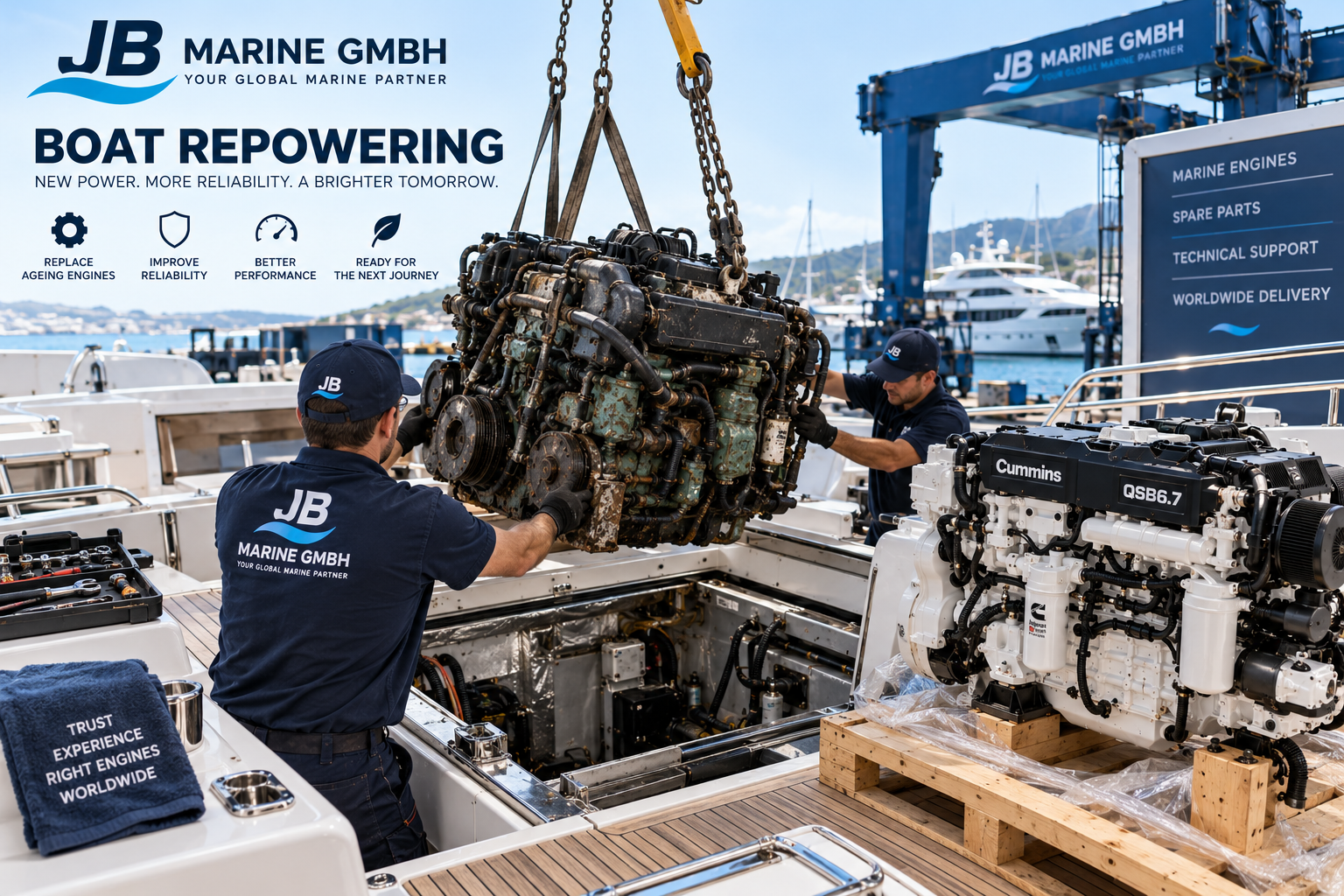
Your marine diesel engine has started asking for more attention than it used to.
First, it was a cooling-system repair.
A few months later, another component needed replacing.
Now there’s more smoke than you remember, the engine doesn’t feel quite as strong under load, and you’re beginning to wonder whether you can trust it for another season.
Then another repair estimate arrives.
And suddenly you’re asking a much bigger question:
Should I repair this engine again, rebuild it—or replace it completely?
It’s a decision almost every owner of an aging vessel eventually has to consider.
Unfortunately, there’s no magic number of years or operating hours that tells you exactly when to replace a marine engine.
A well-maintained older engine may still have useful service ahead of it. Meanwhile, a younger engine with fewer hours can develop expensive problems because of poor maintenance, corrosion, overheating, unsuitable operating conditions or long periods of inactivity.
That’s why boat repowering should be treated as an engineering and financial decision rather than simply an age decision.
At JB Marine GmbH, replacement-engine inquiries often begin with horsepower or an existing engine model. But identifying an appropriate repower option requires more information than that. The existing gearbox, engine-room dimensions, duty cycle, electrical system, cooling and exhaust arrangements, vessel characteristics and intended use can all influence the decision.
Before you start shopping for a replacement marine engine, therefore, there is one question worth answering:
Does the existing engine genuinely need replacing?
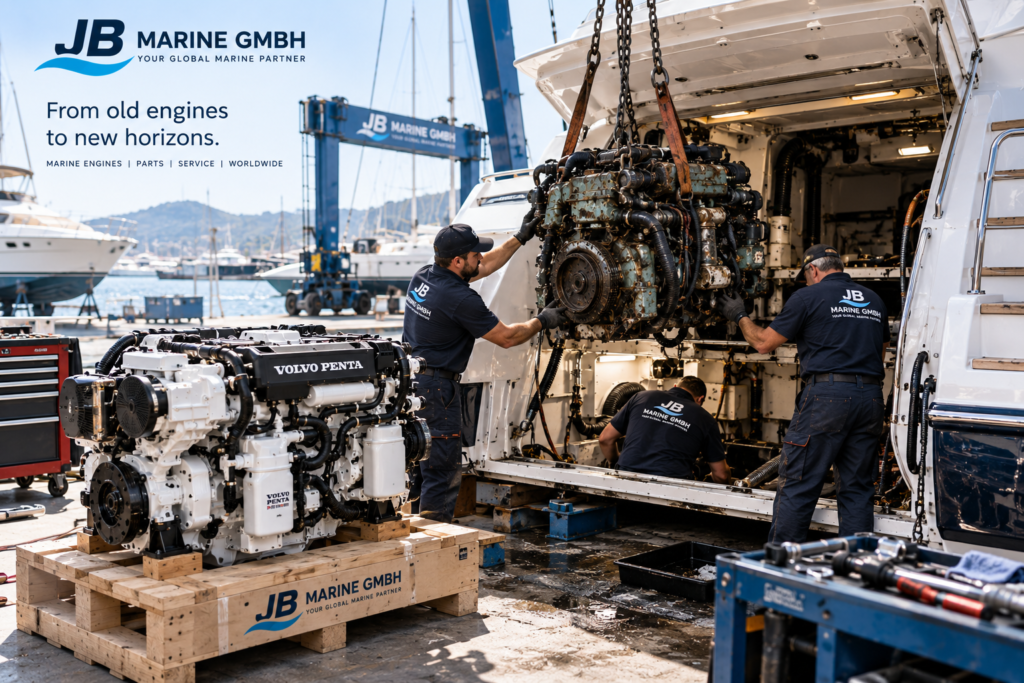
Let’s start there.
Quick Answer: When Should You Repower a Boat?
Boat repowering should be considered when the existing engine’s reliability, repair costs, parts availability, condition or performance no longer make sense for the vessel’s intended use.
Age and engine hours are useful indicators, but neither should determine the decision alone.
Before replacing an engine, evaluate:
- Current mechanical condition
- Maintenance and repair history
- Frequency of breakdowns
- Cost of upcoming repairs
- Parts availability
- Engine reliability
- Vessel usage
- Expected future ownership
- Gearbox and drivetrain condition
- Cost and complexity of installing a replacement
A major repair doesn’t automatically mean you need a new engine.
Likewise, an engine that still starts and runs isn’t automatically economical to keep.
The right time to repower is when the technical and financial case for replacement becomes stronger than continuing to maintain the existing propulsion system.
What Is Boat Repowering?
Boat repowering is the process of replacing or substantially changing a vessel’s existing propulsion engine or propulsion package.
In its simplest form, that could mean removing an old diesel engine and installing another compatible engine.
In a more extensive project, repowering can involve replacing or modifying:
- Marine engine
- Gearbox
- Engine mounts
- Shaft
- Propeller
- Exhaust system
- Cooling system
- Fuel system
- Electrical system
- Controls
- Instrumentation
That’s why the phrase repower boat engine can describe projects ranging from relatively straightforward replacements to major engineering work.
A successful repower isn’t simply about getting another engine into the engine room.
It’s about making the complete propulsion system work correctly together.
Repowering vs Repairing vs Rebuilding a Marine Engine
These terms are sometimes used loosely, but they describe different approaches.
Understanding the difference is important because the right solution may not actually be a complete repower.
Marine Engine Repair
A repair normally addresses a particular fault or component.
For example:
- Replacing a leaking pump
- Repairing a starter
- Replacing a damaged hose
- Correcting an electrical fault
- Replacing a faulty sensor
- Repairing part of the cooling system
If the engine is fundamentally healthy and the problem is isolated, repairing it may be more sensible than replacing the entire engine.
A failed component doesn’t automatically mean a failed engine.
Marine Engine Rebuild or Overhaul
A rebuild or overhaul goes considerably further.
Depending on the engine, its condition and the scope of work, this may involve disassembly, inspection, measurement and replacement or reconditioning of significant internal components.
The exact meaning of “rebuilt” can vary.
That’s important.
If you’re considering a rebuilt engine—or paying to rebuild your current one—ask exactly what the work includes.
For example:
- Was the engine fully disassembled?
- Which components were inspected?
- Which components were measured?
- Which parts were replaced?
- Were cylinder components addressed?
- Was the cylinder head serviced?
- Was the fuel system inspected?
- Was the cooling system serviced?
- Was the engine tested afterward?
- What documentation is provided?
- What warranty applies to the work?
Don’t evaluate a rebuild by the word “rebuilt.” Evaluate it by the work that was actually performed.
Marine Engine Repower
A repower replaces the existing propulsion engine with another engine or propulsion package.
The replacement might be:
- A new marine engine
- A used marine engine
- A manufacturer-remanufactured engine
- A different model from the same manufacturer
- An engine from another manufacturer
Repowering becomes especially relevant when continuing to repair or rebuild the existing engine no longer makes technical or financial sense. Cummins Marine Engines
But it introduces a different challenge:
Compatibility.
The replacement engine has to work with the boat.
Engine-Only Replacement vs Complete Repower
Not every marine engine repower requires replacing the entire drivetrain.
Sometimes the existing gearbox, shaft and other components can remain.
In other situations, changing the engine triggers additional modifications throughout the propulsion system.
Engine-Only Replacement
An engine-only replacement may be possible when the replacement engine is appropriately compatible with the existing:
- Gearbox
- Mounting arrangement
- Shaft
- Propeller
- Cooling system
- Exhaust system
- Electrical system
- Controls
This can potentially reduce the complexity and cost of the project.
However, compatibility should be verified rather than assumed.
Even two engines with similar horsepower can have different:
- Rated RPM
- Torque characteristics
- Physical dimensions
- Mounting points
- Electrical requirements
- Exhaust arrangements
- Gearbox interfaces
So when someone describes an engine as a “direct replacement,” the specifications still need checking.
Complete Propulsion Repower
A more extensive repower may involve replacing the engine and several associated systems.
For example, an older mechanically controlled engine may be replaced by a modern electronically controlled diesel.
That could potentially require:
- New gearbox
- New control system
- Electronic display
- New wiring
- Modified engine mounts
- Exhaust modifications
- Cooling modifications
- Propeller evaluation
The engine may physically fit inside the boat while still requiring substantial installation work.
This is one reason marine engine replacement cost cannot be estimated accurately from the engine price alone.
Buying the engine and completing the repower are two different costs.
How Long Does a Marine Diesel Engine Last?
This is one of the first questions owners ask when considering boat engine replacement:
“How many hours should my marine diesel engine last?”
It would be convenient if there were one number.
There isn’t.
Marine diesel engine service life depends on many variables, including:
- Engine design
- Duty rating
- Operating load
- Maintenance
- Fuel quality
- Cooling-system condition
- Lubrication
- Installation
- Operating environment
- Storage conditions
- Frequency of use
Two identical engines can therefore reach the same number of operating hours in very different mechanical condition.
This is why generalized claims such as “a marine diesel lasts exactly X hours” should be treated carefully.
Engine Hours vs Engine Condition
Marine engine hours are useful.
They just aren’t enough by themselves.
Imagine two identical engines.
Engine A
It has accumulated substantial hours but has been regularly serviced, operated within its intended duty cycle and maintained with documented attention to the cooling, fuel and lubrication systems.
Engine B
It has far fewer hours but has spent long periods inactive, has incomplete maintenance history and has experienced repeated overheating problems.
Which one would you rather own?
You can’t answer responsibly from the hour meters alone.
That’s the point.
Engine hours tell you how long an engine has operated. They don’t tell you everything that happened during those hours.
High Hours Don’t Automatically Mean It’s Time to Repower
An engine with substantial operating hours may still be performing well.
If it:
- Starts correctly
- Maintains appropriate operating temperature
- Produces expected power
- Has acceptable oil consumption
- Has good maintenance history
- Has readily available parts
- Remains reliable
then age or hours alone may not justify replacement.
For a commercial operator, regular inspection and maintenance records can be particularly valuable when making this assessment.
Repowering an otherwise serviceable engine simply because the hour meter has reached an arbitrary number may mean replacing equipment before there is a strong technical or economic reason to do so.
Low Hours Don’t Automatically Mean the Engine Is Healthy
The opposite assumption can also cause problems.
A 20-year-old engine with low hours may sound attractive.
But why are the hours low?
Perhaps the boat was used only occasionally.
That’s possible.
But the engine may also have spent years sitting in a humid marine environment.
Long periods of inactivity can contribute to problems involving:
- Corrosion
- Seals
- Fuel contamination
- Cooling components
- Electrical connections
This doesn’t mean low-hour engines are bad.
It means low hours need context just as much as high hours do.
8 Signs It May Be Time to Repower Your Boat
There is no single symptom that automatically means you need a new engine.
However, several warning signs together can make the case for repowering a boat much stronger.
1. Repairs Are Becoming More Frequent
Every marine engine needs maintenance.
That’s normal.
What’s more concerning is when repairs become increasingly frequent and unpredictable.
You fix one problem.
Then another appears.
Then another.
Eventually, the issue isn’t simply how much each repair costs.
It’s how much confidence you still have in the engine.
For a recreational owner, unreliable propulsion can ruin planned time on the water.
For a commercial operator, repeated downtime can directly affect revenue.
When reliability becomes a recurring problem, it may be time to compare continued repairs against a repower.
2. Major Repair Costs Are Approaching Replacement Economics
Suppose an older engine now needs significant internal work.
The repair is possible.
But should you do it?
That depends on what you’re getting for the money.
Consider:
Cost of the repair
versus
Condition of the rest of the engine
versus
Expected remaining service
versus
Cost of a suitable replacement
A €5,000 repair on an otherwise healthy, well-supported engine may make sense.
The same repair on an obsolete engine with additional major problems could be difficult to justify.
The question isn’t:
“Can this engine be repaired?”
Many engines can.
The better question is:
“Does repairing this engine still make economic sense?”
3. Replacement Parts Are Becoming Difficult to Find
Parts availability can eventually become a bigger problem than engine condition.
An older engine might still run beautifully.
But if a critical component fails and replacement parts are extremely difficult or impossible to source, the vessel can remain out of service for an extended period.
Investigate availability of:
- Filters
- Pumps
- Cooling components
- Fuel-system parts
- Gaskets
- Sensors
- Electrical components
- Major internal components
For older or discontinued engines, parts support deserves serious consideration when deciding whether to rebuild or repower.
4. Reliability Is Affecting How You Use the Boat
This is easy to underestimate.
Ask yourself:
Do I still trust the engine?
If you avoid longer journeys because you’re worried about a breakdown, reliability has already changed how you use the vessel.
For commercial vessels, the calculation can be even more direct.
If the engine regularly causes cancelled work, lost charters or operational delays, downtime needs to become part of the boat repower cost calculation.
An unreliable engine can be expensive even when the repair invoices look manageable.
5. Excessive Smoke or Oil Consumption Has Developed
Changes in smoke or oil consumption can indicate that an engine needs investigation.
But they don’t automatically mean it needs replacing.
Smoke can have many possible causes depending on its color, operating conditions and engine design.
Likewise, increased oil consumption can have several causes.
The correct response is diagnosis.
Not assumption.
A qualified technician may need to evaluate the engine before deciding whether the problem calls for repair, overhaul or replacement.
Symptoms should trigger investigation—not an automatic engine purchase.
6. Persistent Overheating or Cooling-System Problems
A marine diesel engine depends heavily on an effective cooling system.
Recurring overheating deserves serious attention.
Potential causes can exist in different parts of the cooling arrangement, so the problem should be properly diagnosed rather than immediately blamed on the entire engine.
But repeated overheating can also contribute to more serious engine damage.
If an older engine has a history of significant overheating combined with other mechanical problems, a repower may deserve consideration.
7. Performance Has Declined Significantly
Perhaps the boat no longer reaches its previous cruising performance.
Maybe the engine struggles under load.
Fuel consumption appears to have increased.
Acceleration feels different.
Before deciding the engine is worn out, investigate the complete system.
Performance problems can also involve:
- Propeller condition
- Hull fouling
- Fuel supply
- Air intake
- Turbocharger
- Gearbox
- Excess vessel weight
- Other installation factors
A proper diagnosis prevents an expensive mistake:
Replacing an engine that wasn’t actually the primary problem.
8. The Existing Engine No Longer Meets the Vessel’s Needs
Sometimes the engine hasn’t failed at all.
The vessel’s requirements have changed.
Perhaps a recreational vessel is moving into a different operating role.
Maybe the boat has gained significant weight through modifications.
Perhaps the owner wants to change the propulsion configuration.
In these situations, repowering may be driven by operational requirements rather than mechanical failure.
But increasing horsepower isn’t automatically the solution.
The vessel, drivetrain, gearbox, shaft and propeller must all be considered before changing power.
The First Repowering Decision: Diagnose Before You Buy
When an aging engine becomes frustrating, buying a replacement can feel like the fastest way forward.
But the first step in a good repower isn’t shopping.
It’s diagnosis.
Understand:
What is wrong with the current engine?
What would it cost to repair?
What would a rebuild realistically provide?
Are parts still available?
How reliable is the engine likely to be afterward?
How long do you plan to keep the vessel?
What will a complete repower actually cost?
Only then should you compare replacement options.
This is particularly important when contacting a supplier such as JB Marine GmbH. Providing the existing engine model, serial number, horsepower, rated RPM, gearbox information, vessel application and photographs of the current installation can make the discussion much more productive than simply asking:
“What 400 HP engine do you have?”
Horsepower matters.
But a successful repower requires much more than matching one number.
Repair, Rebuild or Repower Your Marine Engine?
Once you’ve established that your existing marine engine has a problem, the next decision isn’t automatically to replace it.
You generally have three paths to consider:
Repair it.
Rebuild it.
Repower the boat.
Each option can make sense under the right circumstances.
The mistake is choosing one before understanding the condition of the engine, the cost of the work and what you expect from the vessel afterward.
A €3,000 repair can be a sensible investment if it restores a fundamentally healthy engine to reliable service.
The same €3,000 can become the beginning of an expensive cycle if the engine has several other major problems waiting behind it.
That’s why this decision needs to look beyond the next invoice.
Repair vs Rebuild vs Repower: What’s the Difference?
Here’s a practical way to think about the three options.
| Factor | Repair | Rebuild | Repower |
|---|---|---|---|
| Main purpose | Correct a specific fault | Restore major engine systems/components | Replace existing propulsion engine |
| Initial cost | Often lower | Can be substantial | Usually larger project investment |
| Engine retained | Yes | Yes | No |
| Existing installation changes | Usually limited | Usually limited | Can range from minor to extensive |
| Parts availability | Important | Critical | Important for replacement engine |
| Engine history remains relevant | Yes | Yes | Replacement starts with its own history |
| Downtime | Depends on repair | Can be significant | Depends on installation complexity |
| Gearbox changes | Usually unnecessary | Usually unnecessary | May be required |
| Warranty | Depends on work/parts | Depends on rebuilder | Depends on replacement engine/supplier |
| Best evaluated by | Fault + overall condition | Core engine condition + rebuild economics | Total project cost + compatibility |
The table doesn’t tell you which option is “best.”
It tells you what needs to be investigated.
When Does Repairing the Existing Marine Engine Make Sense?
Repair is often worth considering when the fault is identifiable and the rest of the engine remains in good condition.
For example, an engine doesn’t necessarily need replacing because of:
- A failed starter
- A leaking pump
- A faulty sensor
- A damaged hose
- A localized electrical problem
- A serviceable cooling-system fault
If the engine has otherwise been reliable, parts remain readily available and the repair restores normal operation, replacing the entire engine could be unnecessary.
Look Beyond the Failed Component
Before approving a significant repair, ask:
What condition is the rest of the engine in?
If you’re spending money on one major component today, are several other expensive components likely to require attention soon?
This is where maintenance history and professional inspection become valuable.
A repair makes a stronger financial case when the engine surrounding the failed component is still fundamentally sound.
When Does Rebuilding a Marine Engine Make Sense?
A marine engine rebuild can occupy the middle ground between continued repairs and complete replacement.
Instead of replacing the engine, major components are inspected and restored or replaced as necessary.
For some older engines, this can make excellent sense.
Particularly when:
- The basic engine is suitable for the vessel.
- The engine block and major structure remain serviceable.
- Parts are available.
- The existing installation works well.
- Replacement would require substantial vessel modifications.
- A competent rebuild can provide a reasonable service outlook.
But a rebuild shouldn’t be chosen just because it appears cheaper than a new engine.
You need to understand what you’re actually buying.
What Should a Marine Engine Rebuild Include?
There isn’t one universal rebuild specification covering every engine and workshop.
That’s why the word rebuilt needs explanation.
Depending on engine condition and scope, work may involve inspection or attention to areas such as:
- Cylinder head
- Pistons
- Cylinder liners or bores
- Piston rings
- Bearings
- Crankshaft
- Connecting rods
- Valvetrain
- Oil system
- Fuel system
- Cooling components
- Gaskets and seals
But don’t assume every item was replaced simply because an engine is advertised as rebuilt.
Ask for documentation.
You want to know:
What was inspected?
What was measured?
What was reused?
What was replaced?
Which specifications were followed?
Who performed the work?
Was the engine tested afterward?
What warranty applies?
A detailed rebuild record is more meaningful than a fresh coat of paint.
When Does a Complete Boat Repower Make Sense?
A full boat repowering project deserves consideration when the disadvantages of keeping the existing engine begin to outweigh the cost and complexity of replacement.
Several factors can push the decision in that direction.
Reliability Has Become Unacceptable
If you’re repeatedly repairing the engine and still don’t trust it, reliability itself has value.
For a recreational owner, reliability affects confidence and time on the water.
For a commercial operator, reliability can directly affect revenue.
The financial impact of downtime should therefore be considered alongside repair costs.
Major Repairs Are Required on an Aging Engine
Suppose an older engine requires significant internal work.
You could rebuild it.
But if other expensive systems are also approaching the end of their practical service life, the rebuild may not solve the complete ownership problem.
This is where you need to look at the engine as a whole.
Not just the failed component.
Parts Support Is Becoming Difficult
An engine can be mechanically repairable while becoming commercially impractical to maintain.
If critical components are difficult to source, every future breakdown can create extended downtime.
For vessels that need dependable availability, this can become a strong reason to investigate a replacement marine engine.
Your Operating Requirements Have Changed
Perhaps the boat is now being used more intensively.
Maybe it has moved from recreational use into charter or commercial service.
Perhaps modifications have changed the vessel’s displacement.
Or you want a propulsion system better suited to your future operating profile.
Repowering can therefore be proactive rather than reactive.
The old engine doesn’t necessarily need to be dead.
It may simply no longer be the right engine for the job.
The JB Marine REPOWER Framework
At JB Marine GmbH, a useful repower discussion needs to go beyond one question:
“How old is the engine?”
Age matters.
But it isn’t enough.
For this guide, we can organize the decision around seven factors.
Together, they form the JB Marine REPOWER Framework.
R — Reliability
Ask the most practical question first:
Can you trust the engine?
Think about:
- Breakdown frequency
- Starting reliability
- Overheating history
- Oil or coolant problems
- Unplanned repairs
- Lost operating time
A technically repairable engine can still become economically unattractive if reliability has deteriorated badly.
Reliability is especially important when the vessel operates commercially or travels where technical support isn’t immediately available.
E — Economics
Next, examine the numbers.
Don’t compare:
Repair invoice vs engine purchase price.
Compare:
Cost of keeping the current engine reliably operational
against
Total cost of installing and operating the replacement.
Suppose your current engine needs a €6,000 repair.
A replacement engine costs €20,000.
At first glance, repairing seems obvious.
But what if the old engine is also likely to need expensive fuel-system and cooling-system work?
What if parts are becoming scarce?
What if repeated downtime is costing the business money?
Now the calculation changes.
Likewise, don’t automatically assume replacement is better.
If €6,000 restores an otherwise healthy and well-supported engine to dependable service, spending substantially more on a repower may not make financial sense.
Economics requires looking forward, not simply comparing today’s invoices.
P — Parts & Support
Ask:
Can this engine still be supported properly?
Investigate the availability of:
- Routine service parts
- Cooling-system components
- Fuel-system components
- Sensors
- Electrical components
- Major internal parts
- Technical information
- Qualified service
An older engine with excellent parts availability may remain practical for years.
Another engine of similar age can become difficult to operate because one critical component is no longer readily obtainable.
This is why engine age alone is a weak repower trigger.
Supportability matters more than the calendar.
O — Operating Requirements
What does the vessel need to do now?
And what will it need to do over the next several years?
Consider:
- Recreational or commercial use
- Expected annual hours
- Typical cruising load
- Vessel displacement
- Operating environment
- Required reliability
- Planned changes to vessel use
The engine that suited the boat 15 years ago may not be the engine that best suits its current operation.
But don’t use changing requirements as an excuse to simply install more horsepower.
Power changes need to be evaluated across the complete propulsion system.
W — Wear & Condition
This is where professional diagnosis becomes essential.
Instead of guessing based on age, evaluate the engine’s actual condition.
Depending on circumstances, useful information may come from:
- Maintenance history
- Visual inspection
- Oil analysis
- Compression or cylinder assessment where appropriate
- Electronic diagnostics
- Cooling-system inspection
- Fuel-system evaluation
- Operational testing
The more expensive the decision, the stronger the case for obtaining reliable technical evidence.
E — Engine-Room Compatibility
Now look at the proposed replacement.
Will it actually fit?
This question involves much more than length and width.
Consider:
- Engine dimensions
- Height
- Service access
- Weight
- Engine mounts
- Gearbox
- Shaft alignment
- Exhaust
- Cooling connections
- Fuel connections
- Electrical system
- Controls
A replacement engine can be excellent on paper and still be wrong for a particular engine room.
This is one reason buyers should provide photographs and dimensions when discussing a repower with JB Marine GmbH.
The more we know about the existing installation, the easier it becomes to identify compatibility questions before an engine is purchased.
R — Remaining Ownership Horizon
Finally, ask:
How long do you intend to keep the vessel?
This can significantly change the economics.
If you plan to operate the boat for many more years, investing in a well-planned repower may make more sense.
If the vessel will be sold soon, the economics may look different.
Commercial owners should also consider the expected working life of the vessel and whether a new propulsion investment supports the business case.
The Core REPOWER Principle
Put the seven factors together:
R — Reliability
E — Economics
P — Parts & Support
O — Operating Requirements
W — Wear & Condition
E — Engine-Room Compatibility
R — Remaining Ownership Horizon
And one principle emerges:
Don’t repower simply because an engine is old. Repower when reliability, economics, supportability, condition and future vessel requirements make replacement the stronger technical case.
That distinction matters.
A 20-year-old engine with strong parts support, excellent maintenance and dependable operation may still be worth keeping.
A much younger engine with severe damage and poor support may not be.
Age is information. It isn’t the verdict.
New vs Used Marine Engine for a Repower
Once you’ve decided to repower, another question appears:
Should the replacement engine be new or used?
A new marine engine may provide:
- Known starting condition
- Current documentation
- Applicable warranty coverage
- A clean maintenance history from installation onward
A properly evaluated used marine engine may provide:
- Lower initial purchase cost
- Access to older or discontinued models
- Potentially closer compatibility with an existing installation
- Strong value when history and condition can be verified
Neither option automatically wins.
The decision should consider:
- Condition
- Engine hours
- Maintenance history
- Warranty
- Parts support
- Included equipment
- Installation requirements
- Expected vessel usage
- Total project cost
This is exactly why the new-versus-used decision should be made after understanding the repower requirements—not before.
Choosing the Replacement Engine: Don’t Start With Horsepower Alone
One of the most common mistakes in a marine engine repower is assuming horsepower is the main compatibility requirement.
Imagine your current engine produces 350 HP.
You find another 350 HP engine.
Does that make it suitable?
Not necessarily.
Two engines with identical advertised horsepower can have different:
- Rated RPM
- Torque characteristics
- Dimensions
- Weight
- Duty ratings
- Gearbox requirements
- Electronic systems
- Cooling requirements
- Exhaust requirements
The replacement engine needs to match the vessel and propulsion system, not simply the number printed on the specification sheet.
Vessel Type Matters
A replacement engine needs to suit the vessel.
Important characteristics can include:
- Hull type
- Vessel length
- Displacement
- Existing propulsion arrangement
- Desired cruising performance
- Operating environment
- Recreational or commercial use
A planing recreational boat and a heavy displacement workboat can require very different propulsion considerations even if their horsepower requirements appear similar.
Duty Cycle Matters
A marine engine’s power rating needs to be considered alongside how the vessel will operate.
An engine intended for relatively light recreational operation may not be appropriate for a vessel expected to operate for long periods under demanding commercial loads.
When requesting a marine diesel engine replacement, therefore, tell the supplier how the vessel will actually be used.
Don’t provide only the desired horsepower.
Rated RPM Matters
Horsepower doesn’t operate independently of engine speed.
Suppose the existing engine develops its rated output at one RPM while the proposed replacement reaches similar horsepower at a substantially different RPM.
That difference can affect:
- Gearbox selection
- Gear ratio
- Shaft speed
- Propeller requirements
This is another reason an apparently similar engine may not be a direct replacement.
The Marine Gearbox Is Part of the Repower Decision
The gearbox is sometimes treated as an accessory.
It shouldn’t be.
Your marine gearbox connects the engine’s output to the propeller system.
When evaluating a replacement engine, consider:
- Gearbox make
- Model
- Gear ratio
- Input power capacity
- Input RPM
- Rotation
- Interface with the engine
- Current gearbox condition
In some repowers, retaining the existing gearbox may be possible.
In others, replacing it may be technically necessary or financially sensible.
Never assume.
Verify.
The Propeller Cannot Be Ignored
Changing engine power, rated RPM or gearbox ratio can change what the propeller needs to do.
That means a repower may require the existing propeller to be evaluated.
A poorly matched propeller can prevent the new engine from operating as intended.
So the propulsion chain should be viewed as:
Engine → Gearbox → Shaft → Propeller → Vessel
Change one major part and you may affect the others.
This is one of the most important concepts in successful repowering a boat.
Before You Buy the Replacement Engine
At this stage, you should know two things.
First:
Whether replacing the existing engine makes sense.
Second:
What characteristics the replacement engine needs.
Only now should the buying process become serious.
Before placing an order, gather as much information as possible about:
- Existing engine
- Gearbox
- Engine-room dimensions
- Vessel
- Electrical system
- Exhaust
- Cooling
- Controls
- Shaft and propeller
- Intended operation
This preparation can prevent an expensive situation where an attractive engine is purchased first and compatibility problems are discovered afterward.
Planning a Marine Engine Repower Correctly
Deciding to repower is only half the job.
The next challenge is making sure the replacement engine actually works with the vessel.
This is where a repower can either become a well-planned upgrade or an expensive chain of unexpected modifications.
A marine diesel engine doesn’t operate independently.
It works as part of a complete system:
Engine → Gearbox → Shaft → Propeller → Vessel
Around that system are the cooling, exhaust, fuel, electrical and control systems.
Change the engine and you may affect several of them.
That’s why the most important rule before purchasing a replacement marine engine is simple:
Measure first. Verify compatibility. Then buy.
Marine Engine Repower Compatibility Checklist
Before ordering an engine, work through the following areas.
1. Engine Dimensions
Start with the obvious question:
Will the replacement engine physically fit?
Check:
- Overall length
- Width
- Height
- Clearance around the engine
- Space above the engine
- Access for installation
- Future service access
The last point is particularly important.
An engine might technically fit into the compartment while leaving insufficient space to replace filters, service belts or access important components.
Don’t design only for installation.
Design for maintenance too.
2. Engine Weight
The replacement engine’s weight also matters.
A substantial change in weight can affect:
- Vessel trim
- Weight distribution
- Mounting requirements
- Handling characteristics
If you’re replacing a heavy older diesel with a lighter modern engine, the weight reduction may sound automatically beneficial.
But vessel balance still needs to be considered.
The same applies when the replacement is heavier.
Don’t evaluate horsepower and dimensions while ignoring mass.
3. Engine Mounts
Engine mounts aren’t simply there to hold the engine in place.
They form part of the alignment between the engine, gearbox and shaft.
Check:
- Mount locations
- Mount spacing
- Engine-bed arrangement
- Height
- Alignment requirements
If the replacement engine has different mounting positions, fabrication work may be necessary.
This is one of those costs that can easily be overlooked when calculating a boat repower cost from the engine price alone.
Can You Keep Your Existing Marine Gearbox?
Sometimes.
But it must be verified.
Keeping the existing marine gearbox can potentially reduce the cost and complexity of a repower, particularly when it remains in good condition and is technically compatible with the replacement engine.
Before retaining it, investigate:
- Gearbox manufacturer
- Exact model
- Gear ratio
- Power rating
- Input RPM capability
- Rotation
- Engine interface
- Current condition
The existing gearbox must be suitable for the replacement engine’s output and operating characteristics.
“It bolts on” does not necessarily mean “it is correctly matched.”
Why Gear Ratio Matters
A marine gearbox doesn’t simply connect the engine to the propeller.
Its reduction ratio determines the relationship between engine speed and shaft speed.
For example, if a new engine operates at a different rated RPM from the old engine, retaining the same gearbox ratio can change propeller shaft speed.
That can affect the suitability of the existing propeller.
This is why changing the engine may lead to questions about the gearbox and propeller even when neither component is physically damaged.
Shaft and Propeller Compatibility
The shaft and propeller are critical parts of the propulsion system.
When repowering a boat, consider whether the existing drivetrain remains appropriate for the replacement engine.
Important factors can include:
- Engine power
- Engine RPM
- Gear ratio
- Shaft dimensions
- Propeller diameter
- Propeller pitch
- Vessel characteristics
A propeller that worked correctly with the previous engine and gearbox combination may not automatically be ideal for the new setup.
After a repower, the engine should be able to operate within the appropriate manufacturer specifications under load.
Propeller selection and drivetrain calculations should therefore be handled by appropriately qualified marine professionals where required.
Exhaust System Requirements
The replacement engine may have different exhaust requirements.
Check:
- Exhaust outlet size
- Routing
- Backpressure requirements
- Exhaust hose
- Water injection arrangement where applicable
- Silencer/waterlock arrangement where applicable
- Existing component condition
An exhaust system should not simply be reused because it physically connects.
The system needs to meet the requirements of the replacement engine and installation.
Cooling System Compatibility
Marine engines depend heavily on correct cooling.
Depending on the propulsion system, a repower may require evaluation of:
- Seawater intake
- Seacock
- Strainer
- Seawater hose
- Heat exchanger
- Coolant circuit
- Seawater pump
- Associated plumbing
If the replacement engine has different cooling-flow requirements, the existing system may require modification.
This is an area where cutting corners can become expensive very quickly.
Fuel System Considerations
Older marine diesels and modern electronically controlled engines can have different fuel-system requirements.
Before installing a marine diesel engine replacement, inspect the existing:
- Fuel tanks
- Supply lines
- Return lines
- Filters
- Water separators
- Shutoff arrangements
Fuel cleanliness is particularly important for modern high-pressure injection systems.
An expensive new engine should not inherit a neglected fuel system without proper evaluation.
12V vs 24V Marine Engine Electrical Systems
This is one of the easiest repower details to overlook.
Your vessel may operate a 12V electrical system, while an available replacement engine is configured for 24V.
Or the opposite may be true.
That doesn’t automatically mean the engine can never be used.
But it does mean the electrical configuration must be addressed correctly.
Components potentially affected can include:
- Starter motor
- Alternator
- Relays
- Engine wiring
- Instrumentation
- Control modules
- Batteries
- Charging system
Do not assume that converting a marine engine from 24V to 12V—or from 12V to 24V—is simply a matter of changing the battery.
The exact requirements depend on the engine and its electrical/control architecture.
For electronically controlled engines in particular, verify manufacturer specifications and component compatibility before making changes.
When requesting a repower quotation from JB Marine GmbH, include the vessel’s electrical voltage from the beginning.
That small piece of information can prevent a large compatibility problem later.
Controls and Instrumentation
Older marine engines may use mechanical throttle and shift controls.
Modern engines may use electronic controls and digital displays.
Changing between systems can add:
- New control heads
- Wiring harnesses
- Displays
- Sensors
- Interface components
- Installation labor
If you’re replacing an older mechanical engine with a newer electronically controlled engine, don’t assume the existing dashboard and controls can simply remain unchanged.
Ask what comes with the engine package and what must be purchased separately.
Boat Repower Cost: What Should You Budget For?
One of the most common searches around boat repowering is:
How much does it cost to repower a boat?
There is no responsible universal price.
A small recreational boat with a relatively straightforward engine replacement is very different from a commercial vessel requiring extensive drivetrain and engine-room modifications.
Instead of looking for one number, calculate the project in categories.
A useful starting formula is:
Engine + Gearbox + Accessories + Shipping + Installation + Modifications + Commissioning = Approximate Total Repower Cost
The key word is total.
The Engine Price Is Not the Repower Price
Suppose you find a replacement engine for €20,000.
That does not necessarily mean you have a €20,000 repower project.
You may still need:
- Gearbox
- Engine mounts
- Controls
- Instrumentation
- Wiring
- Exhaust components
- Cooling components
- Fuel-system work
- Shaft work
- Propeller modifications
- Lifting/crane services
- Installation labor
- Freight
- Taxes or customs charges where applicable
- Commissioning
Some projects need only a few of these.
Others need many.
This is why comparing engine purchase prices without comparing installation requirements can be misleading.
Hidden Boat Repowering Costs
Several costs frequently appear only after the project begins.
Engine Mount Fabrication
A replacement engine with different mount locations may require changes to the engine beds or brackets.
Exhaust Modifications
Different exhaust dimensions or requirements may mean replacing hoses, fittings or other components.
Cooling-System Changes
Seawater plumbing may need to be resized or rerouted.
Electrical Conversion
Moving between 12V and 24V configurations—or mechanical and electronic engine systems—can increase parts and labor requirements.
New Controls and Displays
Modern engines may require manufacturer-compatible electronic controls or displays.
Propeller Work
Changes in rated RPM, power or gearbox ratio may require propeller evaluation or modification.
Freight and Handling
A marine engine for sale may look competitively priced until international freight, packaging and inland delivery are added.
For international buyers, total landed cost matters more than warehouse price.
How Long Does a Boat Repower Take?
There isn’t one universal timeline.
Repower duration depends on factors such as:
- Engine availability
- Shipping time
- Removal of the existing engine
- Engine-room access
- Fabrication
- Gearbox availability
- Electrical work
- Exhaust modifications
- Cooling modifications
- Shaft alignment
- Propeller work
- Testing
- Commissioning
A relatively straightforward replacement can be very different from a custom repower requiring significant fabrication.
Before beginning the project, identify which components are available and which modifications need to be completed.
Good planning can reduce the amount of time a vessel remains out of service.
For commercial operators, that downtime should be treated as part of the economic calculation.
Common Boat Repowering Mistakes
Many expensive repower problems begin before the engine is purchased.
Here are some of the most important mistakes to avoid.
Mistake 1: Choosing by Horsepower Alone
A 400 HP engine isn’t automatically a suitable replacement for another 400 HP engine.
Check:
- RPM
- Duty rating
- Dimensions
- Weight
- Gearbox
- Installation requirements
Horsepower is a requirement—not the entire specification.
Mistake 2: Assuming Similar Power Means a Drop-In Replacement
Two engines can have similar power while using completely different mounting, electrical, exhaust and control arrangements.
Treat the phrase drop-in replacement cautiously unless compatibility has actually been verified.
Mistake 3: Ignoring Gearbox Ratio
A gearbox mismatch can affect shaft speed and propeller performance.
Always include gearbox information when evaluating a replacement engine.
Mistake 4: Forgetting the Propeller
The existing propeller was selected around a particular propulsion arrangement.
Change the engine or gearbox and that relationship may change.
Evaluate the complete drivetrain.
Mistake 5: Underestimating Electrical Changes
This is particularly common when moving between:
- 12V and 24V
- Mechanical and electronic engines
- Analog and digital instrumentation
Identify electrical requirements before ordering the engine.
Mistake 6: Ignoring Exhaust and Cooling Requirements
If the replacement engine needs different exhaust capacity or cooling flow, existing systems may need modification.
These systems should be evaluated as part of the repower plan—not after installation begins.
Mistake 7: Comparing Engine Prices Instead of Complete Repower Costs
A cheaper engine may require more modification.
A more expensive engine may integrate more easily.
Until you calculate installation, accessories, shipping and commissioning, you don’t know which option is genuinely less expensive.
Mistake 8: Buying Before Measuring
This might be the simplest lesson in the entire guide.
Measure first. Buy second.
Record:
- Engine-room length
- Width
- Height
- Access opening
- Mount positions
- Service clearances
Then compare those measurements against the proposed engine configuration.
A fantastic engine that doesn’t fit isn’t a fantastic deal.
Information to Collect Before Requesting a Marine Engine Repower Quote
The more accurate information you provide, the more useful the engine discussion can be.
Before contacting JB Marine GmbH or another marine engine supplier, collect as much of the following information as possible:
1. Existing engine manufacturer
2. Exact engine model
3. Engine serial number
4. Current horsepower
5. Rated RPM
6. Approximate operating hours
7. Engine dimensions where available
8. Vessel manufacturer and model
9. Vessel length
10. Vessel displacement/weight where available
11. Hull type
12. Recreational or commercial application
13. Current gearbox manufacturer and model
14. Gear ratio
15. Shaft information where relevant
16. Propeller information where available
17. Vessel electrical voltage — 12V or 24V
18. Mechanical or electronic controls
19. Photographs of the current engine and installation
20. Delivery destination
If you already have a particular replacement model in mind, include that too.
Why Photos Can Be Extremely Helpful
When discussing a repower remotely, photographs can provide useful context that specifications alone may not show.
Useful photographs include:
- Complete engine installation
- Engine identification plate
- Gearbox identification plate
- Front of engine
- Rear of engine
- Both sides
- Engine mounts
- Exhaust arrangement
- Cooling connections
- Dashboard/controls
- Engine-room access
Photos don’t replace proper measurements or professional installation assessment.
But they can help identify questions early.
Frequently Asked Questions About Boat Repowering
What Does Repowering a Boat Mean?
Boat repowering means replacing or substantially changing a vessel’s existing propulsion engine or propulsion package. Depending on the project, it may involve only the engine or also the gearbox, controls, electrical system, cooling, exhaust, shaft or propeller.
When Should I Replace My Boat Engine?
Consider replacement when declining reliability, repeated repair costs, poor parts availability, major engine wear or changing vessel requirements make continued operation of the existing engine increasingly impractical. Age or engine hours alone should not determine the decision.
How Many Hours Does a Marine Diesel Engine Last?
There is no universal hour limit for every marine diesel engine. Service life depends on engine design, duty cycle, maintenance, operating conditions, cooling, fuel quality and other factors. Evaluate engine condition and history alongside operating hours.
Is It Cheaper to Rebuild or Replace a Marine Engine?
It depends on the engine and project. Rebuilding may cost less when the existing engine is fundamentally sound, parts remain available and the current installation is suitable. Repowering may make more sense when major repairs, poor support, recurring failures or future operating requirements reduce the value of rebuilding.
How Much Does It Cost to Repower a Boat?
There is no single boat repower cost. The total depends on engine price, gearbox, accessories, shipping, labor, vessel modifications and commissioning. Calculate the complete installed project rather than comparing engine prices alone.
Can I Install a More Powerful Engine When Repowering?
Potentially, but increasing horsepower should not be done without evaluating the vessel, gearbox, shaft, propeller, engine mounts and other drivetrain components. More horsepower isn’t automatically appropriate or beneficial.
Can I Keep My Existing Gearbox?
Possibly. Compatibility should be checked using the gearbox model, ratio, input capacity, RPM, rotation, engine interface and current condition.
Can a 24V Marine Engine Be Converted for a 12V Boat?
Sometimes a different electrical configuration may be technically possible, but it depends on the specific engine and its electrical architecture. Components such as the starter, alternator, relays, wiring, controls and electronic modules may be affected. Verify the correct configuration for the exact engine rather than assuming a simple battery change is sufficient.
Should I Buy a New or Used Engine for a Repower?
Either can be appropriate. A new engine generally provides a known starting condition and may include applicable warranty coverage. A properly evaluated used engine may reduce initial cost or provide closer compatibility with an older installation. Compare condition, configuration, warranty, installation requirements and total project cost.
Does Changing the Engine Mean I Need a New Propeller?
Not always. However, changes in engine output, rated RPM or gearbox ratio can affect propeller requirements. The existing propeller should therefore be evaluated as part of the repower.
How Long Does a Boat Repower Take?
The timeline depends on engine availability, shipping, engine-room access, required modifications, gearbox and drivetrain work, electrical changes, testing and commissioning. A direct replacement may be considerably faster than a custom installation.
What Information Do I Need for a Marine Engine Repower Quote?
At minimum, provide the current engine model, horsepower, rated RPM, vessel/application, gearbox details, electrical voltage and delivery destination. Serial numbers, photographs, engine-room measurements and propeller information can make the evaluation more useful.
Conclusion: Repower Based on the Vessel, Not Just the Engine
So, when should you replace your marine engine?
Not simply when it becomes old.
Not when it reaches an arbitrary number of operating hours.
And not automatically when the first expensive repair arrives.
A good marine engine repower decision considers the complete picture.
Return to the JB Marine REPOWER Framework:
R — Reliability
Can you still depend on the existing engine?
E — Economics
Does continuing to repair it make financial sense compared with replacement?
P — Parts & Support
Can you still obtain the parts and technical support needed to operate it?
O — Operating Requirements
Does the engine still suit what the vessel needs to do?
W — Wear & Condition
What does actual inspection tell you?
E — Engine-Room Compatibility
Will the proposed replacement integrate properly with the vessel?
R — Remaining Ownership Horizon
How long do you expect to keep and operate the boat?
Those questions are more useful than asking:
“Is my engine too old?”
Because the objective isn’t to install the newest engine you can find.
It’s to build a propulsion system that makes sense for the vessel.
Planning a Boat Repower? Talk to JB Marine GmbH
If you’re considering boat repowering or searching for a replacement marine engine, JB Marine GmbH can help you review available engine options based on your project requirements.
When requesting a quotation, send as much information as possible, including:
- Existing engine make and model
- Engine serial number
- Current horsepower and RPM
- Vessel make/model and application
- Gearbox model and ratio
- 12V or 24V electrical system
- Preferred replacement engine, if known
- Required accessories
- Photographs of the existing installation
- Delivery destination
If you don’t yet know which replacement engine you need, start with the information from the existing installation.
A successful repower begins with understanding the boat—not simply choosing an engine from a catalogue.
JB Marine GmbH can then help identify relevant available options and prepare a quotation based on the information provided.


Write a comment
Your email address will not be published. All fields are required