
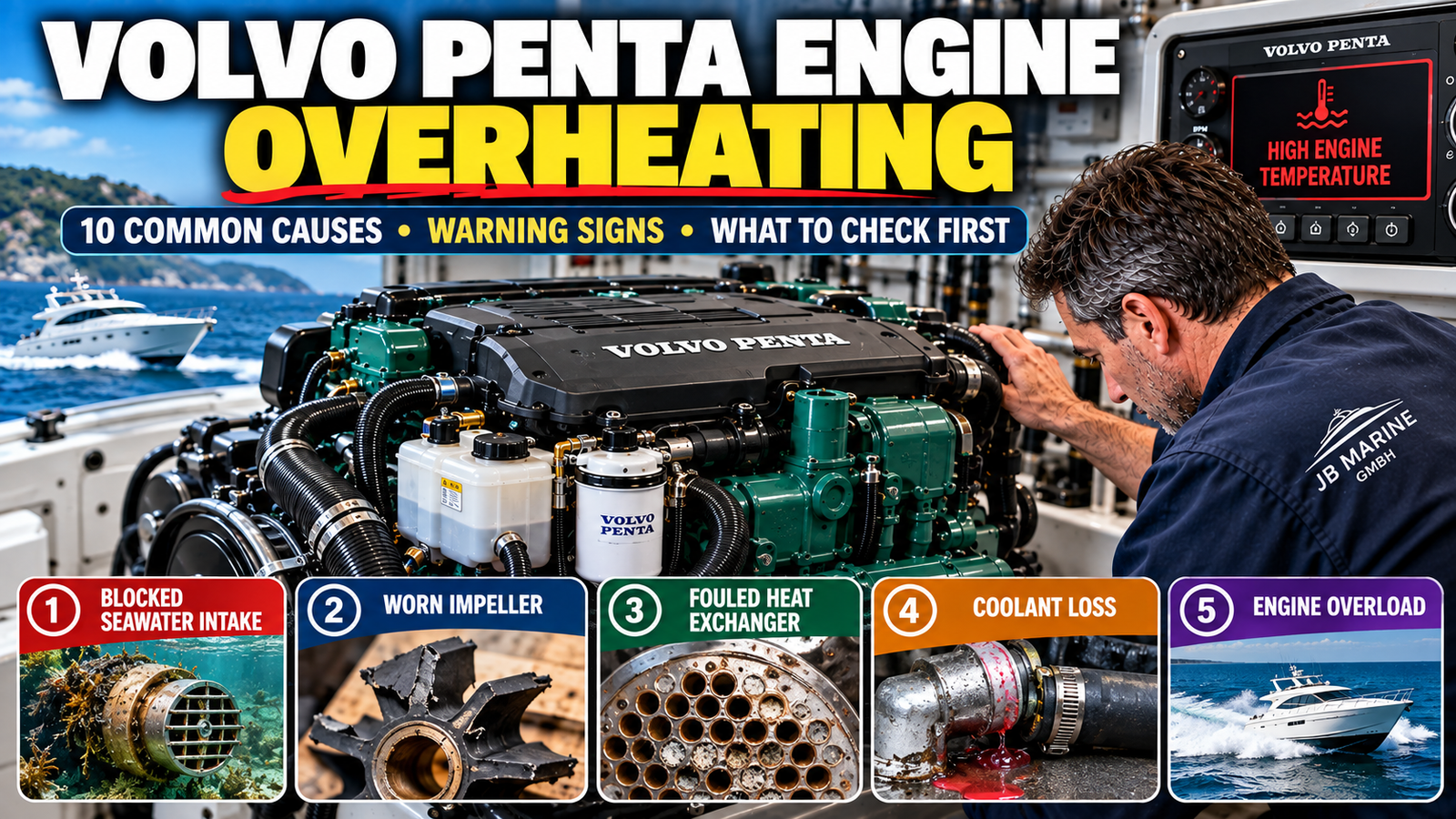
A Volvo Penta engine overheating warning is one of those problems that immediately changes the mood onboard. The engine may have been running normally for an hour, then the temperature starts climbing as you increase RPM. Or the temperature alarm appears shortly after leaving the marina.
A common troubleshooting pattern in marine-engine enquiries goes like this:
The owner sees the temperature rise and immediately assumes:
“The seawater impeller must be bad.”
The impeller gets replaced. The engine is restarted. Everything looks fine at idle.
Then the boat gets underway, the throttle comes up—and the engine overheats again.
That situation illustrates something important about marine-engine diagnostics: finding one worn component does not necessarily mean you have found the entire cause of the problem.
For example, pieces from a damaged impeller may have travelled downstream and contributed to a restriction. The intake or strainer may be restricted. A hose may be collapsing. The heat exchanger may have reduced heat-transfer capacity. The closed coolant circuit may have a circulation problem. Or the engine may be excessively loaded.
That is why JB Marine GmbH approaches overheating as a cooling-system problem that needs to be traced systematically rather than as an automatic instruction to replace the most commonly blamed part.
The principle throughout this guide is simple:
An overheating alarm tells you the engine is too hot. It does not tell you which part failed.
We will work from the symptom toward the root cause using a clear diagnostic sequence:
CONFIRM → WHEN → FLOW → TEST → CAUSE → REPAIR
This article covers the 10 common causes of Volvo Penta overheating, the warning signs that matter, why some engines overheat only under load, what to check after an impeller or coolant change, and how to recognize when an overheating event may justify deeper engine inspection.
Is Your Volvo Penta Really Overheating?
Before replacing anything, answer two questions:
Is the engine genuinely operating at an excessive temperature?
And if it is:
What is preventing the cooling system from controlling that temperature?
This distinction matters because a temperature warning is a symptom, not a component diagnosis.
Depending on the Volvo Penta engine and installation, temperature information may involve the engine’s temperature sensor, wiring, instrumentation, EVC or other electronic monitoring systems.
At the same time, you should never assume an alarm is false simply because the engine still sounds normal.
Until the condition has been properly verified, treat an overheating warning seriously.
Temperature Alarm vs Actual Engine Overheating
A Volvo Penta high temperature alarm can be associated with genuine excessive engine temperature, but the warning itself does not identify the underlying fault.
Look for supporting evidence.
For example:
- Is the indicated temperature continuing to rise?
- Has exhaust-water flow changed?
- Is coolant being lost?
- Are there visible coolant or seawater leaks?
- Is there steam?
- Has engine performance changed?
- Did the problem begin after maintenance?
- Does the alarm occur only at a particular RPM?
- Are other warnings present?
The pattern matters.
An engine that overheats only at high load provides different diagnostic clues from one that rapidly overheats after startup.
Likewise, a temperature alarm that appears immediately after electrical work may deserve a different investigation from an engine that gradually becomes hotter during a sustained high-load run.
Good diagnosis uses all available evidence, not one dashboard indication in isolation.
Why You Shouldn’t Immediately Blame the Temperature Sensor
It is possible for temperature sensors, electrical connections or instrumentation to fail.
But there is a dangerous troubleshooting habit:
“The engine seems fine, so the sensor must be bad.”
That conclusion should be tested, not assumed.
If the sensor is faulty, proper testing should demonstrate it.
If the engine is actually overheating and the alarm is ignored, continued operation—particularly at high load—can increase the risk of expensive damage.
So the correct sequence is:
Warning → Verify → Diagnose
not:
Warning → Assume sensor → Keep running
That is a much safer and more technically defensible approach.
What Temperature Should a Volvo Penta Engine Run At?
There is no responsible single temperature figure that should be applied to every Volvo Penta marine engine.
Volvo Penta has produced numerous marine diesel families, ratings, generations and cooling-system configurations.
The correct normal operating range, thermostat specification and applicable alarm information should therefore be verified using documentation for the exact engine.
This is particularly important when dealing with models such as the:
D1, D2, D3, D4, D6, D8 and D13.
Don’t find a temperature specification for one Volvo Penta model online and assume it applies to another.
Record the engine’s:
- Product designation
- Product number where applicable
- Serial number
Then use the correct operator or workshop information.
If you’re uncertain which document applies, our guide to finding the correct Volvo Penta engine manuals explains how to identify the engine before selecting technical documentation.
This model-specific approach is especially important when specifications determine whether a temperature is actually abnormal.
What Should You Do Immediately If Your Volvo Penta Overheats?
If your engine is overheating while the vessel is underway, the first objective isn’t to diagnose every component.
The first objective is to respond safely and avoid unnecessary engine damage.
Follow the warning, load-reduction and shutdown procedures specified in the operator documentation for your particular engine and vessel.
Vessel safety still comes first. An engine problem occurring while maneuvering in a dangerous location is obviously different from one occurring while safely secured at the dock.
But as a general principle:
Don’t knowingly continue running an overheating engine hard simply to see whether the temperature gets worse.
Reduce Engine Load and Pay Attention to the Warning
An engine operating under greater load generally produces more heat.
If temperature rises abnormally as engine load increases, reducing unnecessary load may provide useful information while you respond according to the appropriate operating procedure.
For example, suppose the engine remains stable at moderate RPM but the temperature consistently rises as you approach higher load.
That pattern is valuable.
It suggests you should investigate why cooling capacity becomes insufficient as heat production increases.
Potential areas might include:
- Restricted seawater supply
- Inadequate pump flow
- Heat-exchanger restriction
- Exhaust-side cooling restriction
- Engine loading
- Propeller or hull condition
It does not prove which one is responsible.
Don’t Keep Running at High RPM to Test an Overheating Engine
If the engine has already demonstrated that it overheats under high load, repeatedly recreating the condition without a controlled diagnostic reason can expose the engine to additional thermal stress.
A better approach is to record:
When the temperature begins rising.
At approximately what RPM/load.
How quickly it rises.
Whether temperature falls when load is reduced.
Whether exhaust-water flow changes.
Whether alarms or other symptoms appear.
Those observations can be far more useful to a technician than:
“We kept running it until the alarm came on several times.”
Never Open a Hot Pressurized Cooling System
This is one of the most important safety points in the entire article.
Do not remove the pressure cap from a hot cooling system unless the applicable manufacturer procedure specifically makes it safe to do so.
Hot pressurized coolant can escape violently and cause severe burns.
Allow the engine to cool and follow the correct procedure before inspecting coolant level or opening pressurized parts of the system.
Similarly, be cautious around:
- Rotating belts
- Pulleys
- Hot exhaust components
- Moving machinery
- Seawater plumbing below the waterline
Troubleshooting an engine should never create a more immediate hazard than the engine fault itself.
What Can You Check Once the Engine Is Safe?
After the engine has been made safe and cooled as necessary, begin with observations before dismantling components.
Look for obvious signs such as:
- Coolant leaks
- Seawater leaks
- Damaged hoses
- Loose connections
- Broken or loose belts
- Debris in the seawater strainer
- Abnormally low coolant level
- Signs of steam
- Coolant smell
- Evidence of a failed pump or impeller
- Changes in exhaust-water discharge
Write down what you find.
A useful diagnostic record might look like:
Engine stable at 1,800 RPM. Temperature begins rising above 2,400 RPM. Exhaust-water discharge appears lower than normal. No visible coolant leak. Seawater strainer contains debris.
That tells you considerably more than:
“Engine overheats.”
Understand the Volvo Penta Cooling System Before Replacing Parts
One of the easiest ways to troubleshoot marine diesel engine overheating badly is to think of the cooling system as a collection of unrelated parts.
Impeller.
Thermostat.
Heat exchanger.
Coolant.
Pump.
Instead, think of it as a flow and heat-transfer system.
For many heat-exchanger-cooled marine installations, you can simplify the system into two interacting circuits:
1. Seawater / raw-water circuit
2. Freshwater / closed-coolant circuit
The exact configuration varies by engine and installation, but understanding these two sides makes troubleshooting much more logical.
The Seawater / Raw-Water Side
A simplified Volvo Penta seawater cooling system may follow a path resembling:
SEA INTAKE → SEACOCK → STRAINER → SEAWATER PUMP → COOLERS / HEAT EXCHANGER → EXHAUST DISCHARGE
Additional coolers and components may be present depending on the engine and propulsion installation.
The key point is that seawater has to:
enter the system,
flow through the system,
absorb heat,
and
leave the system.
A restriction anywhere along that path can reduce available cooling capacity.
This is why seeing some water from the exhaust does not automatically prove the cooling system is healthy.
There may be water flow—but not enough flow under load.
The Freshwater / Closed-Coolant Side
The engine’s closed cooling circuit carries coolant through the engine and transfers heat toward the heat exchanger.
Depending on the specific engine, important components can include:
- Engine coolant passages
- Coolant circulation pump
- Thermostat
- Heat exchanger
- Expansion tank
- Hoses
- Connections
If coolant isn’t circulating correctly, or if heat cannot be transferred effectively into the seawater circuit, engine temperature can rise even when seawater appears to be present.
That’s why an overheating diagnosis should examine both sides of the cooling system.
Heat Transfer Is the Real Job of the Cooling System
The basic process can be visualized as:
COMBUSTION HEAT → ENGINE → COOLANT → HEAT EXCHANGER → SEAWATER → OVERBOARD
This immediately gives you a better diagnostic question.
Instead of asking:
“Which part causes Volvo Penta overheating?”
ask:
“Where is heat transfer being interrupted or becoming insufficient?”
Now the troubleshooting becomes systematic.
Maybe not enough seawater is entering.
Maybe the pump isn’t moving enough water.
Maybe the heat exchanger cannot transfer enough heat.
Maybe coolant isn’t circulating.
Maybe the engine is generating excessive heat because it is overloaded.
Maybe the temperature indication itself is incorrect.
Each possibility can be investigated.
The JB Marine C.O.O.L. Method
To make that process easier to remember, JB Marine GmbH uses a simple four-step framework:
C — Confirm the Condition
Verify that excessive temperature is actually occurring.
Consider the temperature indication together with alarms, cooling-water flow, coolant condition, leaks and other symptoms.
Don’t ignore the warning.
But don’t diagnose a failed component from the warning alone.
O — Observe When It Happens
Ask:
Does it overheat at idle?
At cruising RPM?
Only at high RPM?
Immediately after startup?
After running for 20–30 minutes?
After an impeller replacement?
After coolant service?
Only when the boat is heavily loaded?
The timing of the problem can narrow the diagnostic path dramatically.
For example, Volvo Penta overheating under load may point you toward cooling capacity and engine-loading questions that would be less obvious if the engine overheated immediately from cold.
O — Observe the Cooling Flow
Follow the system rather than jumping between components.
On the seawater side:
INTAKE → STRAINER → PUMP → COOLERS / HEAT EXCHANGER → EXHAUST
On the closed side:
COOLANT LEVEL → CIRCULATION → THERMOSTAT → HEAT TRANSFER → LEAKS
If flow becomes restricted somewhere, find where.
If flow is adequate but heat transfer remains poor, investigate why.
L — Locate the Root Cause
Only after narrowing the problem should parts replacement become the focus.
Inspect.
Measure.
Test.
Compare findings with the correct technical information.
Then repair the confirmed problem.
The principle is:
An overheating alarm tells you the engine is too hot. It does not tell you which part failed.
And the complete sequence is:
CONFIRM → WHEN → FLOW → TEST → CAUSE → REPAIR
10 Common Causes of Volvo Penta Engine Overheating
With the cooling system understood, we can now work through the likely problem areas.
These causes are not ranked as a universal failure order. The symptoms and exact engine configuration determine where troubleshooting should begin.
1. Blocked Seawater Intake
Before blaming expensive engine components, make sure the cooling system can actually obtain enough seawater.
The intake can potentially become restricted by:
- Weed
- Plastic
- Marine growth
- Debris
- Fouling around the through-hull
A complete blockage can cause an obvious problem.
A partial restriction can be harder to recognize.
At low RPM, there may still be enough water to keep temperature under control.
As engine load increases, the engine produces more heat and cooling demand rises.
The restricted intake may no longer supply enough water.
That creates a common pattern:
Runs normally at lower RPM → Temperature climbs under heavier load
What to Check
Depending on the vessel and safe access, inspect the seawater supply path and determine whether the intake is restricted.
Be especially careful when working on seawater plumbing below the waterline. Opening the wrong fitting or hose without isolating the seawater supply can create a flooding risk.
2. Clogged Seawater Strainer
The strainer protects the cooling system from debris.
But once enough debris accumulates, the strainer itself becomes a restriction.
This can produce symptoms similar to a partially blocked intake:
- Reduced seawater flow
- Rising temperature under load
- Normal temperature at lower RPM
- Reduced exhaust-water discharge
Inspect the basket, housing and sealing surfaces as appropriate.
But remember:
A clean strainer doesn’t prove the intake ahead of it—or the cooling circuit after it—is clear.
It is one checkpoint in a complete flow path.
3. Worn or Damaged Volvo Penta Impeller
A damaged Volvo Penta impeller is a well-known cause of inadequate seawater circulation.
Possible findings include:
- Cracked vanes
- Missing vanes
- Permanently bent vanes
- Excessive wear
- Damaged hub
- Incorrect replacement component
- Pump-related damage
If the pump cannot move enough seawater, cooling performance suffers.
But finding a failed impeller creates another important question.
Where Are the Missing Impeller Pieces?
If you remove an impeller and discover pieces are missing, don’t automatically assume installing a new impeller completes the repair.
Fragments can potentially travel downstream and contribute to restrictions elsewhere in the seawater circuit.
That can create a frustrating situation:
Old impeller fails → New impeller installed → Engine still overheats
The new impeller may be perfectly good.
The remaining problem may be downstream.
This is why the old impeller should be examined carefully when removed.
4. Restricted or Collapsing Seawater Hose
Hoses are easy to overlook because a hose can appear acceptable externally while still causing a flow problem.
Possible issues include:
- Internal deterioration
- Delamination
- Kinks
- Soft hose collapsing under suction
- Incorrect routing
- Debris
- Unsuitable replacement hose
When investigating Volvo Penta overheating at high RPM, don’t inspect only the pump and heat exchanger.
Consider the plumbing connecting the entire system.
A restriction doesn’t need to stop flow completely.
It only needs to reduce flow below what the engine requires under the operating condition where overheating occurs.
5. Blocked or Fouled Heat Exchanger
The Volvo Penta heat exchanger is where heat from the engine’s closed coolant circuit is transferred into seawater.
If the heat exchanger becomes restricted or heat transfer deteriorates, the engine may struggle to control temperature.
Possible contributors can include:
- Deposits
- Debris
- Marine growth
- Corrosion products
- Impeller fragments
- Restricted passages
One particularly useful clue is an engine that behaves normally at lower load but begins overheating as load rises.
Why Can a Restricted Heat Exchanger Cause High-RPM Overheating?
At low engine load:
Heat produced < available cooling capacity
At higher load:
Heat produced > restricted cooling capacity
The engine hasn’t necessarily developed a completely new fault at high RPM.
The existing cooling limitation has simply become large enough to reveal itself.
Don’t Replace the Heat Exchanger Just Because It’s on This List
A heat exchanger can be expensive.
Its presence on a list of common overheating causes does not prove yours has failed.
Inspect and test the cooling system systematically.
That brings us back to the principle behind the entire JB Marine approach:
Parts replacement is not the same as diagnosis.
6. Faulty or Sticking Thermostat
The thermostat is an important part of the closed cooling circuit. Its job is to help regulate coolant flow according to engine temperature.
If it doesn’t operate correctly, the engine may have difficulty maintaining the intended operating temperature.
Potential thermostat-related problems include:
- Thermostat stuck closed
- Thermostat not opening fully
- Incorrect thermostat installed
- Incorrect installation
- Corrosion or deposits affecting operation
- Previous maintenance using an unsuitable replacement part
A thermostat that restricts coolant circulation can contribute to Volvo Penta engine overheating, but don’t automatically replace it simply because the engine is running hot.
The thermostat is only one component in a complete cooling system.
How Do You Know Whether the Thermostat Is the Problem?
The correct testing procedure depends on the exact Volvo Penta engine.
Use the workshop information applicable to your model to determine the correct thermostat specification and testing procedure.
Avoid relying on a universal opening temperature found online.
A D2, D4, D6 or another Volvo Penta model should be checked against its own technical documentation.
This is another reason accurate engine identification matters.
7. Low Coolant or a Coolant Leak
A Volvo Penta coolant loss problem deserves investigation.
The closed cooling circuit needs the correct amount of coolant to absorb and transfer engine heat effectively.
If the coolant level falls significantly, cooling performance can be compromised.
Possible sources of coolant loss can include:
- Hoses
- Hose connections
- Clamps
- Expansion tank
- Pressure cap
- Heat exchanger
- Coolant pump
- Seals or gaskets
- Other model-specific cooling components
- Internal leakage
Some leaks are obvious.
You see coolant under the engine or around a hose connection.
Others are much harder to find.
Why Repeatedly Topping Up Coolant Isn’t a Repair
Suppose you check the engine every few days and discover the coolant is low again.
You add more.
Then it happens again.
At that point, the question isn’t:
“How much coolant should I add?”
The question is:
“Where is the coolant going?”
Repeated coolant loss is evidence that something needs investigation.
The loss may be external.
It may occur only when the system is hot and pressurized.
Or, in more serious situations, there may be an internal problem.
Don’t assume the worst—but don’t normalize repeated coolant loss either.
Look at the Pattern
Useful questions include:
Does the coolant level fall only after long runs?
Is there dried coolant residue around connections?
Does the engine compartment smell strongly of coolant?
Is there coolant under the engine?
Is the expansion tank behaving abnormally?
Does the cooling system become unusually pressurized?
Is there evidence of contamination between oil and coolant?
Those observations help determine the next diagnostic step.
8. Coolant Circulation Problem
Having enough coolant does not guarantee that coolant is circulating correctly.
A closed cooling circuit relies on circulation to carry heat away from hot engine components toward the heat exchanger.
Potential circulation problems can involve:
- Coolant pump
- Belt drive where applicable
- Air trapped in the system
- Internal restriction
- Incorrect servicing
- Thermostat-related flow problems
- Other model-specific components
This becomes particularly relevant when overheating begins immediately after cooling-system maintenance.
Did the Problem Start After a Coolant Change?
This is a valuable diagnostic clue.
If an engine operated normally before maintenance but began overheating immediately afterward, investigate what changed.
Depending on the engine and service performed, areas worth checking can include:
- Correct coolant level
- Correct filling procedure
- Trapped air
- Hose connections
- Leaks
- Thermostat installation
- Pump/belt condition
- Components disturbed during servicing
That doesn’t prove the technician caused the problem.
It simply establishes a logical diagnostic timeline.
When a new problem appears immediately after work was performed, start by checking the systems that were changed or disturbed.
9. Exhaust-Side Cooling Restriction
The exhaust system is sometimes overlooked during marine engine overheating diagnosis.
On many marine installations, seawater eventually enters the exhaust stream and helps cool the exhaust before discharge.
Depending on the engine and installation, relevant components can include:
- Exhaust elbow
- Mixing elbow
- Water-injection point
- Exhaust hose
- Associated seawater passages
Deposits, corrosion or restriction in this area can affect how cooling water leaves the system.
The exact configuration varies considerably, so don’t assume that a diagram from another Volvo Penta model represents your installation.
Why Exhaust-Water Flow Matters
Boat owners often become familiar with the normal sound and appearance of water leaving the exhaust.
A significant change can provide a useful clue.
For example:
Normal exhaust-water discharge → suddenly reduced discharge → temperature begins rising
That pattern deserves investigation of the seawater circuit.
But be careful with conclusions.
Seeing water at the exhaust does not prove that cooling-water flow is adequate everywhere in the system.
A partially restricted system can still discharge water.
The important question is whether sufficient flow exists for the engine’s current operating load.
10. Engine Overload, Propeller or Vessel Performance Problem
This is one of the most important—and most overlooked—causes to include in a serious overheating guide.
Sometimes the cooling system isn’t the only issue.
The engine may be working harder than it should.
Possible contributors include:
- Excessive propeller pitch
- Incorrect propeller
- Fouled propeller
- Fouled hull
- Excessive vessel loading
- Driveline resistance
- Installation changes
- Engine unable to achieve its expected rated RPM under appropriate full-load conditions
An overloaded marine diesel can produce high combustion temperatures and increased thermal demand.
If the cooling system is already marginal, the combination can reveal itself as overheating under load.
A Useful Question: Can the Engine Reach Its Expected RPM?
Suppose a Volvo Penta previously achieved its expected operating RPM, but now struggles significantly below that point at full throttle.
Don’t automatically adjust the propeller.
First determine why performance changed.
Possibilities might include:
- Hull fouling
- Propeller damage or fouling
- Increased vessel weight
- Fuel-system problem
- Air/boost problem
- Exhaust restriction
- Engine mechanical problem
- Driveline resistance
The RPM shortfall is evidence.
It isn’t a diagnosis by itself.
For a deeper explanation of engine loading and propulsion matching, see Marine Engine Horsepower: How Much HP Does Your Boat Really Need?
Quick Volvo Penta Overheating Troubleshooting Table
The following table is best used as a starting point, not as a replacement for diagnosis.
What You Observe Areas Worth Investigating Overheats rapidly after startup Coolant circulation, thermostat, severe flow restriction, temperature indication Overheats mainly at high RPM Seawater restriction, pump flow, heat exchanger, exhaust cooling, excessive engine load Overheats at idle Seawater flow, pump/impeller, thermostat, coolant circulation, indication Little or no exhaust water Intake, seacock, strainer, pump, impeller, hoses, downstream restriction Coolant level keeps dropping External leak, pressure-related leak, cooling component or possible internal leak Overheats after impeller replacement Installation, water supply, missing impeller pieces, downstream restriction Overheats after coolant service Coolant level, trapped air, leak, circulation, thermostat/service issue Alarm appears but other signs seem normal Verify actual temperature, sensor, wiring, display/EVC Temperature rises as vessel speed/load increases Cooling capacity, seawater restriction, heat exchanger, propeller/hull loading Temperature remains high after reducing load Persistent cooling/circulation fault requiring further diagnosis The key phrase is:
Areas worth investigating.
A symptom should tell you where to look next, not which part to order next.
Why Does My Volvo Penta Overheat Only at High RPM?
This is one of the most useful overheating patterns to understand.
An engine may run perfectly at idle.
It may cruise normally at moderate RPM.
Then, as the throttle increases, temperature begins climbing.
Why?
Because engine load and cooling demand are related.
As the engine produces more power, it also produces more heat that the cooling system must remove.
Imagine that the cooling system should be capable of supplying 100% of the cooling capacity required under the intended operating conditions.
Now imagine a partial restriction has reduced effective capacity.
At low load, the engine may need only part of the available cooling capacity.
Everything looks normal.
At higher load, the engine’s heat output increases until cooling demand exceeds what the restricted system can handle.
Then the temperature rises.
This is why Volvo Penta overheating at high RPM often deserves careful inspection of the entire seawater and heat-transfer path.
Areas to Check for High-RPM Overheating
Potential areas include:
- Partially restricted seawater intake
- Dirty strainer
- Worn impeller
- Seawater pump problem
- Collapsing suction hose
- Restricted cooler
- Fouled heat exchanger
- Exhaust-water restriction
- Excessive engine loading
- Propeller problems
- Hull fouling
Notice how several of these faults can produce almost the same symptom.
That’s precisely why diagnosis matters.
Why Does My Volvo Penta Overheat at Idle?
An engine that becomes too hot at idle presents a different pattern.
Potential areas to investigate can include:
- Inadequate seawater circulation
- Worn/damaged impeller
- Seawater pump problem
- Thermostat problem
- Low coolant
- Poor coolant circulation
- Air trapped in the closed circuit
- Temperature-sensor or indication problem
Again, the pattern alone does not prove which fault exists.
Ask additional questions.
Does temperature improve when RPM increases slightly?
Is seawater discharge unusually low at idle?
Did the problem appear after maintenance?
Is coolant disappearing?
Does the alarm appear immediately from cold?
Each answer helps narrow the investigation.
Volvo Penta Overheating After Changing the Impeller
This situation deserves its own section because it causes so much frustration.
The engine overheats.
The owner replaces the impeller.
The engine still overheats.
The conclusion becomes:
“The new impeller must be defective.”
Maybe.
But several other possibilities need to be considered.
Was the Old Impeller Complete?
Compare the removed impeller with what an intact impeller should look like.
If vanes or pieces are missing, investigate where they may have travelled.
Downstream fragments can potentially restrict cooling passages.
Replacing the impeller restores the pump component.
It does not automatically remove downstream debris.
Was the New Impeller Correctly Installed?
Check that the replacement component is correct for the exact pump and engine application and that installation followed the appropriate procedure.
Also inspect the pump itself where applicable.
An impeller operates as part of a pump assembly.
If another part of the pump is damaged or excessively worn, replacing only the flexible impeller may not restore expected performance.
Is Water Actually Reaching the Pump?
This is easy to overlook.
A perfectly installed new impeller cannot pump adequate seawater if the supply to the pump is restricted.
Possible upstream problems include:
- Closed or partially closed seacock
- Blocked intake
- Clogged strainer
- Restricted hose
- Air entering the suction side
This is why the C.O.O.L. method follows the complete flow path.
Is There a Downstream Restriction?
If seawater reaches the pump and the pump operates correctly, continue downstream.
Depending on the installation, investigate:
- Coolers
- Heat exchanger
- Hoses
- Exhaust-water injection point
- Other seawater passages
The important lesson is:
A new impeller does not prove you have good cooling-water flow.
It proves only that a new impeller has been installed.
Volvo Penta Overheating After Coolant Change or Service
Another useful troubleshooting clue is timing.
If the engine never overheated before cooling-system service but begins overheating immediately afterward, don’t ignore that relationship.
Possible areas to investigate include:
- Coolant level
- Filling procedure
- Trapped air
- Incorrect coolant/service procedure
- Hose connection
- Leak
- Thermostat disturbed during service
- Coolant pump/belt condition
- Other components touched during the work
The correct filling and bleeding procedure should come from the documentation for the exact engine.
Don’t assume every Volvo Penta cooling system is filled and bled in exactly the same way.
Volvo Penta D4 Overheating
A search for Volvo Penta D4 overheating should not end with a generic instruction to change the impeller.
Start with the exact D4 product designation and serial number.
Then evaluate the system logically.
Relevant areas may include:
- Seawater intake
- Strainer
- Seawater pump
- Hoses
- Heat exchanger/coolers
- Closed coolant circuit
- Thermostat
- Exhaust-water discharge
- Temperature indication/EVC
- Engine loading
The exact layout and technical procedures depend on the particular D4.
That model-specific distinction is important because the D4 family has existed in different versions and configurations.
Volvo Penta D6 Overheating
The same principle applies to Volvo Penta D6 overheating.
If a D6 runs hot, the first question shouldn’t simply be:
“Which D6 overheating part should I buy?”
Establish the operating pattern.
Does the engine overheat at idle?
At cruise?
Only under heavy load?
Has coolant been disappearing?
Has exhaust-water flow changed?
Did the problem appear after servicing?
Are EVC warnings present?
Then work through the cooling system systematically.
Because JB Marine GmbH already covers the D6 in greater depth, readers dealing with additional symptoms such as power loss, smoke or EVC warnings can also see Volvo Penta D6 Problems: Common Faults, Symptoms & What to Check Before They Get Expensive.
Could the Volvo Penta Temperature Sensor Be Wrong?
Yes.
A temperature sensor, electrical connection, wiring circuit, gauge, display or related monitoring system can potentially produce incorrect information.
But this possibility should not become an excuse to ignore an overheating warning.
A competent diagnosis may involve comparing the indicated temperature with an appropriate independent measurement or diagnostic information, depending on the engine and system.
If the engine temperature is actually normal but the display indicates overheating, the electrical or monitoring system can then be investigated.
If the engine is genuinely too hot, replacing the sensor won’t fix the cooling problem.
The principle remains:
Verify first. Replace second.
Warning Signs That Can Accompany Volvo Penta Overheating
The temperature gauge or alarm may be the most obvious warning, but other symptoms can provide important diagnostic clues.
Pay attention to combinations of symptoms rather than viewing each one in isolation.
Possible warning signs include:
- Temperature rising above the engine’s normal pattern
- High-temperature alarm
- Reduced exhaust-water discharge
- Steam
- Coolant smell
- Coolant loss
- Visible coolant or seawater leak
- Reduced engine performance
- Abnormal exhaust smoke
- Repeated need to top up coolant
- Unusual engine-room heat or smell
- Temperature rising specifically under load
A change from the engine’s established normal behavior is often valuable information.
For example:
High temperature + reduced exhaust water points the investigation in one direction.
High temperature + repeated coolant loss may point it in another.
High temperature + inability to achieve expected RPM adds engine-loading and performance questions.
This is where experience becomes valuable: not because one symptom magically identifies the failure, but because patterns help narrow the system that needs testing.
Can Overheating Damage a Volvo Penta Engine?
Yes. Severe or repeated overheating can potentially cause significant engine damage.
That does not mean every brief temperature rise destroys the engine.
The outcome depends on factors such as:
- How high the temperature became
- How long the engine remained overheated
- Engine load at the time
- Whether coolant was lost
- Whether lubrication was affected
- The engine’s design and existing condition
Potential consequences of severe thermal stress can include problems involving:
- Cylinder head
- Head gasket/sealing
- Seals and gaskets
- Lubricant condition
- Pistons and cylinders in severe cases
- Cooling-system components
- Other heat-sensitive engine components
The important word is potential.
Don’t tell an owner that an engine needs rebuilding merely because the temperature alarm appeared once.
Likewise, don’t assume there is no damage after a severe overheating event simply because the engine restarts.
The engine’s behavior afterward matters.
Signs the Engine May Have Been Damaged by Overheating
Once the original cooling-system fault has been corrected, watch the engine carefully.
Warning signs that may justify deeper inspection include:
- Persistent coolant loss
- Oil/coolant cross-contamination
- Difficult starting
- New abnormal smoke
- Excessive blow-by
- Reduced power
- Compression concerns
- Abnormal mechanical noise
- Repeated cooling-system pressurization
- Continued overheating despite repairing the original fault
None of these alone automatically proves catastrophic engine damage.
They provide evidence that further testing may be justified.
This connects directly with another important JB Marine topic: how long Volvo Penta engines last and the signs that may indicate major repair or rebuilding is approaching.
The same principle applies there:
Condition and diagnostic evidence matter more than assumptions.
What Tests May Be Needed After a Serious Overheating Event?
Once the original cause of Volvo Penta engine overheating has been identified and corrected, the next question is whether the overheating event caused additional damage.
Not every temperature alarm requires an engine teardown.
Testing should be guided by:
- Severity of the overheating
- How long it lasted
- Whether coolant was lost
- Whether the engine was heavily loaded
- Symptoms after the repair
- Oil and coolant condition
- Current engine performance
The objective is to collect evidence before making an expensive decision.
Cooling-System Pressure Testing
If the engine continues losing coolant after the obvious fault has been repaired, pressure testing may help locate certain leaks.
Depending on the engine and symptoms, this can help investigate:
- Hose or connection leaks
- Heat-exchanger problems
- Cooling-system sealing problems
- Other external or internal leakage
Testing procedures and allowable pressures should come from the technical documentation applicable to the exact engine.
Compression Testing
If the engine becomes difficult to start, loses power or develops other symptoms following a serious overheating event, compression testing may be appropriate.
The important information isn’t simply whether a cylinder produces “a number.”
Results should be interpreted against the correct specifications and test conditions, with attention to differences between cylinders.
Low or significantly uneven compression can justify further investigation.
Leak-Down Testing
Where appropriate, a leak-down test can provide additional information about cylinder sealing.
Rather than simply identifying that pressure is being lost, it may help a competent technician investigate where that leakage is occurring.
Again, this isn’t a test that every engine automatically needs after one temperature warning.
Use symptoms and earlier findings to determine whether deeper testing is justified.
Oil and Coolant Inspection
After significant overheating, the condition of the engine oil and coolant deserves attention.
Look for evidence of abnormal contamination.
Oil analysis can also provide additional information in some cases.
A laboratory sample may help identify:
- Certain wear materials
- Fuel dilution
- Coolant contamination
- Lubricant condition
Trend data from repeated samples can be particularly useful because it allows changes to be compared over time.
Borescope Inspection
A borescope can sometimes provide useful visual information about internal engine areas without immediately dismantling the complete engine.
Whether it is appropriate depends on the suspected fault and engine.
It should complement other diagnostic evidence rather than being treated as a magic test that reveals every problem.
Diagnostic Scan
On electronically controlled Volvo Penta engines, appropriate diagnostic equipment can provide useful fault information.
This may help establish:
- Recorded faults
- Active warnings
- Sensor-related problems
- Other available engine data
A fault code still needs interpretation.
The presence of a code does not always mean the component named in the code is automatically defective.
Operating Test
After repairs, a controlled operating test can be one of the most important checks.
Monitor:
- Engine temperature
- RPM
- Load behavior
- Exhaust smoke
- Cooling-water discharge
- Alarms
- Leaks
- Power delivery
- Vibration
The goal is not simply to prove that the engine can idle at the dock.
You want evidence that the cooling system can control engine temperature under the appropriate operating conditions.
When Should You Stop Troubleshooting and Call a Marine Technician?
There is plenty an experienced boat owner can observe.
But there is also a point where continuing DIY troubleshooting can become unsafe, expensive or misleading.
Professional diagnosis is particularly sensible when you have:
- Repeated severe overheating
- Persistent coolant loss with no obvious source
- Oil and coolant contamination
- Suspected internal engine damage
- Abnormal mechanical knocking or noise
- Confirmed oil-pressure problems
- Severe or persistent smoke
- Compression concerns
- EVC or electronic faults requiring proper diagnostics
- Cooling-system problems that continue after basic checks
- A need for internal engine testing
The same applies when you’re simply unsure whether continued operation is safe.
One good diagnostic session can cost considerably less than replacing several perfectly serviceable components based on guesses.
How to Prevent Volvo Penta Overheating Problems
You cannot guarantee that a marine engine will never develop a cooling-system fault.
But good maintenance can reduce risk and make emerging problems easier to identify.
Follow the Correct Maintenance Schedule
Start with the schedule for your exact Volvo Penta engine.
Maintenance can depend on operating hours, calendar time and specific engine configuration.
Do not assume that a maintenance interval published for another D-series engine automatically applies to yours.
Use your product designation and serial number to identify the correct documentation.
Inspect the Seawater System
The seawater circuit deserves routine attention because restrictions can directly reduce cooling capacity.
Depending on your installation, this can include checking the:
- Intake
- Seacock
- Strainer
- Hoses
- Seawater pump
- Impeller
- Connections
Become familiar with what the system looks like when it is operating normally.
That makes changes easier to recognize.
Maintain the Heat Exchanger and Coolers
Heat exchangers and associated coolers need to transfer heat efficiently.
Follow the inspection and maintenance requirements applicable to your engine.
Don’t wait until the engine repeatedly overheats before thinking about the heat-transfer side of the system.
At the same time, avoid unnecessary dismantling based on arbitrary internet schedules that may not apply to your exact engine.
Monitor Coolant Level and Condition
Learn what normal coolant behavior looks like.
If you repeatedly need to add coolant, investigate why.
A cooling system should not require endless topping-up without an explanation.
Check the correct coolant specification and service procedure for your engine.
Mixing or substituting fluids without confirming compatibility is poor preventive maintenance.
Pay Attention to Exhaust-Water Flow
Owners often become familiar with the normal exhaust-water behavior of their own vessel.
If that pattern changes noticeably, investigate.
A reduction in discharge can provide an early clue that the raw-water cooling system isn’t behaving normally.
But remember:
Visible water does not prove adequate flow.
A partially restricted system may still discharge water while lacking sufficient cooling capacity under heavy load.
Make Sure the Engine Is Correctly Loaded
If the vessel becomes slower, the engine no longer reaches its expected RPM, or temperature starts climbing under load, don’t look only at the cooling system.
Inspect the complete propulsion picture.
Potential factors can include:
- Propeller fouling
- Hull fouling
- Propeller damage
- Increased vessel weight
- Driveline resistance
- Engine-performance problems
The cooling system and propulsion load work together.
Keep Maintenance and Temperature Records
A simple record can become extremely valuable.
Record things such as:
Date
Engine hours
Maintenance performed
Parts replaced
Coolant added
Impeller condition
Any overheating events
RPM/load when the problem occurred
Repairs performed
If the engine later develops another temperature issue, you have a history to compare against.
7 Overheating Troubleshooting Mistakes to Avoid
Some expensive cooling-system repairs begin with a reasonable observation followed by a bad assumption.
Here are seven mistakes worth avoiding.
1. Automatically Replacing the Impeller
The impeller is important.
But Volvo Penta overheating does not automatically equal failed impeller.
Check the complete seawater path.
2. Ignoring Missing Impeller Fragments
If the old impeller has missing pieces, don’t simply throw it away and install another one.
Determine where those pieces may have travelled.
A new impeller won’t remove an existing downstream restriction.
3. Assuming the Temperature Sensor Is Wrong
A faulty sensor is possible.
Prove it.
Don’t continue running an engine under heavy load simply because a false alarm would be the cheaper explanation.
4. Opening a Hot Cooling System
This is not just a troubleshooting mistake.
It is a safety hazard.
Hot pressurized coolant can cause serious burns.
Follow the correct cooling and pressure-release procedure.
5. Continuing to Run at High Load
If the engine consistently overheats at high RPM, repeatedly recreating the problem without a diagnostic reason can increase thermal stress.
Record the behavior and diagnose it.
6. Repeatedly Topping Up Coolant
If coolant keeps disappearing, topping it up is not solving the underlying problem.
Find the leak or determine why coolant is being lost.
7. Replacing Expensive Components Without Confirming the Fault
Heat exchanger.
Pump.
Thermostat.
Sensor.
Cooler.
These components can all be involved in temperature problems.
That doesn’t mean you should replace all of them.
The better principle is:
Parts replacement is not the same as diagnosis.
What Information to Send JB Marine GmbH for an Overheating Volvo Penta
If you need help identifying parts, sourcing a replacement engine or evaluating whether an older engine should be replaced, accurate information makes the process much faster.
Send JB Marine GmbH:
- Exact engine model/product designation
- Serial number
- Clear photograph of the identification plate
- Engine horsepower or kW
- Rated RPM
- Approximate engine hours
- Photos of the engine and installation
- Description of the overheating problem
- RPM/load when overheating occurs
- Temperature indication or alarm information
- Recent maintenance history
- Parts already replaced
- Gearbox or drive model
- Vessel type
- Delivery country or port
Avoid sending only:
“I need a water pump for a Volvo Penta D6.”
There are different products and configurations within engine families.
The identification plate helps establish exactly what equipment you’re working with.
Frequently Asked Questions About Volvo Penta Engine Overheating
Why Is My Volvo Penta Engine Overheating?
A Volvo Penta engine overheating problem can result from insufficient seawater flow, a blocked intake or strainer, damaged impeller, hose restriction, fouled heat exchanger, thermostat problem, coolant loss, poor coolant circulation, exhaust-side restriction, excessive engine load or another model-specific fault.
The correct approach is to verify the overheating condition and trace the cooling system systematically.
What Is the Most Common Cause of a Marine Diesel Engine Overheating?
There is no single cause that should be assumed for every marine diesel.
Restrictions in the seawater cooling circuit are an important area to investigate, but the actual cause should be confirmed before replacing parts.
Start with the operating pattern and work through the cooling path.
Why Does My Volvo Penta Overheat at High RPM?
Volvo Penta overheating at high RPM can occur when the engine’s heat output increases beyond the cooling capacity available.
Potential causes include a partially blocked seawater intake, clogged strainer, weak seawater-pump performance, restricted hose, fouled heat exchanger, exhaust-side restriction or excessive engine loading.
An engine that runs normally at low RPM but overheats under load often deserves particular attention to cooling capacity and propulsion load.
Why Does My Volvo Penta Overheat at Idle?
Possible causes include inadequate seawater circulation, a damaged impeller, pump problem, thermostat fault, low coolant, poor coolant circulation, trapped air or incorrect temperature indication.
The symptom alone doesn’t identify which one is responsible.
Can a Bad Impeller Cause a Volvo Penta to Overheat?
Yes. A damaged or worn seawater-pump impeller can reduce cooling-water flow and contribute to overheating.
If the removed impeller has missing pieces, investigate where the fragments may have travelled before assuming the repair is complete.
Why Is My Volvo Penta Still Overheating After Changing the Impeller?
A new impeller doesn’t guarantee adequate cooling flow.
Possible reasons include:
- Blocked intake
- Clogged strainer
- Restricted hose
- Pump problem
- Missing old impeller fragments downstream
- Fouled heat exchanger
- Exhaust-water restriction
- Coolant-circuit problem
- Excessive engine load
Follow the entire cooling-water path.
Can a Blocked Heat Exchanger Cause Overheating?
Yes.
If seawater passages or heat-transfer surfaces become sufficiently restricted, the heat exchanger may be unable to remove enough heat from the engine coolant.
The problem may become more obvious as engine load increases.
Can a Thermostat Cause a Volvo Penta to Overheat?
Yes.
A thermostat that fails to open correctly or otherwise restricts coolant circulation can contribute to overheating.
However, thermostat specifications and testing procedures vary by engine, so use the technical information for the exact Volvo Penta model.
Why Is My Volvo Penta Losing Coolant?
Potential causes include external leaks from hoses, connections, heat exchangers, pumps or other cooling components.
In some situations, coolant loss can also involve an internal engine problem.
If coolant repeatedly disappears, find the source rather than continually topping up the system.
Why Is There No Water Coming From My Marine Exhaust?
Depending on the installation, little or no cooling water at the exhaust can indicate a problem somewhere in the seawater circuit.
Possible areas include:
Intake → Seacock → Strainer → Pump/Impeller → Hoses → Coolers/Heat Exchanger → Exhaust injection
Treat loss of expected cooling-water discharge seriously.
Can an Over-Pitched Propeller Cause Engine Overheating?
An incorrectly matched propeller can place excessive load on a marine engine.
If the engine cannot achieve its expected rated RPM under appropriate full-load conditions, propeller loading is one of several areas that may need investigation.
Do not assume the propeller is responsible without also checking engine performance, hull condition and driveline factors.
Can a Faulty Temperature Sensor Cause an Overheating Alarm?
Yes.
A faulty sensor, wiring problem, instrumentation fault or electronic issue can potentially produce an incorrect temperature warning.
But the actual engine temperature should be verified before concluding that the alarm is false.
What Temperature Should a Volvo Penta Run At?
There is no single correct temperature specification for every Volvo Penta marine engine.
Use the operator or workshop documentation applicable to the exact model, product designation and serial number.
Avoid using specifications from a different engine simply because it belongs to the same brand.
Can I Keep Running My Volvo Penta If It Overheats?
Continuing to operate an engine that is genuinely overheating—particularly under substantial load—can increase the risk of damage.
Respond according to the warning procedures in the applicable operator manual and vessel-safety requirements.
If the cause is unknown, diagnose it before returning to normal operation.
Can Overheating Damage a Volvo Penta Engine?
Yes. Severe or prolonged overheating can potentially damage a marine diesel engine.
Possible consequences can involve the cylinder head, head sealing, gaskets, lubrication, cooling components and internal engine parts.
The extent of damage depends on the severity and duration of the event and the engine’s condition.
How Do I Know If Overheating Damaged the Head Gasket?
There is no single external symptom that conclusively proves head-gasket failure.
Possible warning signs can include persistent coolant loss, abnormal cooling-system pressure, contamination, smoke or performance changes.
Proper testing is needed to establish the cause before major engine disassembly is recommended.
How Can I Prevent My Volvo Penta From Overheating?
Follow the maintenance requirements for your exact engine, maintain the seawater and closed cooling circuits, inspect the impeller and cooling components as required, investigate coolant loss, maintain heat exchangers/coolers appropriately and address changes in temperature or exhaust-water behavior early.
Also make sure the engine isn’t being subjected to an unresolved propulsion-loading problem.
Conclusion: Don’t Diagnose Overheating by Guessing
When dealing with Volvo Penta engine overheating, it’s tempting to search for one component that causes every temperature problem.
That component doesn’t exist.
Sometimes the problem really is the impeller.
Sometimes it’s debris before the pump.
Sometimes it’s an obstruction after the pump.
Sometimes coolant isn’t circulating properly.
Sometimes the heat exchanger can’t transfer enough heat.
Sometimes the engine is overloaded.
And sometimes the temperature indication itself needs verification.
That’s why JB Marine GmbH recommends the C.O.O.L. Method:
C — Confirm the Condition
Establish whether the engine is genuinely overheating.
O — Observe When It Happens
Idle? Cruise? High RPM? Immediately? After maintenance?
O — Observe the Cooling Flow
Follow both the seawater and closed coolant circuits systematically.
L — Locate the Root Cause
Inspect and test before replacing parts.
Remember:
An overheating alarm tells you the engine is too hot. It does not tell you which part failed.
The diagnostic path should be:
CONFIRM → WHEN → FLOW → TEST → CAUSE → REPAIR
That approach can save time, avoid unnecessary parts replacement and, most importantly, reduce the risk that a manageable cooling problem becomes major engine damage.
Need Volvo Penta Parts, a Replacement Engine or Repower Support?
If you’re dealing with an older Volvo Penta that needs cooling-system parts, major repair, replacement or complete repowering, JB Marine GmbH can help identify the correct equipment for your application.
We supply Volvo Penta marine engines, new and used marine diesel engines, marine engine parts, gearboxes and generators, with supply options for customers across Europe and international destinations.
For the most accurate enquiry, send your:
Engine model • Serial number • Identification-plate photo • HP/kW • Rated RPM • Engine hours • Gearbox/drive details • Photos • Description of the overheating problem • Vessel information • Delivery country or port
The goal is not to guess which part your engine needs.
It’s to establish what you have, what is actually wrong, and what solution makes technical and commercial sense.


Write a comment
Your email address will not be published. All fields are required