
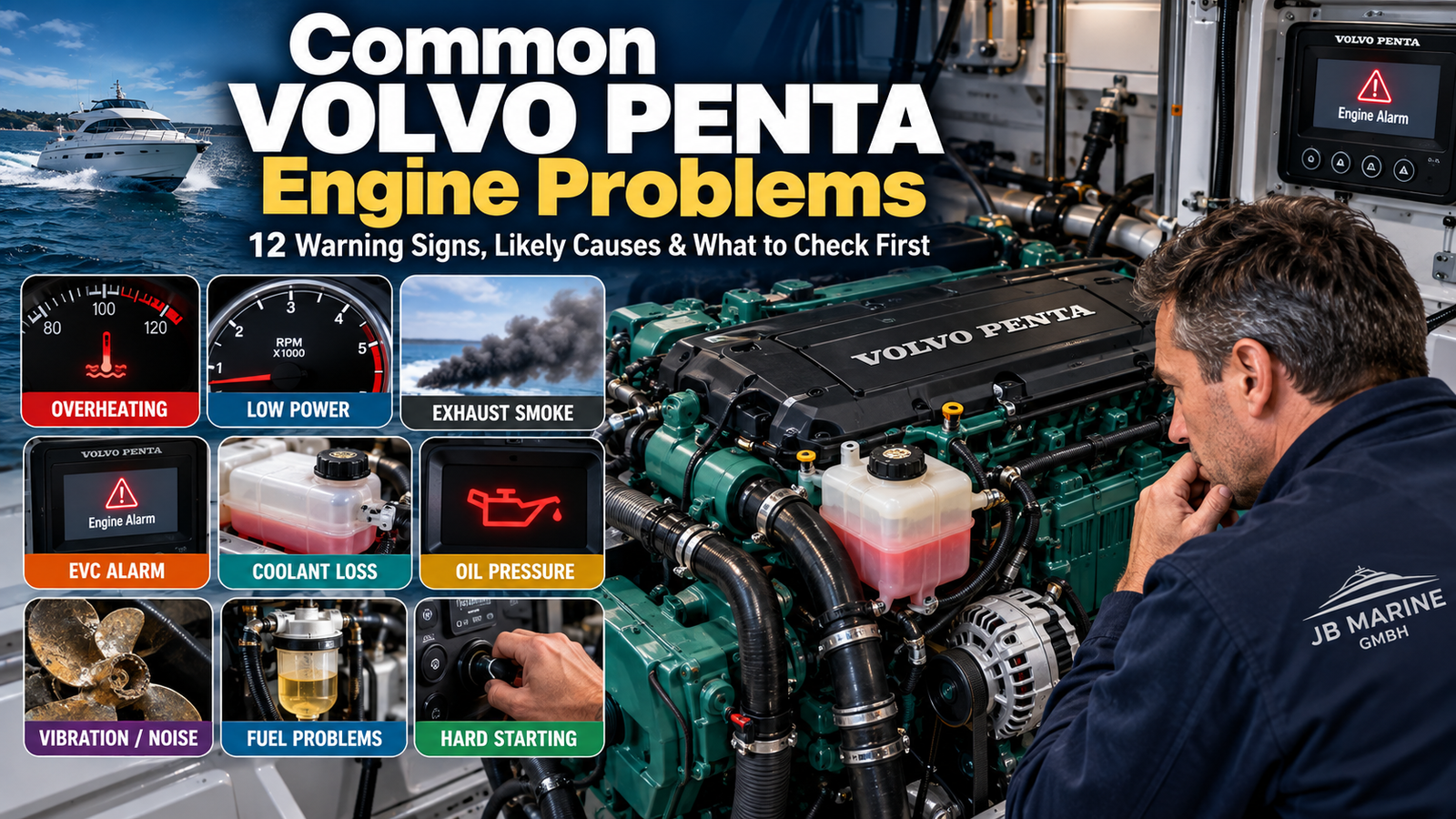
When a marine engine develops a problem, the first warning is not always dramatic.
Sometimes the boat still starts and runs, but something has changed. It may take a little longer to start in the morning. The engine may lose 200 RPM at full throttle. The temperature may begin creeping higher during a long run. You may notice a small amount of smoke that wasn’t there before, or an EVC warning that appears intermittently and disappears after restarting.
A situation that repeatedly comes up in marine-engine enquiries is this: an owner notices one symptom, searches online, finds one component repeatedly blamed for it, and starts thinking about replacing that component.
For example:
“My Volvo Penta is losing power. It must be the turbo.”
Maybe.
But the same complaint could involve a restricted fuel supply, damaged charge-air hose, exhaust restriction, dirty hull, fouled propeller, drivetrain resistance or another issue.
That’s why good troubleshooting starts with what changed, not with what part should I buy?
At JB Marine GmbH, this distinction is particularly important when evaluating engine replacement and repower enquiries. An exact engine model, serial number, rated RPM, gearbox information, photographs and a description of how the problem developed provide far more useful information than simply saying, “The engine has lost power.”
This guide approaches common Volvo Penta engine problems in the same way.
We’ll look at 12 warning signs, what they may indicate, which systems deserve attention first and when a seemingly small symptom may require more urgent investigation.
Technical note: Volvo Penta has produced many marine-engine families, ratings and generations. Exact specifications, service intervals, alarm meanings, diagnostic procedures and repair instructions vary by engine and serial number. Use the manufacturer documentation applicable to your specific engine, and leave high-pressure fuel-system work, internal engine repairs and other safety-critical procedures to appropriately qualified technicians.
Are Volvo Penta Engines Problematic?
People searching for Volvo Penta common problems often want a simple answer:
“Are Volvo Penta engines reliable, or do they have lots of problems?”
A list of faults cannot answer that question by itself.
The condition of an individual marine engine depends on much more than the badge on the valve cover.
Factors such as maintenance history, duty cycle, operating hours, installation quality, engine loading, cooling-system condition, fuel quality, corrosion and previous repairs can significantly affect what happens later in the engine’s life.
A well-maintained engine operating in an appropriate installation is a very different proposition from an engine that has experienced repeated overheating, contaminated fuel or years of neglected seawater-system maintenance.
“Common Problem” Does Not Mean “Every Engine Has This Problem”
This distinction matters.
Search for almost any marine engine model followed by the word “problems,” and you will naturally find problems.
That’s partly because owners generally go online when something isn’t working.
An owner whose engine starts normally, maintains temperature and reaches its expected RPM has little reason to post:
“Everything worked normally again today.”
An owner experiencing Volvo Penta overheating, smoke or an EVC alarm has a strong reason to search for help.
That creates selection bias.
So when this guide discusses a “likely cause,” it means an area that may deserve investigation based on the symptom. It does not mean that every Volvo Penta engine develops that fault or that the named component has already been diagnosed as defective.
That difference protects both technical accuracy and your wallet.
Your Exact Volvo Penta Engine Matters
“Volvo Penta engine” describes a very broad range of products.
Depending on the vessel and application, owners may encounter families such as:
D1, D2, D3, D4, D6, D8 and D13.
These engines can differ significantly in:
- Displacement
- Power output
- Rated RPM
- Fuel system
- Turbocharging
- Electronic controls
- Cooling configuration
- Electrical system
- Transmission or drive arrangement
- Intended duty
Even engines within the same family may exist in different generations and ratings.
This is why advice for one D6, for example, should not automatically be treated as the correct procedure for every D6—or every Volvo Penta marine diesel.
Before Troubleshooting, Identify the Engine
Before ordering Volvo Penta engine parts or researching a fault, record:
| Engine Information | What You Need |
|---|---|
| Manufacturer | Volvo Penta |
| Exact engine designation | From identification plate |
| Serial number | From identification plate |
| Rated output | HP / kW |
| Rated RPM | Engine-specific specification |
| Operating hours | Current reading |
| Electrical system | 12V or 24V |
| Gearbox/drive | Make and exact model |
| Gear ratio | Identification plate |
| Control system | EVC version/system where applicable |
Take a clear photograph of the engine identification plate.
Do the same for the gearbox or drive.
Those two photographs can save a surprising amount of confusion when identifying parts, checking compatibility or sourcing a Volvo Penta replacement engine.
Maintenance and Installation Can Change the Whole Story
Imagine two identical engines with 3,000 operating hours.
The first has:
- Documented servicing
- Clean fuel
- A maintained cooling system
- Correct propeller loading
- A clean engine room
- Stable operating temperature
- No history of major overheating
The second has:
- Incomplete maintenance history
- Repeated coolant loss
- Corroded electrical connections
- Unknown fuel quality
- Previous overheating
- Heavy propeller loading
- Several undocumented repairs
The hour meters tell the same story.
The engines do not.
This is especially important when evaluating a used Volvo Penta engine.
Operating hours are useful, but they should always be considered alongside maintenance history, previous application, current condition and available testing.
The JB Marine W.A.R.N. Method
A good troubleshooting process should reduce uncertainty before money is spent.
For that reason, JB Marine GmbH uses a simple concept in this guide:
W — Watch the Warning Sign
What exactly changed?
Not:
“The engine isn’t right.”
Instead:
“The engine previously reached 3,500 RPM and now reaches approximately 3,200 RPM under similar conditions.”
Or:
“Temperature remains normal at idle but rises during sustained high-load operation.”
Specific observations are far more useful.
A — Assess When It Happens
Determine the operating conditions surrounding the symptom.
Does it happen:
- During a cold start?
- After the engine warms up?
- At idle?
- During acceleration?
- At cruise?
- Only at high load?
- After refueling?
- After maintenance?
- After a propeller impact?
- Continuously or intermittently?
This is one of the fastest ways to narrow the investigation.
For example, an engine that overheats immediately presents a different pattern from one that maintains normal temperature at low load but gradually becomes hot during sustained high-power operation.
Same warning sign.
Different evidence.
R — Review the Related Systems
A marine engine is part of a propulsion system.
When investigating Volvo Penta engine problems, think in systems rather than isolated components.
Fuel and Combustion
Tank → Fuel Supply → Filtration → Injection → Combustion
Air and Exhaust
Air Intake → Turbo/Boost → Engine → Exhaust
Cooling
Sea Intake → Seacock → Strainer → Seawater Pump → Cooling Components → Exhaust Discharge
Electrical and Controls
Battery → Connections → Charging System → EVC/Controls → Sensors
Propulsion
Engine → Gearbox/Drive → Coupling/Shaft → Propeller → Hull
This broader view prevents a common mistake: assuming every performance problem originates inside the engine.
It doesn’t.
A fouled propeller can affect RPM. A poor electrical connection can contribute to electronic warnings. Restricted raw-water flow can cause overheating. A fuel-supply restriction may become apparent only when demand increases under load.
N — Narrow It Down With Evidence
Once the symptom and affected systems are understood, testing can become more focused.
Depending on the problem, evidence may come from:
- Visual inspection
- Engine history
- Diagnostic information
- Voltage measurements
- Temperature measurements
- Pressure testing
- Fuel-system testing
- Cooling-system inspection
- Mechanical inspection
- Sea-trial observations
The process is:
SYMPTOM → CONDITIONS → SYSTEM → TEST → CAUSE → REPAIR
The key principle is simple:
A warning sign tells you where to investigate. It does not automatically tell you which component to replace.
With that foundation established, we can look at the first major warning signs.
1. Volvo Penta Engine Is Overheating
Volvo Penta overheating should never be treated as something to simply “keep an eye on” while continuing normal operation.
Excessive temperature can begin as a cooling-system problem and potentially result in much more expensive secondary damage if the underlying cause is not corrected.
What You May Notice
Possible symptoms include:
- Higher-than-normal coolant temperature
- High-temperature alarm
- Temperature increasing during acceleration
- Normal temperature at idle but overheating under load
- Coolant loss
- Visible coolant leakage
- Reduced raw-water discharge
- Steam or unusual exhaust behavior
One of the most valuable pieces of information is whether the problem appeared suddenly or developed gradually.
Likely Areas to Investigate
Depending on the exact engine and installation, possible causes can involve:
- Blocked seawater intake
- Seacock restriction
- Clogged raw-water strainer
- Volvo Penta seawater pump problems
- Damaged or deteriorated impeller
- Restricted raw-water hoses
- Volvo Penta heat exchanger problems
- Low coolant
- Coolant leakage
- Thermostat-related issues
- Restricted cooling passages
- Exhaust water-injection components
This does not mean all these components should be replaced.
It means the cooling circuit should be investigated systematically.
What Should You Check First?
Where safe and appropriate, begin with basic observations.
Check whether:
- The seawater intake could be obstructed
- The seacock is correctly positioned
- The strainer contains debris
- Raw-water discharge has changed
- Coolant level is abnormal
- There is visible coolant or seawater leakage
- Accessible hoses appear damaged or collapsed
- The problem began after recent cooling-system work
Think of the cooling system as a path.
Raw-Water Side
Sea Intake → Seacock → Strainer → Pump → Cooling Components → Exhaust
If flow is restricted at one point, everything downstream can be affected.
Why “Normal at Idle, Hot Under Load” Is Important
Suppose the engine idles for 20 minutes without overheating.
You leave the harbor, increase load, and temperature begins climbing.
Reduce RPM and the temperature starts returning toward normal.
That pattern is valuable.
The engine generates substantially more heat under load. A cooling system with reduced capacity may handle low-load operation but become inadequate as heat production increases.
Possible restrictions or reduced heat-transfer efficiency therefore deserve investigation.
But remember:
Load-related overheating narrows the investigation; it does not identify the failed component by itself.
Coolant Loss Deserves Investigation
Repeatedly adding coolant without finding out where it is going is not a maintenance strategy.
Look for:
- Wet areas
- Dried coolant residue
- Staining
- Damaged hoses
- Loose connections
- Leakage around cooling components
- Changes in expansion/header tank level
A Volvo Penta coolant leak may initially appear minor, but a small leak can become more consequential if coolant loss continues.
Keep a record if the level is changing:
Date → Engine Hours → Coolant Level → Amount Added → Observation
That creates evidence instead of relying on memory.
2. Volvo Penta Engine Won’t Reach Normal RPM
A reduction in maximum RPM is one of the most useful early warning signs because it can reveal changes in either the engine or the vessel.
If your engine used to reach its expected operating RPM and suddenly cannot, don’t immediately assume the engine needs major repair.
Volvo Penta low RPM can involve the engine, propulsion system or vessel itself.
Start With Numbers
Instead of:
“The boat is slower.”
Record actual performance.
| Measurement | Previous | Current |
|---|---|---|
| Maximum RPM | ____ | ____ |
| Maximum boat speed | ____ | ____ |
| Cruise RPM | ____ | ____ |
| Cruise speed | ____ | ____ |
| Operating temperature | ____ | ____ |
Where practical, compare performance under similar loading and environmental conditions.
A documented change from 3,500 RPM to 3,150 RPM is much more useful than “it doesn’t pull like before.”
Check the Vessel Before Condemning the Engine
Before replacing expensive engine components, consider:
- Hull fouling
- Propeller fouling
- Propeller damage
- Incorrect propeller specification
- Significant increase in vessel weight
- Drivetrain resistance
- Recent changes to the propulsion system
A marine engine and its propeller work together.
If the propeller creates excessive load, the engine may struggle to achieve its expected RPM even though the underlying engine problem is not what the owner initially suspects.
The same applies to heavy hull fouling.
This is why Volvo Penta troubleshooting should include the boat, not only the engine.
Engine-Side Causes of Low RPM
If vessel loading and propulsion condition appear appropriate, investigate the engine-related systems.
Fuel Supply
Restricted fuel delivery may prevent the engine from producing full power under load.
Possible areas include:
- Fuel filters
- Water contamination
- Tank contamination
- Supply restriction
- Air entering the fuel supply
Air Supply
Restricted airflow can reduce combustion performance.
Inspect the relevant intake system according to the engine configuration.
Turbo and Charge-Air System
A Volvo Penta turbo problem is one possibility, but don’t stop there.
Damaged charge-air hoses, loose clamps or leaking connections can also affect boost.
Exhaust System
Exhaust restriction can affect the engine’s ability to breathe and produce power.
Electronic Controls
On electronically controlled engines, diagnostic information may reveal faults or operating conditions relevant to reduced performance.
Mechanical Condition
If external systems are eliminated, further mechanical investigation may be necessary.
The important point is that low RPM is not a diagnosis.
3. Volvo Penta Has Lost Power or Accelerates Poorly
Volvo Penta losing power is related to low RPM, but the way the problem occurs can provide additional clues.
For example:
- Does the engine hesitate during acceleration?
- Is performance normal at low RPM but poor under load?
- Does it eventually reach normal RPM but take much longer?
- Is smoke present?
- Does the problem affect one engine on a twin-engine vessel but not the other?
On twin-engine installations, comparing the behavior of both engines under similar conditions can provide particularly useful evidence.
Fuel-Supply Problems
Fuel demand increases as engine load increases.
A restriction that has little effect at idle may become much more obvious at higher power.
Investigate appropriate parts of the fuel system, particularly if the problem began after:
- Refueling
- Extended storage
- Rough sea conditions
- Fuel-filter replacement
- Other fuel-system work
Potential areas include:
- Restricted filters
- Water contamination
- Sediment
- Tank contamination
- Supply restriction
- Air ingress
Repeatedly replacing filters without asking why they are becoming restricted can leave the root problem untouched.
Air and Boost Problems
Diesel power depends on both fuel and air.
Inspect relevant air and boost components for:
- Intake restriction
- Damaged hoses
- Loose clamps
- Leaking charge-air connections
- Other evidence of boost loss
A useful principle here is:
Low power does not automatically mean a failed turbocharger.
The turbo is part of a system.
Check the system.
Propeller and Vessel Loading
If the engine appears healthy but performance has changed, ask:
- Is the hull clean?
- Is the propeller clean?
- Is the propeller damaged?
- Has a different propeller been fitted?
- Has vessel weight increased?
- Has anything changed in the drivetrain?
This is one of the most important lessons in marine-engine diagnostics:
An engine-performance problem can originate outside the engine.
4. Volvo Penta Is Hard to Start or Won’t Start
When an owner says:
“My Volvo Penta won’t start,”
the first question should be:
Does it crank?
That simple distinction immediately separates two different diagnostic paths.
No Crank
If the engine does not turn when the start command is given, possible areas to investigate include:
- Battery condition
- Battery voltage
- Battery terminals
- Ground connections
- Starter circuit
- Starter motor
- Wiring
- Control system
- Relevant interlocks
Observe exactly what happens.
Is there:
- Complete silence?
- A click?
- Slow cranking?
- Normal instrument power but no starter operation?
- An EVC message?
These details are more useful than the general statement “it won’t start.”
Cranks Normally but Doesn’t Start
If the starter turns the engine normally but combustion does not begin, the investigation changes.
Possible areas may include:
- Fuel supply
- Fuel contamination
- Air in the fuel supply
- Electronic/control conditions
- Injection-related issues
- Other combustion-related conditions
Modern common-rail systems require particular care.
Do not loosen high-pressure injection components as an improvised test. Diesel fuel at very high pressure can cause serious injury.
Use the appropriate diagnostic procedures and qualified assistance where required.
Cold Start vs Hot Restart
For Volvo Penta hard starting, record when the problem occurs.
| Condition | Result |
|---|---|
| First start from cold | Normal / Difficult |
| Warm restart | Normal / Difficult |
| After several hours stopped | Normal / Difficult |
| After refueling | Normal / Difficult |
| After maintenance | Normal / Difficult |
If the engine starts perfectly cold but becomes difficult to restart when hot, that is meaningful information.
If it is difficult only after sitting overnight, that is also meaningful.
The more accurately you describe when the problem happens, the less troubleshooting depends on guesswork.
5. Black Exhaust Smoke
Seeing black smoke behind the boat can immediately make an owner think something serious has happened inside the engine.
Sometimes the cause does require significant attention. But Volvo Penta black smoke is fundamentally a sign that combustion conditions are not producing a clean burn.
In practical terms, the engine may be receiving more fuel than the available air can burn efficiently, or it may be operating under excessive load.
What You May Notice
Black smoke may appear:
- During acceleration
- Only at high RPM
- Under heavy load
- Continuously
- Together with reduced power
- Together with lower maximum RPM
- Along with increased fuel consumption
The conditions under which the smoke appears are important.
A brief change during rapid acceleration is different from dense black smoke that remains during normal cruising.
Likely Areas to Investigate
Possible causes can include:
- Excessive engine loading
- Restricted air intake
- Boost loss
- Charge-air leakage
- Turbocharger-related problems
- Fuel or combustion problems
- Propeller overloading
- Hull fouling
Notice how many of those possibilities exist outside the injectors.
That’s important because one of the easiest assumptions to make is:
Black smoke = bad injectors.
That conclusion is too fast.
Volvo Penta injector problems can affect combustion, but injector replacement should follow appropriate diagnosis rather than smoke color alone.
Black Smoke + Low RPM
This combination deserves particular attention.
Suppose the vessel historically reaches its expected maximum RPM.
Now it produces black smoke and cannot achieve that same RPM.
Ask whether anything has changed in:
- Hull condition
- Propeller condition
- Vessel loading
- Air supply
- Turbo/boost system
- Fuel system
- Exhaust system
An engine being excessively loaded by the propeller can produce symptoms that appear to be an internal engine problem.
Similarly, inadequate airflow or boost can reduce the amount of oxygen available for combustion.
The useful question is not:
“Which part causes black smoke?”
It is:
“Why is combustion becoming smoky under these particular operating conditions?”
6. White Exhaust Smoke
Volvo Penta white smoke is another symptom that needs context.
Not every white-looking exhaust plume means the same thing.
The first distinction is whether you are observing actual persistent smoke or visible water vapor/steam associated with operating and environmental conditions.
Then ask when it occurs.
Cold Start vs Warm Engine
Record whether the white exhaust appears:
- Immediately after a cold start
- Only for a short period
- Until the engine warms
- At idle
- During acceleration
- Under load
- Continuously after reaching operating temperature
Persistent white smoke from a fully warmed engine deserves more attention than a temporary condition that occurs only during cold operation.
Possible areas requiring investigation may include fuel delivery, combustion quality and other engine conditions.
What Else Is Happening?
Smoke becomes more diagnostically useful when combined with other symptoms.
For example:
White smoke + rough running
provides different information from:
White smoke + coolant loss
or:
White smoke only during initial cold start
Record:
- Engine temperature
- Smoke duration
- Engine load
- Starting behavior
- Idle quality
- Coolant level
- Fuel-related symptoms
- Any alarms
Avoid making an expensive diagnosis based solely on color.
7. Blue or Blue-Gray Exhaust Smoke
Persistent Volvo Penta blue smoke can indicate that engine oil is entering the combustion process.
That makes oil consumption an important piece of evidence.
Start With Oil-Level History
Ask:
- Is the engine using more oil than before?
- How much oil is being added between services?
- Did consumption increase suddenly or gradually?
- Is there external leakage?
- Does blue smoke occur only at startup or continue under load?
Write the answers down.
If the oil level historically remained stable but now falls noticeably between checks, that trend matters.
Possible Areas to Investigate
Depending on the engine and symptoms, investigation may include:
- Turbocharger-related oil leakage
- Internal engine condition
- Lubrication-related problems
- Other paths allowing oil into combustion
A Volvo Penta turbo problem is one possibility, but persistent blue smoke does not prove that the turbocharger is responsible.
The engine needs to be assessed as a system.
When Blue Smoke Deserves More Attention
Persistent smoke accompanied by:
- Increasing oil consumption
- Loss of power
- Abnormal mechanical noise
- Other significant performance changes
deserves prompt investigation.
Continuing to add oil without determining why consumption has increased can allow the underlying problem to progress.
8. EVC Alarm or Intermittent Electrical Problems
Modern Volvo Penta installations may use Electronic Vessel Control (EVC) to integrate engine monitoring, controls and other functions.
That gives owners useful information.
It can also create confusion when a warning appears and the natural assumption becomes:
“The sensor named in the message must be broken.”
Not necessarily.
Volvo Penta EVC problems can involve the component or system being monitored, but electrical supply, wiring, connections and communication issues can also matter depending on the specific fault.
Start With the Exact Warning
If an alarm or message appears, record it before switching everything off.
Where possible, note:
- Exact message
- Symbol
- Fault information
- Engine RPM
- Engine temperature
- Battery/charging voltage
- Whether performance changed
- Whether the warning remained or disappeared
- Conditions when it occurred
Taking a photograph of the display can be extremely useful.
“Some alarm came on” gives a technician very little information.
An exact message or Volvo Penta fault code provides a much better starting point.
Check the Electrical Basics
Where safe and appropriate, accessible areas worth checking may include:
- Battery condition
- Battery terminals
- Ground connections
- Charging-system condition
- Wiring harnesses
- Connectors
- Signs of moisture
- Corrosion
- Loose connections
Marine electrical systems live in a difficult environment.
Heat, vibration, moisture and corrosion can all affect connections over time.
A sophisticated electronic warning can therefore sometimes have a surprisingly basic electrical cause.
A Fault Code Is Not Automatically a Failed Part
This deserves emphasis.
Suppose diagnostic information points toward a particular sensor or system.
That information helps identify where the control system detected an abnormal condition.
Further testing may still be necessary to determine why.
A better process is:
Fault Information → Affected System → Required Tests → Confirmed Cause → Repair
not:
Fault Information → Buy Component
For model-specific Volvo Penta troubleshooting, use the diagnostic information and procedures applicable to the exact engine and EVC generation.
9. Coolant Level Keeps Dropping
A small coolant loss can be easy to dismiss.
You top it up.
A few trips later, it is low again.
You add more.
Eventually, topping up becomes normal.
It shouldn’t.
A healthy cooling system should not require unexplained, repeated coolant additions as part of routine operation.
Look for External Coolant Leaks
Possible inspection areas include:
- Hoses
- Hose clamps
- Connections
- Expansion/header tank
- Heat-exchanger area
- Seals
- Joints
- Other cooling components
Look for more than an active drip.
Evidence of a Volvo Penta coolant leak can include:
- Dried residue
- Staining
- Wetness
- Corrosion around a connection
- Deposits around a previous leak point
Some leaks may become more noticeable only when the engine is hot and the cooling system is operating under normal pressure.
What If You Can’t See the Leak?
If coolant continues disappearing but no external leak is obvious, the absence of a visible puddle does not mean the coolant loss should be ignored.
Document:
- How often coolant is added
- How much is added
- Engine hours between additions
- Whether overheating occurs
- Whether exhaust appearance has changed
- Whether oil condition has changed
Persistent unexplained coolant loss warrants proper investigation.
Keep a Coolant Record
A basic record can reveal a trend quickly:
| Date | Engine Hours | Coolant Level | Amount Added | Observation |
|---|---|---|---|---|
| ____ | ____ | ____ | ____ | ____ |
| ____ | ____ | ____ | ____ | ____ |
| ____ | ____ | ____ | ____ | ____ |
This is far more useful than trying to remember whether you added coolant “a few weeks ago.”
10. Oil-Pressure Warning or Unusual Oil Level
An oil-pressure warning deserves serious attention because correct lubrication is fundamental to engine survival.
The first question is whether the indication itself is wrong or whether the engine genuinely has inadequate oil pressure.
Until that distinction is established, do not casually assume it is “just the sensor.”
Check the Oil Level Correctly
Follow the procedure appropriate to your engine and installation.
Look for:
- Low oil level
- Unexpectedly high oil level
- Significant change since the previous check
- Visible oil leakage
- Abnormal oil appearance
Both low and unexpectedly high levels can provide important information.
Sensor Problem vs Actual Oil-Pressure Problem
An electrical or sensor-related problem may produce an incorrect indication.
But genuine low oil pressure can be much more serious.
That is why guessing is risky.
If the warning is persistent or accompanied by abnormal mechanical noise, significant oil loss or other serious symptoms, continuing to operate the engine could increase damage.
Actual oil pressure may need to be verified using the correct diagnostic procedure.
Track Oil Consumption
Just as with coolant, record oil additions.
| Date | Engine Hours | Oil Level | Oil Added | Notes |
|---|---|---|---|---|
| ____ | ____ | ____ | ____ | ____ |
This becomes particularly useful if the engine is also producing blue smoke.
11. New Vibration, Knocking or Drivetrain Noise
Not every vibration comes from inside the engine.
The propulsion path includes:
Engine → Mounts → Gearbox/Drive → Coupling/Shaft → Propeller
A problem anywhere along that path can change what you feel or hear inside the vessel.
What Changed?
Ask:
- Did the vibration appear suddenly?
- Does it occur at one particular RPM?
- Does it increase with engine speed?
- Does it happen only in gear?
- Is it present in neutral?
- Did it begin after hitting something?
- Was the propeller recently removed or changed?
- Was engine or gearbox work recently performed?
These observations help separate engine-speed-related problems from propulsion-load-related problems.
Propeller Problems
A damaged or heavily fouled propeller can cause:
- Vibration
- Reduced speed
- Poor acceleration
- Changes in achievable RPM
If the problem began immediately after a propeller strike or underwater impact, don’t ignore that timing.
Engine Mounts
Inspect accessible mounts for signs such as:
- Deterioration
- Loose hardware
- Damage
- Excessive movement
- Obvious misalignment
Mount condition can affect how vibration is transferred into the vessel.
Shaft Alignment and Coupling
On shaft-driven installations, alignment and coupling condition can also matter.
Alignment is not something to judge accurately by sight alone. Proper assessment may require measurement by an experienced marine technician.
Changes in mounts, structural movement, drivetrain work or impact damage can all justify checking alignment.
Gearbox or Drive
If noise or vibration occurs specifically when engaging gear or under propulsion load, the gearbox or drive becomes another area requiring attention.
Document:
- When the noise begins
- Forward vs reverse
- RPM
- Load
- Whether shifting behavior has changed
A new mechanical knock, severe vibration or drivetrain noise should not simply be masked by operating at an RPM where it feels less noticeable.
Find the cause.
12. Fuel Filters Keep Blocking or the Engine Runs Rough
The final warning sign brings us to one of the most important systems on a modern diesel:
fuel quality and fuel delivery.
Volvo Penta fuel problems can produce symptoms ranging from hard starting and rough running to low power and failure to reach normal RPM.
Fuel Contamination
Marine fuel systems can be affected by:
- Water
- Sediment
- Tank contamination
- Degraded fuel
- Debris
- Other contaminants
A fuel filter is supposed to protect downstream components.
If it repeatedly becomes restricted, that may be evidence of a problem upstream.
Don’t Just Keep Changing Filters
Imagine this pattern:
Filter blocks → Replace filter → Engine runs normally → Filter blocks again → Replace filter again
At some point, the question needs to change from:
“Which filter should I buy?”
to:
“Why does this filter keep becoming contaminated?”
The tank and fuel supply may require investigation.
Repeated filter restriction can be a symptom rather than the root cause.
Water Separation Matters
Inspect and service the appropriate water-separation and filtration equipment according to the requirements of the specific installation.
If water is repeatedly found, determine where it may be entering the system rather than treating repeated draining as a permanent solution.
Clean fuel is particularly important on electronically controlled common-rail engines.
What About Volvo Penta Injector Problems?
Possible Volvo Penta injector problems may be considered when symptoms and testing support that direction.
Potential symptoms can include:
- Rough running
- Difficult starting
- Abnormal combustion
- Smoke
- Reduced power
- Changes in fuel consumption
But each of those symptoms can have other causes.
That is why replacing injectors purely because an engine smokes or runs roughly can become an expensive diagnostic shortcut.
Appropriate fuel-supply checks and diagnostic testing should come first.
Common-Rail Fuel-System Safety
Many modern marine diesel engines operate with extremely high fuel pressure.
Do not use your hands to search for high-pressure fuel leaks.
Do not loosen high-pressure injection lines as an improvised diagnostic method.
High-pressure fuel can penetrate skin and cause severe injury.
Work involving high-pressure components should follow the correct manufacturer procedures and be performed by appropriately trained personnel.
Volvo Penta Warning Signs: Quick Reference Table
The 12 warning signs covered so far can now be viewed together.
| Warning Sign | Areas to Investigate | General Priority |
|---|---|---|
| Overheating | Raw water, coolant, pump, impeller, heat exchanger | High |
| Cannot reach normal RPM | Hull, propeller, fuel, air, boost, exhaust | Medium–High |
| Loss of power | Fuel, air, turbo/boost, exhaust, propulsion load | Medium–High |
| Hard starting / won’t start | Battery, starter, fuel, controls, injection | Medium–High |
| Black smoke | Engine load, air, boost, fuel, propeller | Medium–High |
| White smoke | Combustion, fuel, operating conditions | Medium |
| Blue smoke | Oil consumption, turbo, internal engine condition | Medium–High |
| EVC warning | Electrical supply, connections, sensors, indicated system | Varies |
| Coolant loss | Hoses, connections, cooling components, leaks | High |
| Oil-pressure warning | Oil level, actual pressure, sensor/indication, lubrication | High |
| Vibration/noise | Propeller, shaft, mounts, gearbox/drive, engine | Medium–High |
| Repeated fuel restriction | Filters, tank, contamination, fuel supply | Medium |
Important: These priorities are general guidance, not permission to continue operating. Severity, alarm status, fluid loss, abnormal noise and the exact engine condition can make an apparently simple symptom urgent.
The Most Expensive Mistake: Replacing Parts Before Confirming the Cause
One of the easiest ways to turn Volvo Penta troubleshooting into an expensive exercise is to diagnose by association.
For example:
Low power + black smoke = turbocharger
A new turbocharger is installed.
The problem remains.
Later, the actual issue turns out to involve excessive propeller loading or a leaking charge-air connection.
Another example:
EVC warning = sensor
Sensor replaced.
Warning remains.
The real problem is found elsewhere in the electrical circuit.
The lesson isn’t that turbochargers or sensors never fail.
Of course they can.
The lesson is:
A plausible cause is not the same thing as a confirmed cause.
A disciplined diagnostic sequence looks more like:
1. Observe
What exactly is happening?
2. Record
When, at what RPM, temperature and load?
3. Inspect
What visible evidence exists?
4. Measure
What do voltage, temperature, pressure or other relevant measurements show?
5. Test
Test the system using the appropriate procedure.
6. Confirm
Does the evidence actually identify the cause?
7. Repair
Only then should expensive components be replaced where appropriate.
This is particularly valuable on modern electronically controlled marine diesels because multiple systems interact with one another.
When Should You Stop Operating the Engine?
Not every warning requires the same response.
But certain symptoms deserve prompt attention because continuing to run the engine may increase damage or create a safety problem.
Examples include:
- Severe or persistent overheating
- Critical temperature alarm
- Low oil-pressure warning
- Significant coolant loss
- Significant oil loss
- Fuel leakage
- Sudden heavy exhaust smoke
- Abnormal mechanical knocking
- Severe new vibration
- Major unexplained power loss
- Repeated critical Volvo Penta EVC alarms
- Significant seawater leakage
- Evidence of fluid contamination
The fact that an engine is still running does not prove that continuing to operate it is safe.
If a serious alarm or abnormal mechanical condition appears, consult the operating instructions applicable to the exact engine and seek qualified assistance where necessary.
A small problem caught early may require a manageable repair.
The same problem ignored long enough can affect other components.
That is where preventive maintenance and a good engine-performance baseline become particularly valuable.
Prevention, Used Engine Checks, Repair vs Replacement & FAQs
The 12 warning signs above are most useful when they help you catch a change before secondary damage develops.
That is where preventive maintenance becomes more valuable than emergency repair.
For a Volvo Penta owner, the goal isn’t to become a diesel technician overnight. It is to know what normal looks like, recognize when something changes, maintain the systems that protect the engine and collect useful information when professional diagnosis is needed.
Preventive Maintenance That Helps Reduce Volvo Penta Problems
Good Volvo Penta maintenance should cover the entire propulsion system, not only the engine oil.
The exact service requirements depend on the engine model, serial number, application and operating conditions. Always follow the maintenance schedule and specifications applicable to your particular engine.
Engine Oil and Filters
Monitor:
- Oil level
- Oil condition
- Oil consumption
- External leakage
- Filter replacement history
Don’t focus only on whether the oil has reached its scheduled change interval.
A change in consumption can itself be useful information.
If an engine historically uses very little oil between services and suddenly begins requiring regular top-ups, investigate the reason.
Similarly, an unexpectedly high oil level should not simply be ignored.
Fuel Filters and Water Separation
Clean fuel is particularly important for modern diesel injection equipment.
Maintenance should include the appropriate:
- Fuel filters
- Water separators
- Fuel-system inspections
Pay attention to what you find during servicing.
Repeated water, sediment or unusually rapid filter restriction may indicate a problem in the tank or fuel supply rather than the filter itself.
Cooling System
The cooling system deserves consistent attention because loss of cooling capacity can eventually cause much more expensive engine damage.
Depending on the engine, relevant maintenance can include:
- Coolant level and condition
- Hoses
- Connections
- Seawater strainer
- Seawater pump
- Impeller
- Heat exchanger
- Related cooling components
One of the most useful things an owner can monitor is temperature trend.
If the engine begins running progressively hotter under the same operating conditions, investigate the change rather than waiting for a high-temperature alarm.
Seawater Pump and Impeller
The seawater pump may be relatively small compared with the engine, but it performs a critical job.
When an impeller is inspected or replaced, look at the old component.
If vanes or pieces are missing, consider where those fragments may have travelled. Missing pieces can potentially create restrictions elsewhere in the raw-water circuit.
Replacing the impeller may therefore be only part of the job.
Heat Exchanger
A Volvo Penta heat exchanger problem can reduce the cooling system’s ability to transfer heat effectively.
Pay attention to patterns such as:
Normal temperature at low load → Increasing temperature under sustained higher load
That does not prove the heat exchanger is restricted, but cooling capacity should be investigated.
Use model-specific procedures and service information rather than assuming every Volvo Penta heat exchanger has the same maintenance requirements.
Belts and Hoses
Inspect accessible belts and hoses for:
- Cracking
- Chafing
- Deterioration
- Leakage
- Swelling
- Loose connections
- Incorrect tension where applicable
A hose is inexpensive compared with an engine.
The damage caused by losing coolant or seawater flow may not be.
Turbo and Charge-Air Connections
Inspect accessible air and boost components for:
- Damaged hoses
- Loose clamps
- Leaking connections
- Unusual oil residue
- Physical deterioration
- Abnormal turbocharger noise
A small boost leak can become a performance complaint long before the owner considers checking a hose or clamp.
Electrical Connections
Marine electrical systems operate around vibration, heat and moisture.
Periodically inspect accessible:
- Battery terminals
- Ground connections
- Wiring
- Harnesses
- Connectors
- Charging-system connections
Corrosion or a poor connection can contribute to intermittent symptoms that are particularly frustrating because they may disappear before the engine is inspected.
Gearbox or Drive
The engine may receive most of the attention, but the gearbox or drive is part of the propulsion system too.
Follow the appropriate maintenance requirements for the installed transmission or drive and monitor:
- Fluid condition and level
- Leakage
- Shift behavior
- Cooling where applicable
- Mounting
- Couplings
- Abnormal noise
A well-maintained engine connected to a neglected drivetrain is not a well-maintained propulsion system.
Build a Baseline While Your Volvo Penta Is Healthy
You don’t need sophisticated diagnostic equipment to create one of the most useful records for future Volvo Penta troubleshooting.
Record how the vessel behaves when everything is operating correctly.
| Performance Baseline | Normal Reading/Observation |
|---|---|
| Cold-start behavior | __________ |
| Idle RPM | __________ |
| Cruise RPM | __________ |
| Cruise speed | __________ |
| Operating temperature | __________ |
| Maximum achieved RPM | __________ |
| Maximum vessel speed | __________ |
| Charging voltage | __________ |
| Oil-pressure indication, if displayed | __________ |
| Exhaust appearance | __________ |
| Normal vibration | __________ |
| Fuel consumption, if monitored | __________ |
Update this information periodically.
Why?
Because normal vs changed is much more useful than I think something feels different.
If your boat historically reaches 3,500 RPM and later reaches only 3,200 RPM under comparable conditions, you have a measurable change.
If cruise temperature gradually increases season after season, you have a trend.
These records can help both the owner and technician understand when deterioration began.
Buying a Used Volvo Penta Engine? Check These Warning Signs
A used Volvo Penta engine can be a practical option for replacement or repower projects.
But don’t buy an engine because the paint looks fresh and the hour meter looks attractive.
Buy based on evidence.
Verify the Engine Identification
Request a clear photograph of the data plate.
Confirm:
- Exact model
- Full designation
- Serial number
- HP/kW
- Rated RPM
This is the starting point for checking whether the engine actually matches the advertised description.
Don’t Judge an Engine by Hours Alone
Engine hours matter.
But consider:
Engine A: 2,000 hours with almost no maintenance documentation.
Engine B: 4,000 hours with detailed service records and a known operating history.
The lower-hour engine is not automatically the better engine.
Hours should be evaluated together with:
- Maintenance history
- Previous application
- Duty cycle
- Current condition
- Corrosion
- Previous failures
- Testing
Request Service Records
Look for documentation covering items such as:
- Oil and filter services
- Fuel-system maintenance
- Cooling-system work
- Seawater pump servicing
- Turbocharger work
- Injector/fuel-system repairs
- Electrical/EVC repairs
- Gearbox or drive servicing
- Major internal work
If an engine is advertised as rebuilt, ask what that means.
Who performed the rebuild?
When?
At what operating hours?
What parts were replaced?
What measurements or machining were performed?
Are invoices available?
“Rebuilt” should describe documented work, not simply a sales adjective.
Observe a Cold Start Where Practical
If the engine remains installed and operational, observing a genuine cold start can provide useful information.
Look and listen for:
- Cranking behavior
- Time required to start
- Initial smoke
- Idle stability
- Warning messages
- Abnormal noise
A cold start is not a complete condition survey, but it can reveal information that a pre-warmed engine may not.
Inspect Oil and Coolant
Check the appropriate fluid levels and condition.
Look for:
- Unexplained low levels
- Unexpectedly high oil level
- Visible contamination
- Oil leakage
- Coolant leakage
- Evidence of repeated topping-up
If something looks abnormal, ask for an explanation supported by evidence.
Look Carefully for Corrosion
Inspect areas around:
- Cooling components
- Electrical connections
- Fasteners
- Engine mounts
- Exhaust components
- Hose connections
- Seawater-system components
Fresh paint can improve appearance.
It cannot tell you what maintenance occurred underneath it.
Check the Turbo and Cooling Components
Inspect accessible:
- Turbocharger area
- Charge-air connections
- Hoses
- Clamps
- Heat exchanger
- Seawater pump
- Cooling connections
Evidence of leakage, corrosion or previous repair should be investigated.
Review Diagnostic Information Where Available
On compatible electronically controlled engines, diagnostic information can add another layer of evidence.
It may reveal active or stored faults.
Remember that a historical stored fault does not necessarily mean the same problem is currently active. The information needs to be interpreted in context.
Verify the Gearbox or Drive
If the engine is sold with a transmission or drive, record:
- Manufacturer
- Model
- Serial number
- Ratio
- Condition
Don’t assume a gearbox is suitable for your vessel simply because it is attached to the engine.
The ratio and application still need to match the propulsion requirements.
Confirm Exactly What’s Included
Ask for a written scope of supply.
Depending on the engine, this might include:
- Starter
- Alternator
- Turbocharger
- Heat exchanger
- Seawater pump
- Flywheel/flywheel housing
- Engine mounts
- Gearbox
- Wiring harness
- ECU-related equipment
- EVC components
- Display/instrumentation
- Controls
- Sensors
- Exhaust-related components
The word “complete” can mean different things to different sellers.
A component list removes ambiguity.
Repair, Rebuild or Replace Your Volvo Penta Engine?
Eventually, an owner with recurring or serious Volvo Penta engine problems may need to make a bigger decision.
Do you repair the existing engine?
Rebuild it?
Or replace it?
There is no universal answer.
The decision should consider:
- Exact failure
- Engine hours
- Overall mechanical condition
- Maintenance history
- Previous major repairs
- Corrosion
- Secondary damage
- Parts availability
- Labor requirements
- Downtime
- Vessel value
- Future use
When Repair May Make Sense
Repair may be appropriate when the problem is:
- Clearly identified
- Localized
- Economically repairable
and the overall engine remains in good condition.
A verified peripheral-system fault does not automatically justify replacing an otherwise serviceable engine.
When a Rebuild May Make Sense
A rebuild may be worth evaluating when significant internal work is required but retaining the existing engine still makes technical and economic sense.
Before accepting a rebuild quotation, understand:
- What will be dismantled
- What will be measured
- Which parts will be reused
- Which parts will be replaced
- What machining is included
- What testing follows assembly
- What warranty is offered
Compare scopes carefully.
Two quotations both described as an “engine rebuild” may include very different work.
When Replacement Should Be Considered
A Volvo Penta replacement engine becomes worth evaluating when:
- Damage is extensive
- Multiple major systems require work
- Overall condition is poor
- Corrosion is widespread
- Repair costs are becoming substantial
- Downtime is commercially important
- Parts or support considerations affect the project
- The owner wants to modernize the propulsion system
The important word is evaluate.
Replacement isn’t automatically cheaper simply because the repair quotation looks high.
Compare the Complete Project Cost
Suppose a major repair is quoted at €20,000.
A replacement engine is available for €28,000.
It is tempting to say:
“For another €8,000, I’ll install the new engine.”
But the replacement may also require:
- Gearbox changes
- Engine mounts
- Controls
- Wiring
- Cooling modifications
- Exhaust modifications
- Shaft/coupling work
- Propeller changes
- Lifting
- Installation labor
- Commissioning
Suddenly the financial comparison looks different.
On the other hand, an expensive repair may be less attractive if several other major systems are also approaching the point where they need work.
A better comparison is:
Repair + Downtime + Remaining Condition/Risk
versus:
Replacement + Installation + Expected Future Service
This is the type of calculation that should drive a repower decision—not engine purchase price alone.
Replacing a Volvo Penta With Another Marine Engine
If replacement becomes the preferred option, don’t select the new engine based only on horsepower.
A successful repower requires the engine, gearbox or drive, propeller and vessel to work together.
Compare:
- Rated HP/kW
- Rated RPM
- Duty rating
- Physical dimensions
- Dry weight
- Engine-mount locations
- Gearbox compatibility
- Gear ratio
- Shaft or drive requirements
- Propeller requirements
- Electrical voltage
- Cooling requirements
- Exhaust requirements
- Controls
- Instrumentation
Two engines advertised with the same horsepower can have very different installation requirements.
Replacing Volvo Penta With Another Brand
Changing manufacturer can be possible, but it may turn the job into a broader integration project.
Potential changes can involve:
- Engine beds
- Mount locations
- Gearbox interface
- Gear ratio
- Shaft alignment
- Propeller matching
- Exhaust
- Cooling
- Fuel connections
- Electrical system
- Controls
- Instrumentation
- Engine-room access
A Volvo Penta repower should therefore be treated as a propulsion-system project rather than simply removing one engine and dropping another into the same space.
What Information to Send JB Marine GmbH
If your engine has suffered major damage or you need a replacement, gearbox, parts or repower solution, complete information helps JB Marine GmbH evaluate the enquiry more accurately.
Engine Information
Send:
- Manufacturer
- Exact model
- Serial number
- Rated HP/kW
- Rated RPM
- Operating hours
- 12V or 24V
- Clear engine data-plate photograph
Gearbox or Drive Information
Provide:
- Manufacturer
- Model
- Serial number
- Gear ratio
- Data-plate photograph
Also state whether you intend to reuse the existing gearbox or drive.
Vessel Information
Include:
- Vessel manufacturer
- Vessel model
- Vessel type
- Length
- Approximate operating weight if known
- Hull type
- Recreational or commercial use
- Number of engines
Describe the Existing Problem
Useful information includes:
- Main symptoms
- When the problem started
- Whether the engine still runs
- Current maximum RPM
- Previous maximum RPM
- Overheating history
- Smoke
- Coolant or oil loss
- Available fault information
- Repairs already attempted
Send Useful Photographs
Photographs should ideally include:
- Complete engine
- Engine data plate
- Front
- Rear
- Both sides
- Gearbox/drive
- Gearbox data plate
- Engine mounts
- Engine room
- Cooling connections
- Exhaust arrangement
- Any visibly damaged components
For international enquiries, also provide the quantity required and destination country, city or preferred port.
Good information at the beginning can prevent a lot of unnecessary back-and-forth later.
Frequently Asked Questions About Volvo Penta Engine Problems
What Are the Most Common Volvo Penta Engine Problems?
Potential common Volvo Penta engine problems include overheating, reduced power, failure to reach normal RPM, starting difficulties, exhaust smoke, EVC/electrical warnings, coolant loss, oil-pressure issues, fuel contamination and drivetrain vibration.
These are problem categories rather than universal defects. The actual cause depends on the specific engine, installation, maintenance history and operating conditions.
Why Is My Volvo Penta Losing Power?
Volvo Penta losing power can involve restricted fuel supply, inadequate airflow, boost leakage, turbocharger-related issues, exhaust restriction, electronic controls, mechanical condition or excessive vessel/propeller loading.
Compare current RPM and vessel speed with previous performance under similar conditions.
Why Won’t My Volvo Penta Reach Full RPM?
A Volvo Penta that cannot reach its previous RPM may have an engine-related problem, but hull fouling, propeller fouling, propeller damage, excessive vessel weight or drivetrain resistance can produce similar symptoms.
Check both the engine and vessel.
Why Is My Volvo Penta Overheating?
Volvo Penta overheating can be associated with restricted seawater flow, seawater-pump or impeller problems, low coolant, coolant leakage, heat-exchanger restriction, hose problems or other cooling-system conditions.
Document whether overheating occurs at idle, cruise or only under heavy load.
Why Won’t My Volvo Penta Start?
First determine whether the engine:
Does not crank
or:
Cranks but does not start.
No-crank conditions direct attention toward batteries, connections, starter circuits and controls.
An engine that cranks normally but fails to start directs the investigation more toward fuel, electronic controls, injection and combustion-related conditions. This is the most important external resource. Volvo Penta provides troubleshooting guidance, manuals, maintenance information and support resources here. It also allows owners to search for product information relevant to their engine
What Causes Black Smoke From a Volvo Penta?
Volvo Penta black smoke may be associated with excessive engine loading, inadequate airflow, boost problems, fuel/combustion issues or excessive propeller loading.
Black smoke does not automatically mean the injectors have failed.
What Causes White Smoke From a Volvo Penta?
Volvo Penta white smoke may involve combustion or fuel-related conditions, depending on when and how it occurs.
Distinguish temporary cold-start exhaust from persistent smoke after the engine reaches normal operating temperature.
What Causes Blue Smoke From a Volvo Penta?
Persistent Volvo Penta blue smoke can indicate engine oil entering the combustion process.
Monitor oil consumption and investigate possible turbocharger-related oil leakage or internal engine conditions rather than relying on smoke color alone.
What Does a Volvo Penta EVC Alarm Mean?
A Volvo Penta EVC alarm indicates that the control system has detected a condition requiring attention.
Record the exact message or fault information and use diagnostic procedures applicable to the specific engine and EVC generation.
Do not assume the component mentioned by a fault is automatically defective.
How Do I Check Volvo Penta Fault Codes?
Use the operating, workshop or diagnostic information applicable to the exact engine and control-system generation.
A useful sequence is:
Fault information → Affected system → Testing → Confirmed cause → Repair
Model-specific information is preferable to generic internet fault-code lists.
Why Does My Volvo Penta Keep Losing Coolant?
Repeated coolant loss may result from an external leak or another cooling-system problem.
Inspect accessible hoses, connections, cooling components and evidence such as dried residue or staining.
If coolant continues disappearing without an obvious external leak, further investigation is appropriate.
What Causes Low Oil Pressure on a Volvo Penta?
A low-oil-pressure warning may involve actual lubrication pressure, oil level, the indication/sensor system or another lubrication-related condition.
Because genuine low oil pressure can result in serious damage, do not assume the warning is merely an electrical fault without verification.
How Many Hours Does a Volvo Penta Marine Diesel Engine Last?
There is no single operating-hour figure that accurately predicts the lifespan of every Volvo Penta marine engine.
Service life depends on factors such as:
- Engine model
- Duty cycle
- Maintenance
- Loading
- Cooling-system condition
- Fuel quality
- Installation
- Operating environment
- Corrosion
- Previous failures
For a used engine, documented history and current condition are more informative than an arbitrary maximum-hour number.
Are Volvo Penta Engines Expensive to Repair?
Repair cost depends on the actual fault.
A hose, electrical connection or routine service item has very different economics from major fuel-system, turbocharger, cooling or internal engine work.
Secondary damage can also change the cost substantially.
Catching a problem early is therefore financially important.
Is It Worth Buying a Used Volvo Penta Engine?
A used Volvo Penta can be worth considering when you can adequately verify its:
- Identity
- Operating hours
- Maintenance history
- Current condition
- Running/testing evidence
- Diagnostic information where available
- Gearbox or drive
- Scope of supply
Don’t make the decision from photographs and engine hours alone.
Should I Repair or Replace My Volvo Penta Engine?
Repair may make sense when the problem is localized and the overall engine remains in good condition.
Replacement becomes more relevant when damage is extensive, multiple major systems require work, overall condition is poor or repair economics are unfavorable.
Compare the complete installed costs, downtime and expected future service, not simply the repair quotation against the replacement-engine purchase price.
Can I Replace a Volvo Penta With Another Marine Engine Brand?
Potentially, yes.
But compatibility needs to be evaluated across:
Power + RPM + Duty + Dimensions + Weight + Mounts + Gearbox + Ratio + Shaft/Drive + Propeller + Cooling + Exhaust + Electrical + Controls
Horsepower alone is not enough to determine whether another engine is a suitable replacement.
Conclusion: Pay Attention to What Changed
The most useful warning from your Volvo Penta may not be a dramatic alarm.
It could be:
200 RPM disappearing from maximum speed.
Temperature gradually increasing under load.
Coolant needing occasional top-ups.
A new vibration.
More smoke than usual.
An intermittent EVC warning.
Those changes are information.
The mistake is either ignoring them until the engine suffers secondary damage or jumping directly to an expensive component without enough evidence.
Remember the JB Marine W.A.R.N. Method:
W — Watch the Warning Sign
What exactly changed?
A — Assess When It Happens
Under what operating conditions?
R — Review the Related Systems
Which systems could realistically produce the symptom?
N — Narrow It Down With Evidence
Inspect, measure and test until the cause is established.
The principle is straightforward:
Notice the change early. Find the cause. Fix the small problem before it becomes the expensive one.
Need a Volvo Penta Engine, Gearbox, Parts or Repower Solution?
If your existing engine has suffered major damage, you’re comparing repair against replacement, or you’re planning a repower, JB Marine GmbH can assist with enquiries for:
- New marine diesel engines
- Used marine diesel engines
- Volvo Penta replacement engines
- Marine gearboxes
- Engine parts
- Replacement and repower solutions
- European and international supply enquiries
For the most accurate response, send us:
Engine data plate + gearbox/drive data plate + vessel information + current engine condition + installation photographs + quantity + delivery destination.
If the vessel still operates, include its current maximum RPM and previous normal performance where known.
The more accurately the existing installation is documented, the easier it becomes to evaluate the appropriate replacement or repower option.
JB Marine GmbH — Marine Engines, Gearboxes, Generators, Parts & Repower Solutions


Write a comment
Your email address will not be published. All fields are required