
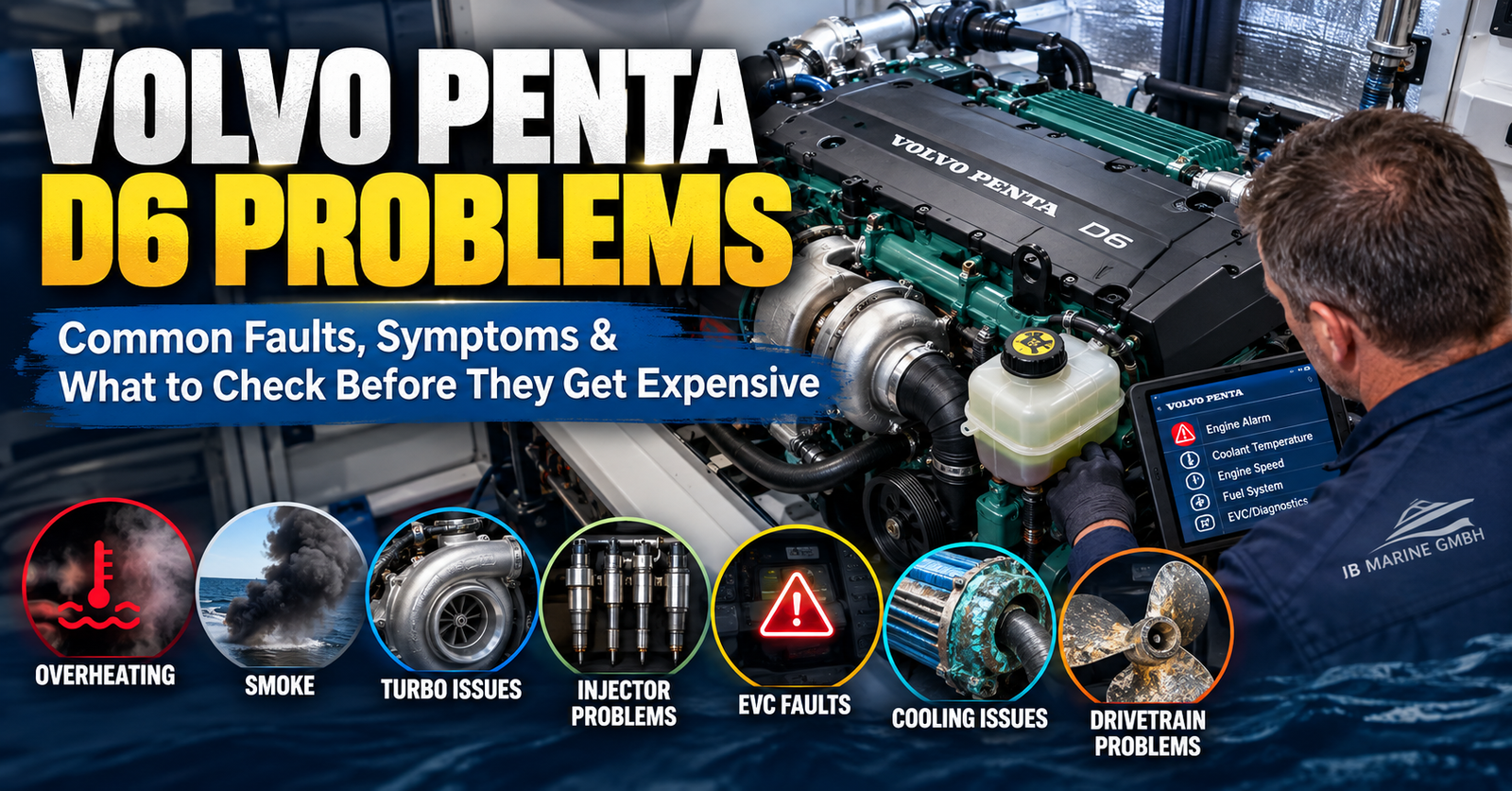
A marine diesel engine rarely needs to be completely dead before it starts telling you something is wrong.
Imagine a Volvo Penta D6 that normally reaches its expected operating RPM without hesitation.
One weekend, the owner notices the boat feels slightly slower.
Nothing dramatic.
The engine starts normally. There is no heavy knocking. No obvious oil leak. No cloud of smoke behind the boat.
So the owner keeps running it.
A few trips later, the engine is several hundred RPM below its previous maximum. Temperature is also slightly higher under load.
Now the question becomes:
Is the engine failing—or is something else causing the engine to work harder?
That distinction matters.
The problem could potentially involve the engine.
But it could also involve the:
- Fuel supply
- Air/boost system
- Cooling system
- Exhaust
- Electrical controls
- Gearbox
- Propeller
- Hull condition
- Vessel loading
Replacing an expensive component before answering that question can turn troubleshooting into very expensive guesswork.
That’s why this guide approaches Volvo Penta D6 problems differently.
Instead of telling you that a particular symptom automatically means a particular part has failed, we’ll work from:
Symptom → Operating Condition → System → Evidence → Diagnosis
At JB Marine GmbH, this same principle is important when evaluating replacement-engine and repower enquiries. The exact engine model, rated RPM, gearbox, vessel application and installation details matter because a marine diesel engine is only one part of the complete propulsion system.
And that’s the first principle to remember throughout this guide:
A symptom is evidence. It is not yet a diagnosis.
A D6 losing power doesn’t automatically need a turbocharger.
Black smoke doesn’t automatically prove Volvo Penta D6 injector problems.
A high-temperature warning doesn’t automatically mean the heat exchanger has failed.
And an EVC warning doesn’t automatically mean an expensive electronic component needs replacing.
The objective is to identify the system involved, verify the cause and correct the actual problem before secondary damage makes the repair considerably more expensive.
Technical note: This article provides general troubleshooting and buying guidance. Volvo Penta D6 specifications, service procedures, alarms, operating limits and maintenance requirements vary by exact engine version and installation. Model-specific Volvo Penta documentation and appropriately qualified marine technicians should be used for diagnosis and repair, particularly for high-pressure fuel, electrical, internal engine and safety-critical work.
Is the Volvo Penta D6 a Problematic Engine?
This question deserves a careful answer.
Searching for Volvo Penta D6 common problems can create the impression that every issue discussed online is a characteristic failure of every D6.
That’s not a reliable conclusion.
The D6 is an engine family used in different outputs, applications, installations and operating conditions.
The condition of an individual engine can be influenced by:
- Exact model and rating
- Engine age
- Operating hours
- Duty cycle
- Maintenance history
- Installation quality
- Cooling-water environment
- Fuel quality
- Propeller loading
- Vessel displacement
- Previous overheating
- Corrosion
- Previous repairs
- Long-term storage
Two apparently similar D6 engines can therefore have very different histories.
One may have operated in a well-maintained recreational vessel with documented servicing.
Another may have spent years working under heavy load with poor maintenance and recurring cooling problems.
The model name alone doesn’t tell you which engine you’re looking at.
Why “Common Problem” Lists Need Context
There is another issue with online research.
People naturally discuss failures more often than normal operation.
An owner with a malfunctioning engine may write several forum posts trying to diagnose it.
An owner whose engine worked perfectly that day usually doesn’t create a post announcing:
“Nothing went wrong with my D6 today.”
That creates selection bias.
It doesn’t mean reported problems are false.
It means the number of online complaints alone doesn’t establish a failure rate.
For that reason, this guide will use phrases such as:
“possible cause,” “area to investigate,” and “symptom associated with”
rather than claiming a component is defective simply because a similar problem has been reported elsewhere.
That’s important for trustworthy technical content.
Your Exact D6 Model Matters
Before diagnosing a Volvo Penta D6 engine problem, identify the engine correctly.
“Volvo Penta D6” isn’t enough.
Different D6 versions may have different:
- Power ratings
- Rated speeds
- Controls
- Hardware
- Installation requirements
- Service procedures
- Parts
You may encounter engines and searches associated with designations such as D6-330, D6-370, D6-400 and D6-440, among others.
Don’t assume information for one D6 version automatically applies to another.
Before ordering parts or making repair decisions, establish:
| Engine Information | Record |
|---|---|
| Exact engine designation | __________ |
| Serial number | __________ |
| Rated power | __________ HP / kW |
| Rated RPM | __________ |
| Operating hours | __________ |
| Electrical system | __________ |
| Gearbox/drive | __________ |
| Gear ratio | __________ |
| EVC/control information | __________ |
A clear photograph of the engine identification plate can prevent a surprising number of misunderstandings.
This is also why JB Marine GmbH asks customers seeking replacement engines to provide data-plate information whenever possible.
Exact identification should come before parts selection.
Build a Baseline Before Troubleshooting
One of the most useful things an owner can have isn’t another spare part.
It’s a record of how the engine behaved when everything was working properly.
Write down normal values such as:
- Cold-start behavior
- Idle behavior
- Normal cruising RPM
- Normal cruising speed
- Maximum achievable RPM under appropriate conditions
- Maximum speed
- Typical operating temperature
- Charging voltage where displayed
- Normal exhaust appearance
- Normal vibration
- Normal engine sound
Why?
Because troubleshooting becomes much easier when you can compare:
Normal vs Current
rather than:
What I vaguely remember vs What it’s doing now.
For example:
“The engine seems down on power.”
isn’t particularly precise.
But:
“The engine previously reached 3,000 RPM and 26 knots under comparable conditions; it now reaches 2,650 RPM and 21 knots.”
is useful evidence.
That gives a technician something measurable to investigate.
The JB Marine S.A.F.E. Diagnostic Framework

To keep troubleshooting systematic, we’ll use the JB Marine S.A.F.E. Method throughout this article.
S — Spot the Symptom
Describe exactly what changed.
Instead of:
“Engine is bad.”
record:
“Coolant temperature increases above its normal range after approximately 15 minutes at high load.”
Or:
“Engine reaches normal idle but is approximately 300 RPM below its previous maximum under load.”
Specific observations narrow the investigation.
A — Assess the Operating Conditions
Ask when the symptom occurs.
Does it happen:
- At cold start?
- After warm-up?
- At idle?
- During acceleration?
- At normal cruise?
- Only near full load?
- After extended operation?
- With full fuel and passengers?
- After refueling?
- After maintenance?
Conditions matter.
An engine overheating only under heavy load presents a different diagnostic pattern from one overheating shortly after starting.
F — Find the System
Think in systems rather than parts.
A D6 depends on interconnected systems:
Fuel → Air → Combustion → Exhaust
plus:
Cooling
Lubrication
Electrical/EVC
Drivetrain
If the symptom is low power, for example, don’t immediately ask:
“Which part should I replace?”
Ask:
“Which systems could produce this symptom, and what evidence would separate them?”
E — Establish the Cause Before Replacing Parts
This is where expensive guesswork stops.
The preferred process is:
SYMPTOM → CONDITIONS → SYSTEM → TEST → CAUSE → REPAIR
not:
SYMPTOM → INTERNET SEARCH → EXPENSIVE PART
That’s the core of the S.A.F.E. framework.
1. Volvo Penta D6 Overheating
Volvo Penta D6 overheating deserves immediate attention because excessive temperature can turn a cooling-system problem into broader engine damage.
The useful question isn’t simply:
“Why is my D6 overheating?”
It is:
“Under what conditions does the temperature rise, and which part of the cooling system is failing to remove heat adequately?”
Symptoms to Watch For
Possible warning signs include:
- Higher-than-normal coolant temperature
- Temperature alarm
- Temperature increasing under load
- Coolant level falling
- Visible coolant leak
- Reduced raw-water discharge where observable and applicable
- Temperature normal at idle but abnormal at cruise
- Repeated need to add coolant
The pattern can be particularly revealing.
Normal at Idle, Hot Under Load
Suppose the engine runs at normal temperature around the marina.
You increase power.
Ten minutes later, temperature starts climbing.
Reduce the load and temperature begins returning toward normal.
That pattern can suggest the cooling system is coping with low heat rejection demand but struggling as engine load increases.
It doesn’t identify the failed component by itself.
But it tells you when the system fails.
That’s valuable diagnostic evidence.
Possible Causes of D6 Overheating
Depending on the exact installation, areas to investigate may include:
- Restricted seawater intake
- Closed or partially restricted seacock
- Blocked seawater strainer
- Seawater pump/impeller problem
- Damaged or restricted hoses
- Heat-exchanger restriction
- Cooling-system contamination
- Low coolant
- Coolant leak
- Thermostat-related issue
- Insufficient raw-water flow
- Installation-related cooling restriction
Notice how many possible causes exist.
This is why:
High temperature = replace heat exchanger
is not a reliable diagnostic strategy.
Start With the Cooling Path
For a typical heat-exchanger-cooled marine installation, think of the raw-water side as a path.
Sea Intake → Seacock → Strainer → Pump → Cooling Components → Exhaust Discharge
If water flow is inadequate, ask where restriction or failure could occur along that path.
Then consider the closed coolant side separately.
This system-based approach is much more reliable than replacing whichever component is easiest to blame.
Check for Coolant Loss
If coolant level is repeatedly falling, don’t simply keep topping it up.
Find out where it is going.
Possible external evidence can appear around:
- Hoses
- Clamps
- Connections
- Expansion/header tank area
- Heat exchanger
- Other cooling-system components
If coolant is disappearing without an obvious external leak, further diagnosis is warranted.
Repeated coolant loss is a symptom—not routine maintenance.
When Overheating Becomes Urgent
A persistent high-temperature alarm or rapid temperature rise should be treated seriously.
Continuing to operate an engine while it is genuinely overheating risks converting a cooling-system fault into a much larger repair.
Follow the applicable engine warnings and operating procedures rather than repeatedly resetting alarms or continuing to run under heavy load.
2. Volvo Penta D6 Loss of Power or Failure to Reach RPM
One of the most useful direct answers in this article is this:
A Volvo Penta D6 that loses power or cannot reach its expected RPM may have a fuel, air, boost, exhaust, control, mechanical or vessel-loading problem. Low RPM does not automatically mean the engine itself needs rebuilding or the turbocharger needs replacing.
This is an important distinction because Volvo Penta D6 low power can originate outside the engine.
Start With Measurable Performance
Before diagnosing anything, record:
| Measurement | Previous | Current |
|---|---|---|
| Maximum RPM | _____ | _____ |
| Cruise RPM | _____ | _____ |
| Cruise Speed | _____ | _____ |
| Maximum Speed | _____ | _____ |
| Operating Temperature | _____ | _____ |
| Smoke | _____ | _____ |
If possible, compare performance under reasonably similar vessel loading and operating conditions.
A heavily loaded boat in poor sea conditions isn’t a fair direct comparison with a lightly loaded boat in calm water.
Check the Boat Before Blaming the Engine
This is one of the most important troubleshooting lessons in marine propulsion.
Poor performance can result from:
- Fouled hull
- Fouled propeller
- Damaged propeller
- Increased vessel weight
- Incorrect propeller
- Drivetrain problems
Imagine an engine that can no longer reach rated RPM because the propeller is heavily fouled.
The engine feels weak.
Smoke may increase.
Boat speed falls.
From the helm, it can feel like an engine problem.
But the engine may simply be trying to turn a propulsion system that is placing excessive load on it.
That’s why JB Marine GmbH approaches replacement and repower discussions as complete propulsion-system questions rather than horsepower-only decisions.
Then Check the Engine Systems
If vessel loading and drivetrain condition are reasonable, potential areas include:
Fuel
- Restricted filter
- Contaminated fuel
- Inadequate supply
- Fuel-system fault
Air and Boost
- Intake restriction
- Charge-air leak
- Hose problem
- Turbo/boost issue
Exhaust
- Excessive restriction
- Exhaust-system problem
Electronic Controls
- Sensor issue
- EVC/engine-management fault
Mechanical Condition
- Engine-specific internal problems requiring further testing
The important point is that all can contribute to similar symptoms.
3. Volvo Penta D6 Fuel-System Problems
Potential Volvo Penta D6 fuel problems can cause:
- Hard starting
- Hesitation
- Power loss
- Uneven running
- Engine stopping
- Smoke
- Poor acceleration
- Warning messages
The fuel system should be considered from the tank forward.
Start With Fuel Quality
Diesel fuel on a boat can be exposed to:
- Water
- Dirt
- Sediment
- Microbial contamination
- Long storage periods
Pay attention to timing.
Did the problem begin:
after refueling?
after long-term storage?
after rough sea conditions?
after fuel-system maintenance?
That history can provide clues.
For example, rough movement can disturb contamination in a fuel tank and contribute to filter restriction.
It doesn’t prove that’s the cause.
But it gives you a rational place to investigate.
Inspect Filtration and Water Separation
A fuel filter that has become restricted can limit supply.
Water or unusual contamination in a separator can also tell you something about the condition of the fuel upstream.
The goal isn’t to assume:
“It’s definitely the filter.”
It’s to eliminate basic supply issues before jumping to expensive high-pressure components.
A logical fuel diagnostic path is:
Tank → Supply → Water Separation → Filtration → Low-Pressure Supply → High-Pressure System → Injectors
Common-Rail Safety Matters
The D6 uses high-pressure fuel-injection technology.
High-pressure diesel fuel can cause serious injury.
Do not loosen high-pressure injection lines as an improvised diagnostic test.
Work involving the high-pressure common-rail system should follow the correct technical procedures and safety precautions.
That is one area where professional diagnosis is worth far more than experimentation.
4. Volvo Penta D6 Injector Problems
Potential Volvo Penta D6 injector problems may be associated with symptoms including:
- Rough running
- Hard starting
- Smoke
- Abnormal combustion noise
- Reduced power
- Increased fuel consumption
- Uneven operation
But none of those symptoms independently proves an injector has failed.
Smoke Does Not Automatically Mean Injectors
Take black smoke.
It may involve a combustion or fueling issue.
But it can also be associated with:
- Insufficient air
- Boost problems
- Excessive engine load
- Propeller loading
- Other combustion-related conditions
Replacing injectors because the exhaust is black can therefore be an expensive guess.
Proper diagnostic evidence might include appropriate:
- Electronic diagnostic information
- Fuel-system testing
- Cylinder-related testing
- Injector testing
- Operating data
The specific method depends on the exact engine and available equipment.
The principle remains:
Test first. Replace second.
5. Volvo Penta D6 Turbo and Boost Problems
Possible Volvo Penta D6 turbo problems often attract attention because turbocharger faults can contribute to substantial performance loss.
Symptoms potentially associated with the boost system include:
- Reduced power
- Poor acceleration
- Failure to reach expected RPM
- Increased smoke
- Unusual turbocharger noise
- Oil traces around relevant components
- Poor performance under higher load
But don’t diagnose the turbocharger before inspecting the system around it.
Check the Air Path
A useful sequence is:
Air Intake → Turbocharger → Charge-Air System → Engine
Inspect applicable:
- Air-intake components
- Hoses
- Clamps
- Connections
- Charge-air plumbing
A split hose or leaking connection can cause boost loss even if the turbocharger itself is capable of operating.
Look for evidence such as:
- Loose clamps
- Split hoses
- Disconnected plumbing
- Oil mist around leaking joints
- Physical damage
Check the Exhaust Side Too
The engine needs to breathe out as well as in.
Excessive exhaust restriction can affect engine performance.
Therefore, a more complete diagnostic path is:
AIR → TURBO/BOOST → ENGINE → EXHAUST
This is a better troubleshooting model than:
LOW POWER → BUY TURBO
6. Volvo Penta D6 EVC, Sensor and Electrical Problems
Electronic control systems add powerful diagnostic and vessel-control capabilities, but they also mean voltage, connections, sensors and communications matter.
Possible Volvo Penta D6 EVC problems may appear as:
- Alarm messages
- Intermittent warnings
- Starting problems
- Throttle/control issues
- Incorrect instrument readings
- Communication errors
- Intermittent functions
What Does EVC Mean?
EVC stands for Electronic Vessel Control.
Depending on the generation and installation, the system integrates engine and vessel-control functions.
That means a warning displayed at the helm may involve more than the display itself.
Check Electrical Fundamentals Before Expensive Electronics
Before assuming a major control module has failed, appropriate basic checks may include:
- Battery condition
- System voltage
- Charging performance
- Battery terminals
- Grounds
- Connectors
- Harness condition
- Signs of corrosion
- Loose connections
This is one of the most valuable practical principles in electronic troubleshooting:
A sophisticated warning can still originate from a basic electrical problem.
Volvo Penta D6 Fault Codes Need Context
A Volvo Penta D6 fault code should be treated as diagnostic information—not an automatic parts order.
The correct logic is:
FAULT CODE → AFFECTED SYSTEM → TEST → VERIFIED CAUSE → REPAIR
A code may indicate that the control system detected a value or circuit outside its expected range.
That doesn’t necessarily prove the named sensor or component itself is defective.
For exact code interpretation, use the correct documentation and diagnostic resources for the specific engine/EVC system.
7. Volvo Penta D6 Starting Problems
If a Volvo Penta D6 won’t start, divide the symptom immediately into two categories.
Engine Does Not Crank
Potential areas can include:
- Battery condition
- Battery connections
- Starter circuit
- Electrical supply
- Control system
- Applicable interlocks
Record exactly what happens when the start command is given:
Nothing?
Single click?
Repeated clicking?
Slow cranking?
Those observations matter.
Engine Cranks Normally but Does Not Start
If cranking speed appears normal but the engine doesn’t start, the investigation changes.
Possible areas include:
- Fuel supply
- Fuel contamination
- Air entering the fuel system
- Filter restriction
- Sensor/control issues
- Injection-system problems
Don’t replace the starter motor simply because the engine won’t start if the starter is already cranking the engine normally.
Again:
Define the symptom accurately.
Cold vs Hot Starting Problems
Record whether the problem happens:
- Only when cold
- Only when hot
- After sitting overnight
- Immediately after shutdown
- Randomly
A useful record looks like this:
| Starting Observation | Result |
|---|---|
| Cold start | Normal / Difficult |
| Warm restart | Normal / Difficult |
| Cranking speed | Normal / Slow |
| Smoke while cranking | Yes / No |
| EVC warning | Yes / No |
| Recent fuel work | Yes / No |
That information gives a technician a far stronger starting point.
What Part 1 Tells Us
We’ve now covered several major categories behind searches for Volvo Penta D6 problems:
- Overheating
- Loss of power
- Failure to reach RPM
- Fuel-system problems
- Injector-related symptoms
- Turbo and boost issues
- EVC and electrical faults
- Starting problems
And one pattern appears repeatedly:
The same symptom can have several different causes.
Low power can come from the engine—or from the propeller.
Smoke can involve fuel—or air—or load.
An electronic alarm can indicate a sophisticated control issue—or something as fundamental as electrical supply and connections.
That’s why the JB Marine S.A.F.E. Method remains the foundation:
S — Spot the Symptom
Record exactly what changed.
A — Assess the Operating Conditions
Determine when and how it happens.
F — Find the System
Identify which systems could realistically produce the symptom.
E — Establish the Cause
Use evidence before replacing components.
That approach makes troubleshooting more systematic, more defensible and far less dependent on guesswork.
And when the repair starts becoming economically questionable, those same facts help determine whether repairing, rebuilding or replacing the engine makes more sense.
JB Marine GmbH can assist with marine diesel engine, gearbox, parts and repower enquiries when a D6 replacement or broader propulsion solution is being considered.
Coming in Part 2
Part 2 will continue with:
Volvo Penta D6 smoke — black, blue and white
Coolant loss and leaks
Oil-pressure warnings
Seawater pump and impeller problems
Heat-exchanger fouling
Exhaust-system problems
Corrosion and saltwater damage
Engine mounts, shaft alignment and drivetrain vibration
It will also include the D6 symptom-to-cause troubleshooting table and explain how to recognize symptoms that should not be ignored.
Volvo Penta Support & Manuals — This is the strongest external source for the article. Volvo Penta provides engine-specific manuals, troubleshooting information, maintenance guidance and support resources, and its database allows users to search by serial number, product number or designation.
Volvo Penta D6 Smoke, Cooling, Oil Pressure, Exhaust & Drivetrain Problems
Part 1 established one of the most important principles for diagnosing Volvo Penta D6 problems:
A symptom is evidence—not a diagnosis.
That becomes even more important when dealing with smoke, coolant loss, oil-pressure warnings and vibration.
These symptoms can look frightening because they are easy to see or feel. But the visible symptom doesn’t always reveal the root cause.
A cloud of black smoke may involve fuel, air, boost or excessive engine load.
Coolant loss could be caused by something as visible as a leaking hose—or require deeper investigation if no external leak can be found.
Vibration that feels like an internal engine problem may actually originate farther down the drivetrain.
So we’ll continue using the JB Marine S.A.F.E. Method:
S — Spot the Symptom
A — Assess the Operating Conditions
F — Find the System
E — Establish the Cause
Let’s apply that method to the next group of D6 symptoms.
8. Volvo Penta D6 Exhaust Smoke
One of the easiest engine symptoms to notice is exhaust smoke.
It’s also one of the easiest to misinterpret.
If you’re investigating Volvo Penta D6 smoke, start by recording:
- Smoke color
- When it appears
- Whether it is temporary or continuous
- Engine temperature
- Engine RPM
- Vessel load
- Whether performance has changed
- Whether fuel consumption appears different
- Whether any alarms are present
Smoke observed briefly during one operating condition can mean something very different from heavy smoke that continues under normal operating conditions.
The three colors most commonly discussed are:
Black
Blue
White
Each can point the investigation in a different direction.
Black Smoke From a Volvo Penta D6
Black exhaust smoke generally indicates that combustion conditions are producing visible soot.
For troubleshooting purposes, areas worth investigating can include:
- Excessive engine load
- Insufficient combustion air
- Intake restriction
- Boost-system problems
- Turbocharger-related issues
- Charge-air leaks
- Fuel/injection problems
- Propeller loading
- Hull fouling
The important point is that black smoke doesn’t automatically mean:
“Bad injectors.”
Imagine a vessel whose propeller has become heavily fouled.
The engine is being asked to work harder.
It may struggle to reach its expected RPM.
Smoke increases.
Boat speed decreases.
From the helm, the symptoms can look like an engine-fueling problem.
But the actual issue may be excessive propulsion load.
This is why black smoke should be considered alongside RPM and vessel performance.
Black Smoke + Low RPM
If you have:
Black smoke + engine cannot reach normal RPM
investigate whether the engine is being overloaded as well as whether it has a fuel/air problem.
Black Smoke + Low Power
If the engine has:
Black smoke + poor acceleration + low power
the air and boost system becomes another important area to investigate.
The correct conclusion is not:
Black smoke = one specific failed component.
It is:
Black smoke gives you a direction for diagnosis.
Blue Smoke From a Volvo Penta D6
Blue or blue-gray exhaust smoke can be associated with engine oil entering the combustion process.
Potential areas requiring investigation can include:
- Oil entering through applicable engine components
- Turbocharger-related oil leakage
- Internal engine wear
- Other lubrication/combustion issues
The amount, timing and persistence matter.
A qualified technician may need to determine whether the smoke genuinely represents oil consumption and where that oil is entering.
Check the Oil Level Trend
One useful piece of evidence is the engine-oil level.
Ask:
Is the engine actually consuming oil?
Record the level correctly and monitor it over time according to the manufacturer’s procedure.
If blue smoke appears alongside measurable oil consumption, that information is considerably more useful than smoke color alone.
White Smoke From a Volvo Penta D6
White exhaust can be more complicated because what looks like “white smoke” may have different causes depending on engine temperature and operating conditions.
Potential areas requiring investigation can include:
- Incomplete combustion
- Cold-engine operating conditions
- Fuel-related issues
- Cylinder combustion problems
- Other engine-specific conditions
You should also distinguish combustion smoke from visible water vapor or steam associated with the exhaust/water system.
That’s why saying:
“My D6 has white smoke.”
isn’t enough.
A better description would be:
“White exhaust is present after the engine is fully warm, becomes heavier during acceleration and is accompanied by rough running.”
Now you have useful diagnostic information.
A Brief Puff vs Persistent Smoke
Duration matters.
A brief change in exhaust appearance during a particular transient condition isn’t necessarily equivalent to:
continuous heavy smoke under normal operation.
Record:
When does it start?
How long does it last?
Does it disappear after warm-up?
Does it increase with load?
Is engine performance affected?
Those answers help turn an observation into diagnostic evidence.
9. Volvo Penta D6 Coolant Loss and Coolant Leaks
A Volvo Penta D6 coolant leak should not be treated as something that is solved simply by adding more coolant.
If the level is repeatedly falling, the question is:
Where is the coolant going?
Start by separating the issue into:
Visible external loss
and
loss with no obvious external evidence.
External Coolant Leaks
Inspect accessible cooling-system areas for evidence around:
- Hoses
- Hose clamps
- Connections
- Expansion/header tank area
- Heat exchanger
- Seals and joints
- Other cooling components
Look for:
- Wet areas
- Dried coolant residue
- Staining
- Corrosion around leak points
- Damaged hoses
- Loose connections
Small leaks can be easier to identify when the engine and surrounding components are clean.
Coolant Loss With No Obvious Leak
This requires more careful diagnosis.
If coolant continues disappearing but nothing obvious is visible externally, don’t assume the coolant is somehow being “used normally.”
A healthy cooling system should not require unexplained, repeated topping up.
Further testing may be necessary to determine where the coolant is going.
The exact procedure depends on the engine and symptoms.
Keep a Coolant Record
Instead of relying on memory, record:
| Date | Engine Hours | Coolant Level | Amount Added | Observation |
|---|---|---|---|---|
| ___ | ___ | ___ | ___ | ___ |
| ___ | ___ | ___ | ___ | ___ |
| ___ | ___ | ___ | ___ | ___ |
If the level falls consistently, you have measurable evidence.
That information can be valuable to a technician.
10. Volvo Penta D6 Oil-Pressure Problems
Few warnings deserve faster attention than an oil-pressure warning.
If you’re investigating a Volvo Penta D6 oil pressure problem, distinguish between:
an incorrect indication
and
genuine inadequate lubrication pressure.
You should never simply assume it is “probably the sensor.”
Possible Oil-Pressure Warning Symptoms
These may include:
- Oil-pressure alarm
- Abnormally low displayed pressure
- Intermittent pressure warning
- Oil leakage
- Unusual mechanical noise
- Change in oil level
The response depends on the circumstances and applicable engine instructions, but a genuine loss of lubrication pressure can cause severe engine damage very quickly.
Check the Oil Level Correctly
Start with the correct engine-oil level check according to the manufacturer’s procedure.
Look for:
- Level below normal
- Level unexpectedly above normal
- Obvious contamination
- Significant oil leakage
An abnormal increase in oil level can also be important and shouldn’t automatically be interpreted as “more oil is better.”
Any unexplained change deserves investigation.
Sensor Reading vs Actual Oil Pressure
An electrical or sensor fault can potentially produce an incorrect reading.
But you cannot safely conclude:
“It’s just the sensor.”
without verification.
Where appropriate, actual oil pressure can be checked using the correct diagnostic procedure and equipment.
This separates:
instrumentation problem
from
real lubrication problem.
That distinction matters enormously.
When an Oil-Pressure Warning Is Serious
If an oil-pressure warning is accompanied by:
- Abnormal mechanical noise
- Significant oil loss
- Visible leakage
- Other critical warnings
continuing to operate the engine can increase the risk of serious damage.
Follow the applicable operating and safety procedures rather than continuing to run the engine simply to “see if it clears.”
11. Volvo Penta D6 Seawater Pump and Impeller Problems
The raw-water side of a marine cooling system works in an environment that automotive engines never experience.
It has to move seawater through the cooling system reliably while dealing with:
- Salt
- Sediment
- Marine growth
- Debris
- Long periods of inactivity
The seawater pump and impeller therefore deserve regular attention.
Why the Impeller Matters
A flexible impeller helps move raw water through the cooling system.
If the impeller becomes:
- Worn
- Damaged
- Brittle
- Missing vanes
- Unable to pump effectively
raw-water flow can decrease.
Reduced flow can contribute to overheating.
But replacing the impeller isn’t always the end of the job.
What Happens to Missing Impeller Pieces?
This is an important practical point.
Suppose you remove an impeller and discover that several vanes are missing.
Ask:
Where did those pieces go?
They may have moved downstream into the cooling circuit.
If fragments remain lodged somewhere in the system, they can potentially restrict water flow.
Installing a new impeller without accounting for missing pieces may leave part of the original problem unresolved.
Think Through the Complete Raw-Water Path
A useful simplified flow is:
SEA INTAKE → SEACOCK → STRAINER → PUMP → COOLING COMPONENTS → EXHAUST SYSTEM
When troubleshooting reduced raw-water flow, inspect the path rather than one isolated component.
Possible issues can include:
- Blocked intake
- Restricted strainer
- Damaged impeller
- Hose restriction
- Debris downstream
- Heat-exchanger restriction
This is another example of why system-level diagnosis is more reliable than parts swapping.
12. Volvo Penta D6 Heat-Exchanger Fouling
A marine heat exchanger allows the engine’s coolant system to reject heat through the raw-water side.
Over time, performance can be affected by contamination or deposits depending on operating environment and maintenance.
Possible symptoms associated with inadequate heat rejection can include:
- Higher operating temperature
- Temperature increasing under load
- Repeated overheating
- Cooling performance gradually worsening
A gradual change is particularly important.
If the engine ran normally for years but operating temperature has slowly begun increasing under comparable load, don’t ignore the trend simply because the alarm hasn’t activated yet.
Why Cooling Problems Often Appear Under Load
At idle, the engine produces relatively little power and heat compared with heavy-load operation.
A partially restricted cooling system may therefore appear adequate at the dock.
Under load, heat production increases.
Now the cooling system may no longer have enough capacity.
That gives you the classic pattern:
Normal at low load → Hot at high load
Again, that’s a symptom pattern—not proof of one particular failed component.
Preventive Inspection vs Emergency Repair
Waiting until the engine overheats severely is rarely the ideal maintenance strategy.
Cooling-system condition should be evaluated according to the correct service schedule and actual operating environment.
Boats operating in different water conditions may experience different contamination and corrosion challenges.
For exact maintenance procedures and intervals, use the service information for the specific D6 model.
13. Volvo Penta D6 Exhaust-System Problems
Marine exhaust systems deserve more attention than they often receive.
An exhaust problem can affect:
- Engine performance
- Engine-room safety
- Exhaust backpressure
- Turbocharger operation
- Temperature
- Water management
And some exhaust problems can initially look like engine problems.
Exhaust Restriction
Excessive exhaust restriction can interfere with the engine’s ability to expel exhaust gases effectively.
Potential symptoms may overlap with:
- Reduced power
- Poor acceleration
- Increased smoke
- Difficulty reaching RPM
That’s why the exhaust side should be considered when diagnosing persistent performance problems.
Inspect Water-Injection and Mixing Components
Many marine exhaust systems combine cooling water with exhaust downstream of the engine.
These components operate in a difficult environment involving:
Heat + Water + Exhaust Gas + Corrosion
Their condition matters.
Inspection should look for appropriate signs of:
- Corrosion
- Leakage
- Restriction
- Deterioration
depending on the exact installation.
Why Exhaust Problems Can Be Mistaken for Turbo Problems
Imagine:
Low power + smoke + poor RPM
The turbocharger becomes an obvious suspect.
But if the exhaust system is significantly restricted, the engine may also struggle to breathe effectively.
This is why the complete airflow path matters:
INTAKE → TURBO → ENGINE → EXHAUST
Diagnosing only half the system can lead you in the wrong direction.
14. Volvo Penta D6 Corrosion and Saltwater Damage
Saltwater is excellent for boating.
It is considerably less friendly to machinery.
Volvo Penta D6 corrosion can affect components well beyond the engine block itself.
Inspect areas including:
- Electrical connectors
- Wiring
- Ground connections
- Cooling components
- Hose fittings
- Fasteners
- Engine mounts
- Exhaust components
- Nearby metal surfaces
Surface Corrosion vs Functional Corrosion
Not every spot of surface rust means a component is about to fail.
The important question is whether corrosion is affecting:
- Structural integrity
- Electrical conductivity
- Sealing surfaces
- Fluid containment
- Fastener strength
- Cooling components
This distinction helps prevent both extremes:
ignoring serious corrosion
and
treating every cosmetic mark as catastrophic.
Small Seawater Leaks Can Become Large Problems
A minor seawater leak can continuously spray or drip onto:
- Electrical connectors
- Engine mounts
- Fasteners
- Sensors
- Nearby components
The leak itself may initially be inexpensive to correct.
The corrosion it causes over time may not be.
This is exactly the type of issue that supports the article’s central theme:
Fix small problems before they create expensive secondary damage.
15. Engine Mounts, Shaft Alignment and Drivetrain Problems
Not every vibration is an internal Volvo Penta D6 engine problem.
The propulsion system extends beyond the engine.
Depending on the installation, it may include:
Engine → Gearbox → Coupling → Shaft → Propeller
A problem anywhere along that path can produce vibration or noise that appears to originate from the engine.
Symptoms Worth Investigating
These can include:
- New vibration
- Increased vibration at specific RPM
- Clunking
- Abnormal drivetrain noise
- Movement around engine mounts
- Coupling-related noise
- Vibration following propeller impact
The timing matters.
For example:
Did vibration begin immediately after striking something underwater?
That’s valuable information.
Inspect Engine Mounts
Engine mounts help support the engine and control movement.
Depending on condition and installation, problems can involve:
- Deterioration
- Loose hardware
- Damage
- Incorrect adjustment
- Excessive movement
A mount problem can influence vibration and alignment.
Check Shaft Alignment
In shaft-drive installations, correct alignment between the engine/gearbox and shafting is important.
Alignment can potentially be affected by factors such as:
- Mount changes
- Engine movement
- Installation work
- Vessel structural movement
- Other drivetrain work
Accurate alignment requires appropriate procedures and measurements.
It shouldn’t be judged simply by looking at the shaft from across the engine room.
Don’t Forget the Propeller
A damaged or fouled propeller can create substantial vibration.
Before assuming an internal engine problem, consider whether the symptom changes:
- In neutral
- In gear
- With RPM
- Under load
If the engine is smooth in neutral but vibration becomes severe when the propulsion system is loaded, that information can help direct the investigation toward the drivetrain.
It doesn’t prove the cause.
It narrows the search.
Volvo Penta D6 Symptom-to-Cause Troubleshooting Table
The following table is designed as a starting point, not a replacement for proper diagnosis.
| Symptom | Systems / Areas to Investigate | Priority |
|---|---|---|
| Overheating | Raw-water intake, strainer, pump, impeller, coolant, heat exchanger | High |
| Cannot reach expected RPM | Hull, propeller, fuel, air, boost, exhaust, drivetrain | Medium–High |
| Black smoke | Engine load, air supply, boost, fuel/combustion, propeller | Medium–High |
| Blue smoke | Oil consumption, turbo-related oil leakage, internal engine condition | Medium–High |
| Persistent white smoke | Combustion, fuel, operating temperature, engine condition | Medium–High |
| Hard starting | Battery, cranking system, fuel supply, controls, injection | Medium |
| No crank | Battery, terminals, starter circuit, controls/interlocks | Medium |
| EVC warning | Voltage, connections, sensor/system indicated by diagnostics | Varies |
| Coolant loss | Hoses, connections, exchanger, external/internal leakage | High |
| Oil-pressure warning | Oil level, actual pressure, sensor/instrumentation, lubrication system | High |
| Poor acceleration | Fuel, air, turbo/boost, exhaust, propeller loading | Medium–High |
| New vibration | Propeller, shaft, coupling, mounts, gearbox, drivetrain | Medium–High |
| Seawater leak | Hoses, clamps, pump, cooling/exhaust components | High |
| Repeated filter restriction | Fuel contamination, tank condition, fuel supply | Medium |
Priority depends on severity, engine warnings and exact operating conditions. A high-priority symptom should not be interpreted as permission to continue operating the engine until convenient.
The Most Expensive Mistake: Replacing Parts Before Diagnosing the System
This deserves its own section because it can save owners a significant amount of money.
Imagine a D6 with:
Low power
Black smoke
Reduced maximum RPM
The owner searches online.
Someone says:
“Turbo.”
A turbocharger is purchased and installed.
The problem remains.
Further investigation discovers the actual issue was elsewhere in the system.
The expensive component wasn’t necessarily defective.
The diagnosis was.
Use a Diagnostic Ladder
A better approach is:
1. Observe
What exactly changed?
2. Record
RPM, temperature, alarms, smoke, speed and operating conditions.
3. Inspect
Look for visible leaks, restrictions, loose connections, contamination or damage.
4. Measure
Use appropriate diagnostic measurements rather than assumptions.
5. Test
Test the suspected system or component according to correct procedures.
6. Confirm
Establish evidence for the actual fault.
7. Repair
Only now should the required component or system repair be finalized.
This is essentially the JB Marine S.A.F.E. Method put into workshop practice.
Warning Signs You Should Not Ignore
Some symptoms deserve prompt investigation because continued operation can increase the risk of expensive secondary damage.
These include:
- Persistent overheating
- Critical temperature alarm
- Low oil-pressure warning
- Significant coolant loss
- Significant oil loss
- Fuel leakage
- Sudden heavy smoke
- Abnormal mechanical knocking
- Sudden severe vibration
- Major unexplained power loss
- Repeated critical EVC alarms
- Significant seawater leakage
- Evidence of fluids mixing or contamination
The correct response depends on the exact warning and operating circumstances.
But one principle is universal:
Don’t repeatedly operate through a serious warning simply because the engine still runs.
An engine continuing to run doesn’t prove it is safe to continue operating.
Build a Symptom Record Before the Technician Arrives
Good troubleshooting information can reduce wasted time.
Create a simple record:
| Question | Observation |
|---|---|
| What is the exact symptom? | __________ |
| When did it begin? | __________ |
| Cold or warm engine? | __________ |
| At what RPM? | __________ |
| Under what load? | __________ |
| Engine temperature? | __________ |
| Smoke color? | __________ |
| Fault/alarm displayed? | __________ |
| Maximum RPM before problem? | __________ |
| Maximum RPM now? | __________ |
| Recent maintenance? | __________ |
| Recent refueling? | __________ |
| Recent propeller impact? | __________ |
| Fluids lost? | __________ |
Take photographs and short videos where safe and useful.
If an alarm appears, record the exact message rather than trying to remember it later.
That evidence can make a remote discussion with a technician, parts supplier or JB Marine GmbH considerably more productive.
The JB Marine S.A.F.E. Check After Part 2
At this stage, we’ve covered a wide range of Volvo Penta D6 problems, but the same diagnostic structure continues to work.
S — Spot the Symptom
Is it:
Smoke?
Temperature?
Coolant loss?
Oil-pressure warning?
Vibration?
A — Assess the Operating Conditions
Does it occur:
At idle?
Under load?
When cold?
When warm?
In neutral?
In gear?
F — Find the System
Follow the system:
Cooling
Lubrication
Fuel
Air
Exhaust
Electrical/EVC
Drivetrain
E — Establish the Cause
Don’t let:
“It could be…”
turn into:
“Order the part.”
without enough evidence between those two statements.
That’s where disciplined troubleshooting protects both the engine and the owner’s budget.
Prevention, Used D6 Inspection, Repair vs Replacement & FAQs
Once a Volvo Penta D6 problem has been identified, the next question is usually practical: how do you prevent it from happening again, and when does continued repair stop making financial sense?
Good Volvo Penta D6 maintenance is not limited to oil changes. The D6 depends on its fuel, cooling, air, exhaust, electrical and propulsion systems working together. A problem in one system can eventually affect another.
This final section focuses on prevention, buying a used D6, deciding between repair and replacement, and preparing for a repower.
Preventive Maintenance That Can Reduce Expensive D6 Problems
Exact service intervals, approved fluids and maintenance procedures depend on the specific engine designation and installation. Always use the applicable Volvo Penta service documentation for your engine.
However, several areas deserve consistent attention.
Engine Oil and Filters
Monitor more than the service date.
Pay attention to:
- Oil level
- Oil consumption
- Unexpected increases in oil level
- Leakage
- Correct oil specification
- Filter condition and replacement history
Changes matter.
If an engine that previously maintained a stable oil level suddenly begins consuming significantly more oil, investigate the reason rather than simply topping it up indefinitely.
Fuel Filters and Water Separation
A modern common-rail diesel needs clean fuel.
Fuel-system maintenance should include appropriate inspection of:
- Primary filtration
- Secondary filtration
- Water separation
- Fuel contamination
Water, sediment or repeated premature filter restriction can indicate a problem farther upstream, including the tank or fuel supply.
If filters repeatedly become contaminated, replacing the filter addresses the immediate restriction but may not address the source.
Cooling-System Maintenance
Cooling-system condition deserves particular attention because overheating can lead to much more expensive secondary damage.
Depending on the specific engine, maintenance may involve inspection or servicing of:
- Coolant
- Hoses
- Clamps
- Seawater pump
- Impeller
- Heat exchanger
- Raw-water intake
- Related cooling components
Pay attention to gradual temperature changes.
An engine that consistently begins operating hotter than it did previously deserves investigation even if it has not yet triggered a high-temperature alarm.
Seawater Pump and Impeller
Inspect the impeller according to the applicable service requirements.
If an old impeller is missing pieces, determine where those pieces may have travelled. Fragments can potentially restrict downstream water flow.
The cooling path should therefore be considered as a complete system rather than treating the impeller as an isolated component.
Belts and Hoses
Check accessible belts and hoses for:
- Cracking
- Chafing
- Deterioration
- Swelling
- Leakage
- Loose connections
- Incorrect tension where applicable
These components may be relatively inexpensive compared with the engine, but their failure can have expensive consequences.
Turbo and Charge-Air System
Inspect accessible air and boost components for:
- Loose clamps
- Damaged hoses
- Leaking connections
- Oil residue around joints
- Physical damage
- Unusual turbocharger noise
A loss of boost pressure can affect power and smoke, so deteriorating charge-air connections should not be overlooked.
Electrical and EVC Connections
When maintaining an electronically controlled D6, include the electrical system.
Check accessible:
- Battery terminals
- Ground connections
- Harnesses
- Connectors
- Charging-system connections
- Signs of moisture or corrosion
Intermittent electrical faults are often more difficult to diagnose than permanent failures, making good connection condition especially important.
Gearbox or Drive
The propulsion system does not end at the flywheel.
The gearbox or drive also requires the appropriate maintenance and inspection.
Depending on the installation, this can include:
- Fluid level and condition
- Leakage
- Cooling
- Mounting
- Coupling
- Shift operation
- Abnormal noise
Use the maintenance requirements for the exact transmission or drive installed.
Build a Healthy-Engine Baseline
One of the most useful maintenance tools costs nothing: record how the boat performs while everything is working correctly.
Keep a simple baseline:
| Measurement | Normal Value |
|---|---|
| Cold-start behavior | __________ |
| Idle RPM | __________ |
| Cruise RPM | __________ |
| Cruise speed | __________ |
| Operating temperature | __________ |
| Maximum achieved RPM | __________ |
| Maximum speed | __________ |
| Charging voltage | __________ |
| Oil-pressure indication | __________ |
| Normal exhaust appearance | __________ |
| Normal vibration | __________ |
| Fuel consumption, if monitored | __________ |
This turns future troubleshooting into a comparison against actual historical performance.
For example, knowing that a vessel previously achieved 3,000 RPM under comparable conditions but now reaches only 2,700 RPM is far more useful than simply saying the engine “feels weaker.”
Keep the record with the vessel’s service history.
Buying a Used Volvo Penta D6? Check These Before Paying
A used Volvo Penta D6 engine can be a practical replacement or repower option, but condition should be verified carefully.
The objective is to build an evidence file before committing to the purchase.
Verify the Exact Model and Serial Number
Request a clear photograph of the engine data plate and confirm:
- Exact model designation
- Serial number
- Rated HP/kW
- Rated RPM
Do not rely only on the seller’s advertisement.
Check Operating Hours in Context
Hours matter, but they should never be evaluated alone.
Consider:
Engine A: 2,000 hours with almost no maintenance records.
Engine B: 4,000 hours with documented servicing and known operating history.
The hour meter alone cannot tell you which engine is in better condition.
Consider hours together with:
- Service history
- Previous application
- Duty cycle
- Current condition
- Testing
- Evidence of major repairs
Request Service and Repair Records
Useful documentation may include records for:
- Oil and filter services
- Fuel-system maintenance
- Cooling-system servicing
- Seawater pump work
- Turbocharger repairs
- Injector or fuel-system work
- Electrical/EVC repairs
- Gearbox or drive servicing
- Major internal engine work
If the engine is advertised as rebuilt or reconditioned, ask exactly what work was performed, by whom, at what engine hours and whether supporting invoices or records are available.
A label is not a substitute for documentation.
Inspect Starting and Running Condition
If the engine is still installed and operational, a genuine cold start can provide useful information.
Observe:
- Cranking behavior
- Time required to start
- Initial exhaust appearance
- Idle stability
- Abnormal noise
- Warning messages
Once warm, observe performance through the appropriate operating range where a proper test is possible.
A running video can be useful for a remote purchase, although it should not be treated as equivalent to an independent mechanical inspection or sea trial.
Check Oil, Coolant and Leakage
Inspect for:
- Abnormal oil level
- Coolant loss
- Visible oil leaks
- Coolant leaks
- Seawater leaks
- Signs of contamination
- Residue around previous leak areas
Repeated coolant loss or unexplained fluid-level changes deserve further investigation before purchase.
Inspect Corrosion
Look closely around:
- Cooling components
- Electrical connectors
- Mounts
- Exhaust components
- Hose fittings
- Fasteners
Fresh paint can make an engine look attractive, but appearance alone says little about internal condition or maintenance history.
Check the Turbo and Air System
Inspect accessible turbo and charge-air components for:
- Damaged hoses
- Loose connections
- Leakage
- Physical damage
- Missing components
If there is evidence of a known turbocharger repair or replacement, ask for documentation.
Review Available Diagnostic Information
Where appropriate and available, electronic diagnostic information can add useful evidence about the engine.
Stored and active faults need to be interpreted in context. Historical fault information should be distinguished from a current active problem.
Verify the Gearbox or Drive
If a gearbox is included, confirm:
- Manufacturer
- Model
- Serial number
- Gear ratio
- Condition
A gearbox being physically attached to an engine does not automatically make it suitable for your vessel.
Gear ratio, capacity and drivetrain compatibility still matter.
Confirm the Scope of Supply
Ask the seller to specify exactly what is included.
Depending on the engine, this may include:
- Starter
- Alternator
- Turbocharger
- Heat exchanger
- Seawater pump
- Engine mounts
- Flywheel/flywheel housing
- Gearbox
- Instrument display
- Wiring harness
- Electronic control components
- Controls
- Sensors
- Exhaust-related components
- Manuals
Words such as “complete” and “ready to install” can mean different things to different sellers.
A written component list is better.
Repair, Rebuild or Replace a Volvo Penta D6?
There is no single engine-hour figure or repair cost that determines this decision.
Consider the complete situation:
- Exact failure
- Overall engine condition
- Engine hours
- Service history
- Previous major repairs
- Secondary damage
- Parts availability
- Labor cost
- Vessel downtime
- Vessel value
- Future use
When Repair May Make Sense
Repair is often worth evaluating when the fault is localized, clearly identified and the rest of the engine remains in good condition.
A failed peripheral component does not automatically justify replacing an otherwise serviceable engine.
When a Rebuild May Make Sense
A rebuild may be considered when substantial internal work is required but the underlying engine and project economics justify retaining it.
Before approving a rebuild, establish:
- What will actually be dismantled
- Which components will be measured
- Which components will be reused
- Which parts will be replaced
- What machining is required
- Who will perform the work
- What testing follows the rebuild
- What warranty is provided
The word “rebuild” is only useful when the scope behind it is clear.
When Replacement Should Be Evaluated
Replacement becomes increasingly relevant when:
- Damage is extensive
- Several major systems require work
- Corrosion is widespread
- Overall engine condition is poor
- Repair cost is becoming substantial
- Downtime has a high commercial cost
- The vessel owner already intends to modernize the propulsion system
The comparison should include the full project cost rather than the engine purchase price alone.
Compare Total Project Cost
A replacement engine that costs €30,000 is not necessarily a €30,000 repower.
Additional costs can include:
- Gearbox
- Engine mounts
- Controls
- Wiring
- Exhaust modifications
- Cooling modifications
- Shaft and coupling work
- Propeller changes
- Lifting
- Installation labor
- Commissioning
Likewise, a €20,000 repair is not automatically the cheaper long-term decision if several other major components are approaching the point where they also require replacement.
Compare:
Repair cost + downtime + remaining condition
with:
Replacement cost + installation + expected future use
This provides a more useful financial picture.
Replacing a Volvo Penta D6
If replacement is being considered, horsepower is only one specification.
A Volvo Penta D6 replacement engine or alternative repower option should be compared using:
- Rated power
- Rated RPM
- Duty rating
- Dimensions
- Weight
- Engine-mount positions
- Gearbox compatibility
- Gear ratio
- Shaft requirements
- Propeller requirements
- Electrical voltage
- Cooling requirements
- Exhaust requirements
- Controls
- Instrumentation
Two engines producing similar horsepower may require very different installations.
Like-for-Like D6 Replacement
Even when replacing one D6 with another D6, compare the exact designations.
Verify:
Existing engine → Proposed replacement
across:
- HP/kW
- Rated RPM
- Dimensions
- Electrical configuration
- Controls
- Gearbox/drive
- Accessories
The D6 family includes different versions, so model-family similarity should not replace specification checking.
Replacing the D6 With Another Brand
Changing manufacturer can involve additional integration work.
Potential considerations include:
- Engine-bed arrangement
- Mount locations
- Gearbox interface
- Gear ratio
- Shaft alignment
- Propeller matching
- Cooling
- Exhaust
- Fuel connections
- Electrical system
- Controls
- Instrumentation
- Service clearances
A repower should therefore be treated as a propulsion-system project, not simply an engine swap.
Information to Send JB Marine GmbH for a D6 Replacement or Repower
If your D6 has suffered major damage or you’re evaluating a Volvo Penta D6 repower, providing complete information at the beginning makes it easier to identify appropriate options.
Existing Engine
Provide:
- Exact D6 model
- Serial number
- Rated HP/kW
- Rated RPM
- Operating hours
- 12V or 24V
- Clear data-plate photograph
Gearbox or Drive
Provide:
- Manufacturer
- Model
- Serial number
- Ratio
- Data-plate photograph
If you intend to retain the existing gearbox, mention this specifically.
Vessel
Provide:
- Vessel make and model
- Vessel type
- Length
- Approximate operating weight if known
- Hull type
- Recreational or commercial application
- Single- or twin-engine installation
Current Engine Condition
Describe:
- Main problem
- Whether the engine still runs
- Any overheating event
- Oil-pressure issues
- Coolant loss
- Exhaust smoke
- Available fault information
- Repairs already attempted
Installation Photos
Useful photographs include:
- Complete engine
- Data plate
- Front and rear
- Both sides
- Gearbox/drive
- Engine mounts
- Engine room
- Cooling connections
- Exhaust installation
Delivery
Include:
- Quantity
- Destination country
- City or port
- Whether collection is an option
With this information, JB Marine GmbH can more effectively evaluate replacement-engine, gearbox, parts and repower requirements.
Frequently Asked Questions About Volvo Penta D6 Problems
What Are the Most Common Volvo Penta D6 Problems?
Potential Volvo Penta D6 problems can involve cooling, fuel delivery, turbo/boost, injectors, EVC/electrical systems, starting, exhaust smoke, oil pressure, coolant leakage, corrosion and the drivetrain.
The exact cause depends on the individual engine, its maintenance history and installation.
Why Is My Volvo Penta D6 Losing Power?
Volvo Penta D6 low power can result from restricted fuel supply, inadequate air or boost, exhaust restriction, control-system issues, mechanical problems or excessive propulsion load.
Hull and propeller condition should also be considered when vessel speed or maximum RPM has fallen.
Why Won’t My Volvo Penta D6 Reach Full RPM?
Potential causes include:
Fuel supply, airflow, boost, exhaust restriction, propeller loading, hull fouling and drivetrain issues.
Compare current RPM with the engine’s previous performance under similar vessel-loading conditions.
Why Is My Volvo Penta D6 Overheating?
Possible causes of Volvo Penta D6 overheating include restricted seawater flow, a seawater pump or impeller issue, heat-exchanger restriction, low coolant, coolant leakage, hose problems and other cooling-system faults.
A temperature increase primarily under higher load is particularly useful information to document.
What Causes Black Smoke From a Volvo Penta D6?
Black smoke may be associated with excessive load, inadequate air, boost problems, fuel/combustion issues or propeller loading.
Black smoke accompanied by reduced maximum RPM makes engine loading and airflow particularly important areas to investigate.
What Causes White Smoke From a Volvo Penta D6?
Persistent white exhaust may involve incomplete combustion, fuel-related conditions or other engine issues.
Record whether it occurs only during cold operation or remains after the engine reaches normal operating temperature.
What Causes Blue Smoke From a Volvo Penta D6?
Blue or blue-gray smoke can be associated with engine oil entering the combustion process.
If it persists, monitor oil consumption and investigate the source.
Why Does My Volvo Penta D6 Show an EVC Alarm?
A Volvo Penta D6 EVC alarm indicates that the system has detected a condition requiring attention.
Record the exact warning or diagnostic information and use the documentation appropriate to the engine and EVC generation.
Electrical supply, connectors, wiring, sensors and the indicated engine system may all require consideration depending on the fault.
How Do I Read Volvo Penta D6 Fault Codes?
Use the correct Volvo Penta diagnostic information for the exact engine and EVC system.
A fault code identifies diagnostic information that should guide testing; it should not automatically be treated as proof that a particular component requires replacement.
How Many Hours Can a Volvo Penta D6 Last?
There is no universal operating-hour number that accurately predicts the life of every D6.
Service life depends on:
- Maintenance
- Duty cycle
- Engine loading
- Installation
- Cooling-system condition
- Fuel quality
- Operating environment
- Corrosion
- Previous repairs
For a used engine, documented maintenance and present mechanical condition are more useful than relying on a single hour threshold.
Is a Volvo Penta D6 Expensive to Repair?
It depends entirely on the fault.
A hose, electrical connection or basic service item has very different repair economics from major fuel-system, turbocharger or internal engine work.
Early identification of a problem can also reduce the risk of secondary damage.
Should I Buy a Used Volvo Penta D6?
A used D6 can be considered when you can adequately verify:
- Exact identity
- Operating hours
- Maintenance history
- Current condition
- Running/testing evidence
- Diagnostic information where available
- Gearbox or drive details
- Scope of supply
The quality of the evidence matters as much as the engine’s advertised condition.
Should I Repair or Replace My Volvo Penta D6?
Consider the verified repair scope, overall engine condition, service history, downtime, remaining risks and the total installed cost of replacement.
A localized problem may favor repair, while extensive damage across several systems can justify comparing repair with replacement or repower.
Can I Replace My Volvo Penta D6 With a Different Marine Engine?
Yes, a different engine may be suitable for a repower, but compatibility must be assessed beyond horsepower.
Compare:
Power, rated RPM, duty rating, dimensions, weight, mounts, gearbox, ratio, shaft, propeller, cooling, exhaust, electrical system and controls.
Conclusion: Catch Small D6 Problems Before They Become Big Ones
The most valuable warning from a marine diesel engine is often the first small change.
Maybe the D6 is running slightly hotter.
Maybe maximum RPM has fallen.
Maybe coolant level is dropping.
Maybe the exhaust looks different.
Maybe a warning has started appearing intermittently.
These changes deserve attention before they become larger problems.
For owners and technicians, the JB Marine S.A.F.E. Method provides a simple way to organize that process:
S — Spot the Symptom
A — Assess the Operating Conditions
F — Find the System
E — Establish the Cause
The goal is straightforward:
Catch the symptom early. Verify the cause. Fix the problem before the problem becomes the engine.
Need a Volvo Penta D6 Replacement, Parts or Repower Solution?
If your D6 requires major repairs or you’re comparing repair with replacement, JB Marine GmbH can assist with enquiries for marine diesel engines, gearboxes, parts and repower solutions.
For a replacement or repower enquiry, send us the engine data plate, gearbox data plate, vessel information, current engine condition, installation photographs, required quantity and delivery destination.
Providing these details from the beginning allows the proposed engine and drivetrain requirements to be evaluated more accurately.
JB Marine GmbH — Marine Engines, Gearboxes, Generators, Parts & Repower Solutions.


Write a comment
Your email address will not be published. All fields are required